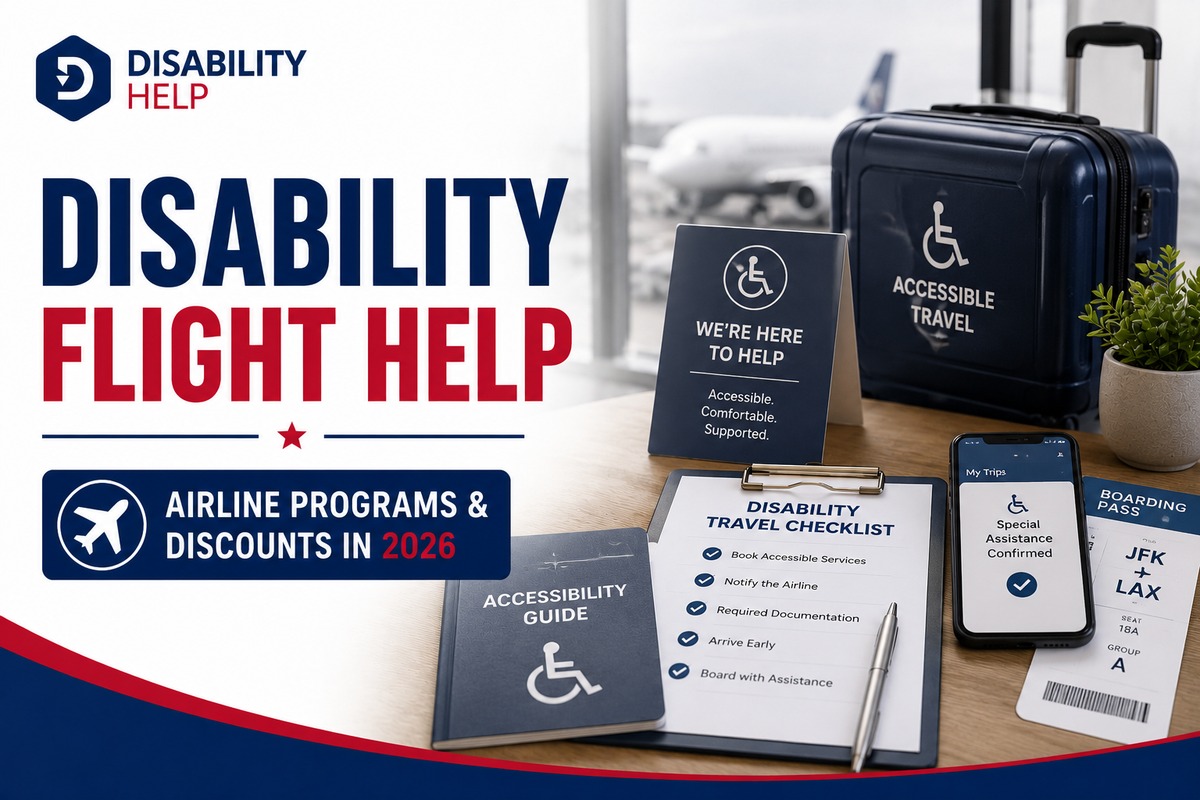
Direct disability flight discounts on US airfare are uncommon. Federal anti-discrimination rules require airlines to charge people with disabilities the same fare as other passengers, so true price cuts on a base ticket are rare in the United States. The real savings come from international airline carer concessions, free assistance services, free transport of mobility devices, and accommodation rules that can reimburse fare differences when your wheelchair will not fit on your booked flight. According to the US Department of Transportation, roughly 5.5 million Americans use a wheelchair, and about 1 in every 100 mobility devices flown domestically is damaged, delayed, or lost.
This guide breaks down which airlines offer real disability and carer discounts, what the Air Carrier Access Act entitles you to at zero cost, and how to use the 2025 DOT Wheelchair Rule to protect your money and your dignity at the gate.
Key Takeaways
- Direct US airfare discounts are rare: Federal nondiscrimination rules mean US carriers charge disabled and non-disabled passengers the same base fare, with savings coming through accommodationsModifications or adjustments in healthcare settings to support patients with disabilities. instead.
- International carer concessions exist: Qantas offers 30% off domestic and 10% off international fares for cardholders and carers, and Japan Airlines offers a caregiver discount.
- Free is the real value: Airlines must transport wheelchairs, service animals, and other assistive devices at no charge under the Air Carrier Access Act, saving travelers hundreds per trip.
- Canada includes free adjacent seating: Canadian carriers must seat a necessary support person next to a passenger with a disability on domestic flights at no additional fare.
- TSA Cares helps free of charge: Call 1-855-787-2227 at least 72 hours before your flight to arrange a Passenger Support Specialist who guides you through security screening.
- The 2025 Wheelchair Rule expanded rights: Effective January 16, 2025, airlines face stricter handling, training, and accommodationAdjustments or modifications provided to individuals with disabilities to ensure equal access and pa... requirements when serving travelers who use wheelchairs.
- Advance notice protects your access: Most accommodations need no advance notice, but specific services like powered wheelchair stowage may require 48 hours of lead time.
Do Airlines Offer Disability Discounts on Airfare?
Most US airlines do not offer published disability discounts on base airfare. The Air Carrier Access Act (ACAA) and its implementing regulation at 14 CFR Part 382 prohibit US and foreign carriers operating in the United States from charging people with disabilities a different price than other passengers, and the law treats different pricing as a form of discrimination. That same rule cuts both ways: airlines cannot mark fares up because you require assistance, and they also do not have to mark them down.
Savings show up in three other ways. First, international carriers in Australia, Canada, and Japan offer formal carer or caregiver concessions for the traveling companion of a person with a disability, with discounts ranging from 10% to 30% off the base fare. Second, US carriers waive fees that other passengers pay: free transport of wheelchairs, scooters, walkers, and other assistive devices; free transport of trained service animals; and free seat selection when a specific seat is needed for a disability-related reason. Third, accommodation rules can force the airline to absorb fare differences in specific circumstances, such as when a passenger’s wheelchair will not fit on the booked aircraft.
If a disability has prevented you from working long enough to apply for federal benefits, the savings conversation gets bigger. Cross-reference our network resource at gov-relations.com for SNAP, LIHEAP, and MedicaidA U.S. government program that provides health coverage to eligible low-income individuals, includin... programs that can offset the broader cost of living for people on SSDI or SSI.
Which Airlines Offer Disability and Carer Concessions?
The clearest disability fare benefits live with international carriers and regulated Canadian airlines. The table below compares the major published programs in 2026, the size of the concession, and what you must do to qualify.
| Airlines | Country | Disability Fare Benefits | How To Qualify |
|---|---|---|---|
| Qantas Carer Concession Card | Australia | 30% off domestic base fare; 10% off international fares for cardholder and carer. | Apply through People with Disability Australia (PWDA). Tickets must be booked together. |
| Air Canada | Canada | Free adjacent seat for a required support person on domestic flights. | Mandated by Canada’s ATPDR. International routes may have separate accommodation rates. |
| Japan Airlines | Japan | caregiver discount on eligible fares. | Requires proper identification at booking and check-in. |
| American Airlines Companion Certificate | United States | Discounted companion ticket through co-branded credit cards or promotions. | Not a true disability discount, but commonly used. A separate fee (around $99 plus taxes) usually applies. |
| Delta Accessible Travel Services | United States | No fare discount; dedicated booking line, complaint resolution officials, and free accommodations. | Open to all passengers with disabilities and their travel companions. |
| Southwest Preboarding | United States | No fare discount; preboarding for disability-related seating needs. | Self-identify at the gate. No medical documentation required. |
A few patterns stand out. The strongest published discounts sit with carriers in countries with stricter consumer protections for disabled travelers. Qantas, regulated under Australian disability law and supported by PWDA card administration, runs the most generous program. Canadian carriers, governed by the Accessible Transportation for Persons with Disabilities Regulations, focus on free adjacent seating instead of a percentage off the fare, and that single rule can offset hundreds of dollars per trip for travelers who require a companion.
US carriers do not advertise base-fare disability discounts. Instead, they invest in dedicated assistance lines, complaint resolution officers, and the free services discussed below. For US travelers, the financial wins come from knowing your federal rights and using them at every step of the booking and travel process.
Air Carrier Access Act Protections That Save You Money
The Air Carrier Access Act is the federal law that protects you from disability discrimination on every US domestic flight and on every international flight operated by a US carrier or flying to or from a US airport. Under 14 CFR Part 382, the law requires airlines to provide a range of services that other passengers would pay extra for, and to absorb costs that would otherwise hit your wallet. The Department of Transportation’s Airline Passengers with Disabilities Bill of Rights summarizes the protections in plain language.
The clearest financial protections include free transport of assistive devices, free service animalAn animal that is trained to perform tasks for the benefit of a person with a disability, protected ... travel, free seat assignment that meets your disability-related needs, and free assistance with boarding, deplaning, and connecting flights. Airlines also cannot require you to travel with a companion as a condition of carriage unless there is a documented safety reason. If they do require a safety assistant under that narrow exception, several carriers will rebook the assistant on the same flight at the lowest available fare.
If your wheelchair does not fit on a specific aircraft and you have to book a different, more expensive flight to accommodate it, federal rules require the airline to reimburse the fare difference. United Airlines rolled out a search tool in early 2025 that lets travelers filter flights by aircraft wheelchair capacity, and similar tools are expected from other carriers as enforcement of the Wheelchair Rule continues.
Beyond the dollars, the law protects your dignity. Airlines must train staff, provide trained assistance, and treat assistive devices with care.
How to Use TSA Cares for Free Airport Screening Assistance
TSA Cares is a free Transportation Security Administration program that gives travelers with disabilities, medical conditions, or other special circumstances dedicated help through security screening. Call 1-855-787-2227 at least 72 hours before your scheduled flight to request a Passenger Support Specialist, a trained TSA officer who meets you at the checkpoint and guides you through screening without rushing or surprises.
The program does not charge a fee. It does not require medical documentation. And it does not replace TSA PreCheck or any other expedited screening program you may already use. It works alongside those programs to provide hands-on help where you need it most: at the body scanner, with your assistive device, or during pat-down screening if you cannot pass through the standard equipment.
The US Department of Transportation recommends combining a TSA Cares request with a direct call to your airline’s accessibilityThe design of products, devices, services, or environments to be usable by people with disabilities.... desk to confirm any in-airport assistance, such as wheelchair transport between gates or escort through long terminals. Both services are free, both are required, and both work better when you give the providers advance notice.
Steps to Request Disability Accommodations Before Your Flight
Airlines cannot require advance notice for most accommodations, but providing it makes the day-of experience smoother and protects your access to services that do require lead time. Use this checklist to lock in every benefit you are entitled to before you reach the airport.
- Book directly through the airline’s accessibility desk. Every major US carrier operates a dedicated phone line for travelers with disabilities. Delta’s Accessible Travel Services, American Airlines’ Special Assistance, and Southwest’s Customers with Disabilities team can pre-arrange wheelchair transport, accessible seating, and onboard accommodations at the time of booking.
- Request a Complaint Resolution Official (CRO) contact if needed. Every US carrier must have a CRO available at every airport and on every phone line. Ask for one immediately if any accommodation is denied at any stage.
- Submit advance notice for time-sensitive services. Airlines may require up to 48 hours’ notice and a one-hour earlier check-in for powered wheelchair stowage on smaller aircraft, medical oxygen hook-up, hazardous materials packaging for wheelchair batteries, and onboard wheelchair availability on aircraft without accessible lavatories.
- Call TSA Cares at least 72 hours before departure. Dial 1-855-787-2227 to schedule a Passenger Support Specialist for screening assistance.
- Label and document your mobility device. Attach written handling instructions to your wheelchair, including lifting points and battery information. Photograph the device before checking it in so you have evidence of its pre-flight condition under the 2025 Wheelchair Rule.
- Confirm seating accommodations in writing. Email or message the airline to confirm any accessible seating, adjacent companion seating, or aisle chair requests. Keep the confirmation on your phone.
- Identify yourself at the gate. Tell the gate agent you would like to preboard. The airline must offer additional boarding time if you self-identify as needing assistance, extra time, or specific seating help.
What the 2025 DOT Wheelchair Rule Means for You
On December 17, 2024, the Department of Transportation finalized a new rule on safe accommodations for air travelers with disabilities using wheelchairs. The rule, often called the Wheelchair Rule, became effective January 16, 2025, and the DOT began enforcement on August 1, 2025. It represents the most significant expansion of airline accountability for disabled passengers since 2008.
The rule sets clear standards across multiple areas. Airlines must provide hands-on, scenario-based training for any employee or contractor who physically assists passengers with disabilities or handles wheelchairs. Annual refresher training is required for that staff. If a checked wheelchair is returned in a different condition than it was received, there is a rebuttable presumption that the airline mishandled it, shifting the burden of proof onto the carrier.
The rule also creates new definitions that matter in a dispute. "Safe" assistance is defined as help that does not put a passenger at heightened risk of bodily injury. "Mishandled" includes lost, delayed, damaged, or pilfered devices. "Custody" begins the moment you check the device and ends when it is returned to you in the same condition. Each of these terms gives a passenger a clearer path to a complaint, a refund, or a settlement.
On September 30, 2025, the DOT delayed enforcement of four specific provisions of the rule while it considers a new rulemaking called Wheelchair Rule II. The delayed provisions cover airline liability for mishandled wheelchairs, refresher training frequency, pre-departure notifications, and fare-difference reimbursements when a wheelchair does not fit on the booked aircraft. The other provisions of the 2025 rule, including training requirements, definitions, and the rebuttable presumption of mishandling, remain enforceable. Watch for proposed updates in 2026.
Key Terms to Know Before You Book
A handful of words appear repeatedly in disability air travel rules. Knowing them changes how you read your ticket, your accommodation requestA formal request made by an employee with a disability for reasonable adjustments to their work envi..., and any future complaint.
- ACAA: Air Carrier Access Act, the federal law prohibiting disability discriminationUnfair treatment of individuals based on their disability in areas such as employment, education, an... on US airlines and on foreign carriers operating to or from the United States.
- CRO: Complaint Resolution Official, a trained airline employee who must be available at every US airport and on every airline phone line to address disability concerns in real time.
- Carer Concession: A discounted or free fare offered to a person traveling as a required caregiver or support person for a passenger with a disability. Available primarily on Australian, Canadian, and Japanese carriers.
- Custody: The period between checking your wheelchair or assistive device and its return to you, during which the airline is legally responsible for the device.
- PSS: Passenger Support Specialist, a TSA officer trained to assist travelers through security screening. Available free of charge through TSA Cares.
- Reasonable AccommodationModifications or adjustments to a job or environment that enable a person with a disability to perfo...: An adjustment or service that lets a person with a disability participate equally. In air travel, this includes free assistive device transport, accessible seating, and preboarding.
- Rebuttable Presumption: A legal default that places the burden of proof on the airline. Under the 2025 Wheelchair Rule, a damaged device is presumed mishandled unless the airline proves otherwise.
Real-World Application: How a Wheelchair User Recovers Costs
Consider a working example. A wheelchair user in Texas books a round-trip domestic flight on a US carrier for a family visit. Without the protections under federal law, the trip could include a fee for checking the wheelchair, a separate fee for a service dog, a paid seat selection for an accessible seat with extra legroom, and a paid escort through the terminal. That single trip could easily add $200 to $400 in fees beyond the base fare.
Under the Air Carrier Access Act and the 2025 Wheelchair Rule, every one of those fees is waived. The wheelchair flies free. The trained service animal flies in the cabin at no charge. The seat assignment is made at no cost. Wheelchair transport from the curb to the gate is provided free. If the wheelchair arrives damaged, the airline must repair or replace it and is presumed responsible. If a chosen flight’s aircraft cannot accommodate the wheelchair and the passenger rebooks on a more expensive flight, current federal rules require fare-difference reimbursement (a provision currently in DOT enforcement review until December 31, 2026).
In a 2024 statement on the new rule, then-US Transportation Secretary Pete Buttigieg said: “Every passenger deserves safe, dignified travel when they fly, and we’ve taken unprecedented actions to hold airlines accountable when they do not provide fair treatment to passengers with disabilities.” The same year the rule was issued, the DOT announced a $50 million civil penalty against American Airlines for repeated wheelchair handling violations between 2019 and 2023, the largest such penalty in agencyThe capacity of individuals with disabilities to act independently and make their own choices. history.
The lesson for travelers is direct. The savings are not in the ticket price. The savings come from knowing what cannot legally be charged to you, from documenting every step before and during the trip, and from escalating to a CRO the moment any required service is delayed or denied.
Final Word: Your Real Savings Come From Knowing Your Rights
Disability flight discounts are real but uneven. The headline number, 30% off with Qantas in Australia, does not translate to most US itineraries. In the United States in 2026, the practical financial benefit of being a disabled traveler comes from federal rules that strip out the fees other passengers absorb and from the 2025 DOT Wheelchair Rule’s stronger accountability standards. Free assistive device transport, free service animal travel, free seat assignment, free assistance from curb to gate, free TSA Cares screening, and reimbursement for damaged wheelchairs add up to hundreds of dollars in protected value per trip, often more on international itineraries.
As of 2026, the DOT is still reviewing several Wheelchair Rule provisions, with proposed updates expected in August 2026. Watch your airline’s accessibility page for changes, document every step of every trip, and contact a Complaint Resolution Official immediately if any required service is denied.
For deeper coverage of related travel and accommodation savings, our guide to disability hotel discounts walks through the same kind of rights-first savings strategy for lodging.
Frequently Asked Questions
Do US airlines offer direct fare discounts for disabled passengers?
Most US airlines do not offer published disability discounts on base airfare. The Air Carrier Access Act requires equal pricing as part of its nondiscrimination protections, so US carriers focus on free accommodations and assistance services rather than reduced fares. International carriers such as Qantas and Japan Airlines do offer formal carer concessions for travel companions.
How do I qualify for the Qantas Carer Concession Card?
The Qantas Carer Concession Card is administered by People with Disabilities Australia. You apply with documentation of a disability that requires a carer for safe air travel. Once approved, the card entitles the holder and their carer to 30% off Qantas domestic base fares and 10% off Qantas international fares, with tickets booked together. The discount is one of the most generous in the global airline industry.
Can I bring a caregiver on a US flight for free?
US airlines do not provide free companion travel as a standard disability accommodation. If the airline determines a safety assistant is required (a narrow circumstance under federal law), some carriers will rebook that assistant at the lowest available fare. Outside that exception, a companion ticket costs the same as any other ticket. American Airlines’ co-branded credit cards offer companion certificates that some disabled travelers use, but the certificate is not a disability program.
Does the airline have to pay for my damaged wheelchair?
Yes. Under the Air Carrier Access Act and the 2025 Wheelchair Rule, airlines must return checked wheelchairs in the condition they were received. If a device is damaged, the airline must repair or replace it and is liable for the cost. The 2025 rule also creates a rebuttable presumption of mishandling when a device is returned in a different condition than checked, shifting the burden of proof to the carrier. Always photograph your device at check-in.
Do I need to give advance notice to fly with a disability?
Most accommodations require no advance notice under the Air Carrier Access Act. Airlines may require up to 48 hours’ notice and a one-hour earlier check-in for a short list of specific services, including powered wheelchair stowage on aircraft with fewer than 60 seats, medical oxygen hook-up, hazardous materials packaging for wheelchair batteries, and onboard wheelchair availability on aircraft without accessible lavatories.
Is TSA Cares free, and what does it cover?
TSA Cares is free. Call 1-855-787-2227 at least 72 hours before your flight to request a Passenger Support Specialist. The specialist meets you at security screening and guides you through the process, including alternative screening procedures if you cannot pass through standard equipment. The service is open to travelers with disabilities, medical conditions, and other circumstances that complicate standard screening.