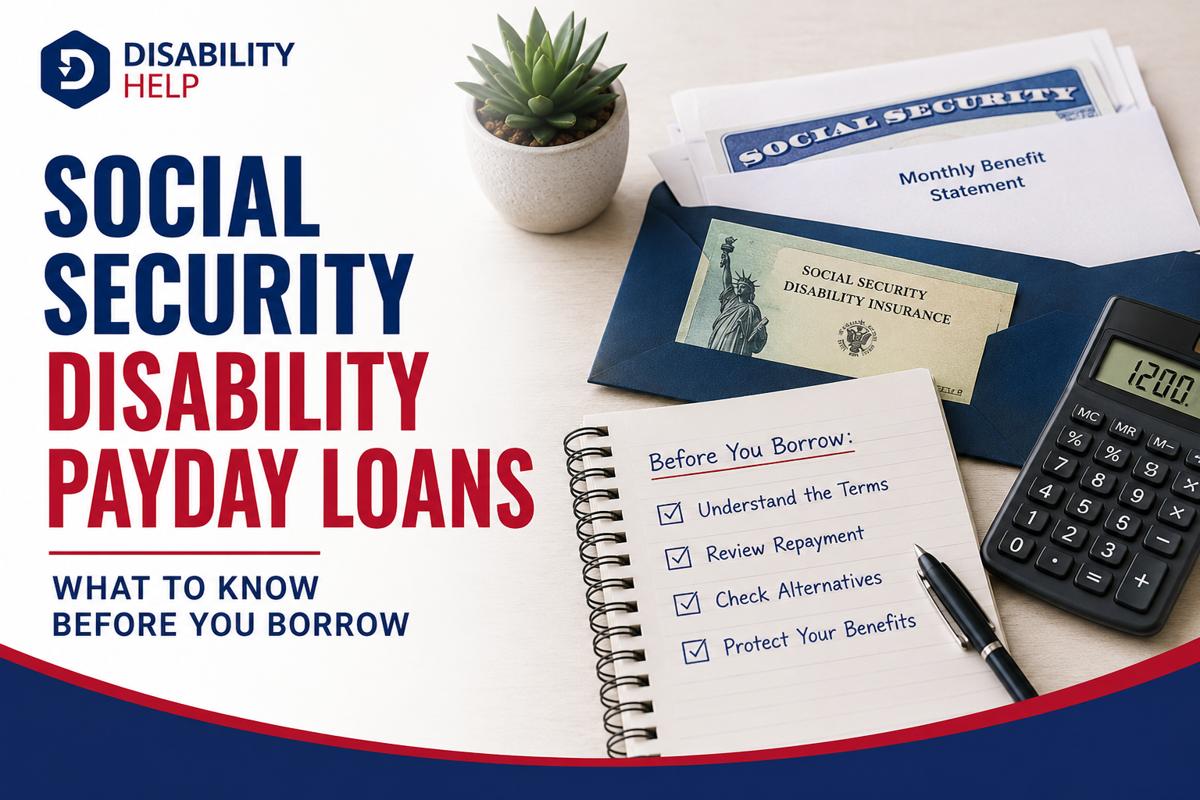
Yes, you can get a payday loan while receiving Social Security Disability, because payday lenders count SSDI and SSI as verifiable income and approve borrowers on their ability to repay, not their credit score. That easy access comes at a steep price. Payday loans carry an average APR near 400%, and disability households borrow at higher rates than the general public:
nearly 6% of disability households under 66 use payday loans, compared with about 4% of the general population, according to the Center for Retirement Research at Boston College. This guide explains how Social Security Disability payday loans work, what they really cost, how federal law protects your monthly check, and which safer alternatives can cover an emergency without putting your benefits at risk.
If you are weighing a fast cash offer against your rent or medication, read this before you sign. For broader benefit and rights guidance, disabilityhelp.org covers the full picture.
Key Takeaways
- Access is easy, the cost is not: Lenders accept SSDI and SSI as income, but disability payday loans average roughly 400% APR, far above safer credit options.
- Your benefits are legally protected: Section 207 of the Social Security Act shields SSDI and SSI from most private creditors, including payday lenders, even after a court judgment.
- Two months are shielded automatically: Banks must protect two months of direct-deposited federal benefits from garnishment without any paperwork from you.
- Disability households borrow more: Nearly 6% of disability households under 66 use payday loans, versus about 4% of the general population.
- PALs cap the damage: Federal credit union Payday Alternative Loans cap APR at 28% and application fees at $20, a fraction of payday loan pricing.
- The SSA offers emergency help: New SSI applicants facing hardship may qualify for emergency advance payments or presumptive disability payments from the SSA.
- ABLE accounts build a buffer: Eligible savers can hold up to $100,000 in an ABLE account without losing SSI, creating an emergency fund that avoids borrowing.
Can you get a payday loan on Social Security Disability?
Yes. Payday lenders approve borrowers based on the ability to repay rather than a credit score, and both SSDI and SSI count as reliable monthly income. The Equal Credit Opportunity Act also bars a lender from denying you solely because your income comes from a public benefit program.
To approve a payday loan, most lenders ask for three things: verifiable income (your benefit award letter or bank statement showing the deposit), an active checking account, and proof of identity and residence. You then sign a post-dated check or authorize an electronic withdrawal timed to your next benefit deposit date.
The program you receive matters for what happens next. SSDI is based on your work history and has no resource limit. SSI is needs-based, and in 2026 the resource limit is $2,000 for an individual and $3,000 for a couple, per the Social Security Administration. A loan itself is not counted as income by the SSA, but any loan money you do not spend in the month you receive it becomes a countable resource the following month. For SSI recipients, unspent payday loan funds can push you over the limit and suspend your check.
How Social Security Disability payday loans actually work
A payday loan is a short-term, high-cost loan due in a single lump sum on your next payday, which for disability recipients usually means your next monthly benefit deposit. You borrow a small amount, typically $100 to $1,000, and repay the principal plus a flat fee within two to four weeks.
Lenders charge a set fee for every $100 borrowed rather than quoting an interest rate. A common fee is $15 per $100. On a two-week loan, that fee structure looks small but converts to a very high annual rate. The trouble starts at repayment: when your entire fee and principal come due on the same day your benefit lands, that check is often already committed to rent, utilities, or medication.
Borrowers who cannot cover both the loan and their living costs roll the loan over or take a new one, which stacks fees and starts a cycle of debt. Research on disability recipients found interest rates averaging 400% annually and repeated borrowing across a single year, according to the Center for Retirement Research.
What do disability payday loans really cost?
A $15 fee on a $100 two-week payday loan equals a 391% APR, according to MyCreditUnion.gov. Over a year of rollovers, a $300 loan can cost more in fees than the amount you originally borrowed. The table below compares payday loans against three safer ways to cover an emergency.
| Borrowing option | Typical APR | Loan amount | Repayment term | Rollovers |
|---|---|---|---|---|
| Payday loan | 300%–500% (avg ~400%) | $100–$1,000 | 2–4 weeks | Often allowed; fuels debt cycle |
| Payday Alternative Loan (PAL) | 28% maximum | $200–$2,000 | 1–12 months | Prohibited by NCUA rules |
| Small personal loan | ~6%–36% | $1,000+ | 12–120 months | Not applicable |
| Credit card cash advance | ~25%–36% | Up to your credit limit | Revolving | Not applicable |
The pattern is clear. A payday loan is the most expensive row on the table and the only one built around a single lump-sum payment tied to your benefit date. Every other option spreads repayment over months and caps the rate well below triple digits.
Are your disability benefits protected from payday lenders?
Yes, largely. Section 207 of the Social Security Act protects SSDI and SSI from garnishment or seizure by most private creditors, including payday lenders, even if the lender wins a court judgment against you. The Consumer Financial Protection Bureau confirms these protections apply to both direct deposit and paper check.
A key safeguard is the two-month rule. When your benefits arrive by direct deposit, your bank must automatically protect an amount equal to two months of federal benefit payments from a garnishment order. You do not file paperwork, and no court hearing is needed. If you receive $994 in SSI each month and a creditor sends a garnishment order, the bank must shield up to two months of that deposit in your account.
Two limits are worth knowing. First, funds above the two-month amount, or benefits withdrawn as cash and re-deposited, can lose automatic protection. Second, the shield against private creditors does not fully cover certain government debts. SSDI can be reduced for unpaid federal taxes (up to 15%), federal student loans, and child or spousal support. SSI stays protected even from most of these, because it is a needs-based benefit.
Because these protections are strongest with direct deposit, keeping your benefits in a dedicated account and using direct deposit or a Direct Express card is the single best way to protect your check from a frozen-account scramble.
Why payday loans hit people on disability harder
Fixed monthly income and thin savings make disability recipients especially vulnerable to the payday debt trap. When your next check is already promised to a lender, a new loan often becomes the only way to cover the gap, and the cycle repeats.
The 2026 maximum federal SSI payment is $994 a month for an individual, per the Social Security Administration, and the average SSDI benefit is about $1,630. Those amounts leave little cushion for a car repair or a medical bill, which is why quick cash offers are so tempting and so risky.
The data backs this up. Research by Haydar Kurban, an economist at Howard University who analyzed the issue for the Retirement and Disability Research Consortium, found that nearly 6% of disability households under 66 use payday loans, compared with about 4% of the general population. That borrowing rate spiked to 22% for disability recipients in the months after the 2008–2009 recession, and roughly 1.8 million Social Security recipients use payday loans in a typical year, according to the Center for Retirement Research.
Watch for tribal and offshore online lenders. Some tribal lenders claim sovereign immunity and argue they are not bound by state lending caps, which can mean fees far above what a state-licensed lender could charge. If a lender is not licensed in your state, that is a warning sign.
Scams target this space too, from companies charging upfront fees to "apply" for free government programs to fake advocates promising to boost your approval odds. Legitimate disability attorneys work on contingency and do not charge upfront fees. If you encounter a suspicious lender or service, you can report it at ReportFraud.FTC.gov.
Safer alternatives to payday loans on disability
Before you accept a 400% APR loan, several lower-cost options can cover an emergency without risking your benefits. Work through this list in order, from free assistance to the cheapest borrowing.
- SSA emergency and expedited payments. New SSI applicants facing a financial emergency may qualify for a one-time emergency advance payment, and claimants whose disability is highly likely to be approved may receive presumptive disability payments for up to six months. The Social Security Administration explains both. Presumptive payments are generally not repaid even if the claim is later denied.
- Payday Alternative Loans (PALs). Federal credit unions offer PALs of $200 to $2,000 with a maximum 28% APR, terms of one to 12 months, and application fees capped at $20, per MyCreditUnion.gov. Rollovers are prohibited, which stops the debt spiral before it starts.
- ABLE accounts as an emergency fund. Eligible people with disabilities can save up to $100,000 in an ABLE account without affecting SSI eligibility, with a $20,000 annual contribution limit in 2026. A rule change effective January 1, 2026, raised the disability-onset age cutoff from 26 to 46, making millions more people eligible. A funded ABLE account replaces the need to borrow at all.
- Government and community assistance. Programs like TANF, LIHEAP, and SNAP provide help you never repay, and local Centers for Independent Living connect you with disability-specific aid. You can find guides to these supplemental programs at gov-relations.com.
- Nonprofit emergency grants. Organizations such as Modest Needs offer self-sufficiency grants for one-time emergency expenses, and dialing 211 or visiting 211.org connects you with local United Way resources at no cost.
- Cheaper borrowing as a last resort. If you must borrow, a small personal loan, a payment plan negotiated directly with a creditor, or even a credit card cash advance all cost far less than a payday loan. Borrowing from family or friends can be interest-free, though it helps to put the terms in writing.
Key terms to know
SSDI: Social Security Disability InsuranceA form of insurance that provides income to individuals who are unable to work due to a disability., a benefit based on your work history and payroll tax contributions. It has no resource limit.
SSI: Supplemental Security Income, a needs-based benefit for aged, blind, or disabled people with limited income and resources. The 2026 resource limit is $2,000 for an individual.
APR: Annual Percentage Rate, the yearly cost of a loan, including fees. It lets you compare a two-week payday loan against a 12-month installment loan on equal terms.
Rollover: Extending a payday loan past its due date by paying another fee. Rollovers are the main driver of the payday debt cycle and are banned for PALs.
PAL: Payday Alternative Loan, a small-dollar loan from a federal credit union capped at 28% APR and designed as a safe substitute for payday loans.
Section 207: The provision of the Social Security Act that protects SSDI and SSI from garnishment or seizure by most private creditors.
A closer look: how the cycle starts
Consider an illustrative example. A 47-year-old SSDI recipient in Ohio receives $1,300 a month and faces a $400 car repair he needs to reach medical appointments. He takes a $400 payday loan with a $60 fee, due when his next check arrives. That check is already spoken for, so he rolls the loan over twice, adding $120 in fees, then borrows again to stay current. Within four months he has paid more than $250 in fees on a $400 need.
The same $400, borrowed as a credit union PAL at 28% over six months, would cost only a few dollars in interest plus a one-time fee capped at $20. That gap between roughly $250 and under $40 is the difference this decision makes. State rate caps can help: 19 states and the District of Columbia set payday APRs at 36% or lower, according to the Center for Responsible Lending, while other states allow the full triple-digit rate. You can check your state's rules through the National Conference of State Legislatures.
The bottom line before you borrow
Social Security Disability payday loans are easy to get and expensive to escape. They average close to 400% APR, tie repayment to the one check you cannot afford to lose, and hit fixed-income borrowers hardest. Your benefits carry strong federal protection, but the smarter move is to avoid the loan entirely.
As of 2026, you have better options: SSA emergency payments, credit union PALs capped at 28%, ABLE accounts that now reach millions more savers, and community programs that never need repaying.
Start with the free and low-cost help, protect your direct deposit, and treat any triple-digit loan as a last resort. For step-by-step guidance on your benefits, rights, and the programs you may qualify for, explore the full resources at disabilityhelp.org.
Frequently Asked Questions
Can payday lenders take my Social Security Disability check?
No, not directly. Section 207 of the Social Security Act protects SSDI and SSI from garnishment by private creditors, including payday lenders, even after a court judgment. If your benefits are direct-deposited, your bank must automatically shield two months of payments. Government debts like federal taxes and child support are the main exceptions, and SSI stays protected from most of those.
Does a payday loan affect my SSI or SSDI benefits?
A loan is not counted as income by the SSA, so it does not reduce your monthly payment. For SSI, though, any loan money you do not spend in the month you receive it becomes a countable resource the next month. If unspent funds push you over the 2026 SSI limit of $2,000, your check can be suspended. SSDI has no resource limit, so this does not apply.
What is the safest loan for someone on disability?
A Payday Alternative Loan from a federal credit union is the safest small-dollar option. PALs cap the APR at 28%, limit fees to $20, run one to 12 months, and ban rollovers. For larger needs, a personal loan from a bank or credit union costs far less than a payday loan. Free help from the SSA, ABLE accounts, and community programs should come first.
Can I get a payday loan with only SSI income?
Often yes, because lenders accept SSI as verifiable income. That does not make it wise. With the 2026 maximum SSI payment at $994 a month, a lump-sum payday repayment can consume a large share of your check and start a debt cycle. Safer alternatives, including SSA emergency payments and credit union PALs, are a better fit for a fixed SSI income.
How do I report a predatory disability lender?
Report suspicious lenders and fee-charging scams to the Federal Trade Commission at ReportFraud.FTC.gov, and file a complaint with the Consumer Financial Protection Bureau. Verify that any payday lender holds a license in your state, and be cautious with tribal or offshore online lenders that claim state laws do not apply to them.