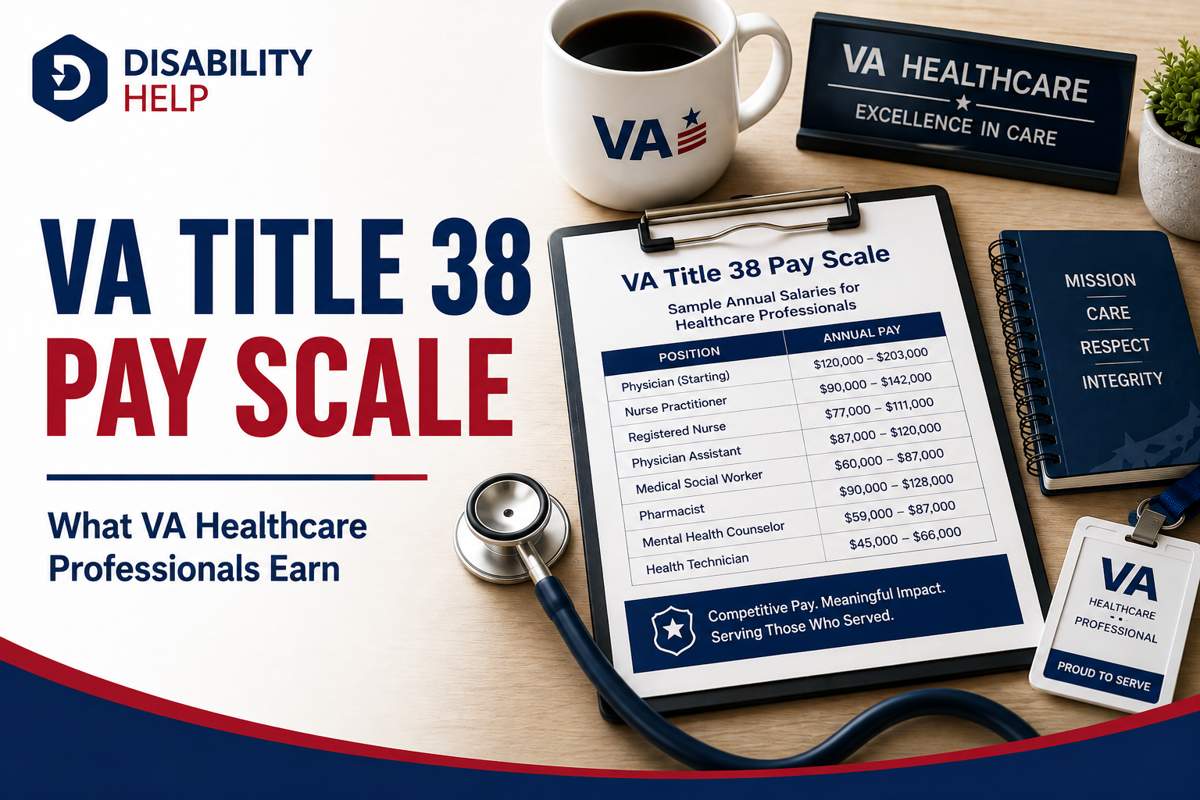
The VA Title 38 pay scale for 2026 carries a 1.0% across-the-board base increase that took effect in the first pay period of January 2026, with physician, dentist, podiatrist, and optometrist minimums set at $124,308 and locality percentages held at 2025 levels (OPM). If you work for the Department of Veterans Affairs, or you are weighing a VA healthcare job, this is the pay system that sets your salary. It sits outside the General Schedule that covers most federal workers, which gives the VA room to compete with private hospitals for clinical talent. This guide breaks down the 2026 rates, the split between full and hybrid Title 38, how locality pay works, and what nurses and physicians actually take home.
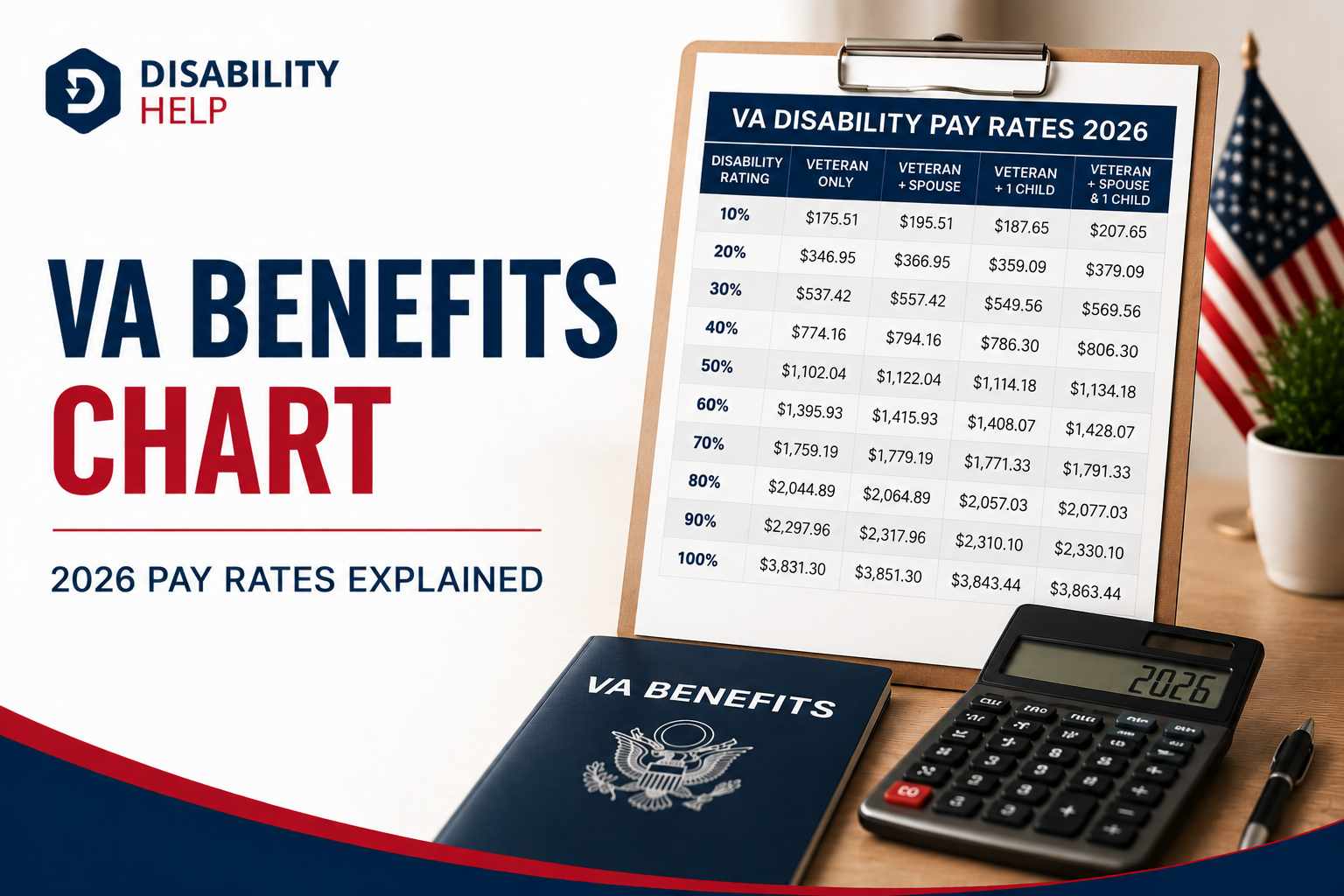
A quick note before you read on: if you came here looking for veteran disability compensation rather than VA employee pay, that is a separate program. You can find the current figures on our 2026 VA disability pay chart.
Key Takeaways
- 1.0% base raise: The 2026 VA Title 38 pay scale received a 1.0% across-the-board base increase, effective the first pay period of January 2026.
- Physician floor is $124,308: Physicians, dentists, podiatrists, and optometrists start at a $124,308 minimum, with some specialties reaching $400,000.
- Two Title 38 tracks: Full Title 38 covers direct-care roles like physicians and nurses; hybrid Title 38 covers pharmacists, therapists, and similar clinical staff.
- Locality was frozen: Locality pay percentages stayed at 2025 levels for 2026, so the base bump drove most of the raise for hybrid roles.
- Nurses use a separate system: VA registered nurses are paid under the Nurse Locality Pay System, with 2026 salaries ranging from about $60,000 to over $200,000.
- Market pay drives physician totals: Physician salaries combine base, longevity, and locally set market pay that is reviewed at least every two years.
- Not the same as VA disability pay: The Title 38 pay scale sets employee salaries, which differs from the tax-free compensation paid to disabled veterans.
What Is the VA Title 38 Pay Scale?
The VA Title 38 pay scale is the compensation system the Department of Veterans Affairs uses to pay its healthcare professionals under Title 38 of the U.S. Code. It applies to roles that provide direct patient care, and it lets the VA set salaries that keep pace with local hospital markets.
Most federal employees are paid under the General Schedule (GS), a fixed grade-and-step system run by the Office of Personnel Management. Title 38 works differently. It falls under excepted service, so the VA sets its own pay rates, uses its own qualification standards, and can hire faster than a standard GS office. That flexibility exists for one reason: the GS ceiling is too low to recruit physicians and specialty nurses against private-sector pay.
One point causes constant confusion. The Title 38 pay scale governs what VA staff earn. It is not the same as the tax-free disability compensation the VA pays veterans for service-connected conditions. If you need the veteran benefit figures, see the VA disability pay chart instead.
What Changed in the 2026 VA Title 38 Pay Scale?
For 2026, Title 38 employees received the same 1.0% across-the-board base increase that applied to other statutory federal pay systems, effective the first pay period of January 2026. Locality pay percentages were frozen at 2025 levels, and the physician pay tables took effect January 11, 2026.
The increase came from Executive Order 14368, signed December 18, 2025, which set the 1.0% base bump and held locality pay flat (OPM pay adjustments memo). Because locality percentages did not move, most of the rise for hybrid roles came from the base adjustment alone.
For physicians, dentists, podiatrists, and optometrists, the 2026 minimum for Pay Table 1, Tier 1 rose to $124,308, up from $123,077 in late 2025 (VA final approved pay ranges). Optometrists reached physician-level pay parity in 2026, with a base and longevity range of $124,308 to $182,324. Special Salary Rates for hard-to-fill roles were updated separately, job by job, so some occupations saw larger 2026 gains than the 1.0% base figure suggests.
Full Title 38 vs. Hybrid Title 38: What's the Difference?
Full Title 38 positions are governed entirely by Title 38 and cover direct patient-care roles. Hybrid Title 38 positions blend Title 38 pay authority with Title 5 rules for other personnel matters. The category you fall into decides how your pay is set, how you advance, and which rules govern discipline and appeals.
| Feature | Full Title 38 | Hybrid Title 38 |
|---|---|---|
| Example roles | Physicians, dentists, podiatrists, optometrists, registered nurses, physician assistants, chiropractors | Pharmacists, physical therapists, occupational therapists, dietitians, mental health counselors, biomedical engineers |
| Pay basis | Title 38 pay tables and market pay (physicians) or the Nurse Locality Pay System (nurses) | GS grades and steps, often with an OPM Special Salary Rate |
| Appointment authority | Title 38 | Title 38 |
| Other personnel rules (discipline, appeals) | Title 38 | Title 5 |
| Market or locality adjustment | Market pay (physicians) or a facility locality survey (nurses) | GS locality pay or a Special Salary Rate, whichever is higher |
The practical difference for hybrid staff is predictability. Hybrid roles advance on GS steps with set within-grade increases, so you know roughly when your next raise arrives. Full Title 38 roles reward clinical credentials more aggressively, but grade increases require a board review rather than an automatic step.
How Physician, Dentist, Optometrist & Podiatrist (PDOP) Pay Works
PDOP pay combines three parts: base pay, longevity pay, and market pay. Base and longevity follow a fixed schedule that starts at $124,308 in 2026. Market pay is set locally based on specialty, experience, board certification, and demand, and it is reviewed at least every two years.
The base and longevity schedule begins at $124,308 for a provider with two years or less of service and rises with tenure (for example, $128,452 at two to four years). Market pay stacks on top, which is why total physician salaries vary so widely by specialty and location. The annual pay ranges below show the 2026 minimums and maximums by pay table and tier (VA pay tables).
| Pay Table | Example specialties or assignments | Tier 1 range | Tier 3 range |
|---|---|---|---|
| Table 1 | Primary care, psychiatry, optometry, family medicine, neurology | $124,308 – $315,000 | $165,000 – $350,000 |
| Table 2 | Anesthesiology, cardiology, surgery, radiology, emergency medicine | $124,308 – $400,000 | $225,000 – $400,000 |
| Table 3 | Network Chief Medical Officer, Chief of Staff, deputies | $220,000 – $400,000 | $180,000 – $375,000 |
| Table 4 | Designated leadership assignments | $145,000 – $310,000 | $145,000 – $285,000 |
The $400,000 figure is the current ceiling for most clinical specialties. Reaching it depends on tier, specialty demand, and the market pay a facility can justify. A rural primary care physician and an urban cardiologist can both start near the same $124,308 floor yet land far apart once market pay is applied.
How Much Do VA Nurses Earn Under Title 38 in 2026?
VA registered nurses are paid under the Nurse Locality Pay System, a Title 38 structure that sets salaries by grade (Nurse I through Nurse V) and adjusts them to local labor-market rates. In 2026, nurse salaries range from roughly $60,000 for entry-level Nurse I positions to more than $200,000 for senior Nurse V roles in high-cost areas.
Grade reflects your role and credentials; step reflects tenure and performance within that grade. A Nurse Professional Standards Board reviews your education, licensure, clinical experience, and leadership to assign your grade, so a nurse with a BSN and specialty certification often lands above a peer with fewer credentials in the same job.
Each facility director runs an annual locality survey that compares VA nurse pay against non-VA hospitals in the same labor market, then recommends adjustments. That is why the same grade can pay differently across cities. Nurses also earn premium pay for nights, weekends, and holidays, plus recruitment or retention bonuses where positions are hard to fill (2026 VA nurse pay breakdown).
How Locality Pay and Special Salary Rates Change Your Total Pay
Locality pay and special salary rates can add 15% to 30% or more to a Title 38 salary, depending on your role and where your facility sits. For hybrid roles on the GS framework, locality pay or a Special Salary Rate applies, whichever is higher. For physicians, locally set market pay serves the same competitive purpose.
Consider a real-world example. A hybrid Title 38 pharmacist at GS-12, Step 1 earns a base near $86,962. In the San Francisco locality area, that base climbs to roughly $125,350 once the local adjustment is applied (2026 Title 38 locality breakdown). The role and the grade are identical. Location alone accounts for a difference of nearly $40,000.
Locality is tied to your official duty station, not your home address. For hybrid or telework staff who report to the office at least twice per pay period, the office location sets the locality. For fully remote staff, the official remote work location applies.
How to Estimate Your 2026 VA Title 38 Salary
You can build a reasonable estimate of your 2026 pay in six steps. Work through them in order, since each figure feeds the next.
- Identify your pay category. Confirm whether your role is full Title 38 or hybrid Title 38, because the two use different pay tables.
- Find your pay basis. Locate the PDOP pay table for physicians, the Nurse Locality Pay System grade for nurses, or the GS grade and step for hybrid roles.
- Locate your base rate on the 2026 schedule. Use the official VA pay tables for your role and tenure.
- Add your local adjustment. Apply your locality pay percentage, market pay, or Special Salary Rate, using whichever is higher for hybrid roles.
- Add premium pay and bonuses. Include night, weekend, and holiday differentials plus any recruitment or retention incentives you qualify for.
- Confirm the total. Check the figure against your Leave and Earnings Statement or the official VA pay tables before you rely on it.
Key Terms in the Title 38 Pay System
A few terms come up in every VA pay discussion. Here is what each one means in plain language.
- Base pay: The starting salary set by the federal schedule before any local or market adjustment.
- Longevity pay: Additional base pay that increases with years of service, built into the PDOP schedule.
- Market pay: A locally determined add-on for physicians and dentists based on specialty demand, experience, and credentials.
- Locality pay: An adjustment tied to your duty station that reflects local labor-market rates, applied to hybrid GS roles.
- Special Salary Rate (SSR): An OPM-set rate for hard-to-fill occupations that replaces standard locality pay when it pays more.
- Nurse Locality Pay System (LPS): The Title 38 structure that sets registered nurse salaries by grade and local survey data.
- Premium pay: Extra compensation for nights, weekends, holidays, and overtime, available to most clinical Title 38 staff.
What Title 38 Pay Looks Like in Practice
Numbers on a schedule are one thing; a real paycheck is another. Take a Nurse III at a VA medical center in a high-cost metro such as the Washington, D.C. area, Los Angeles, or San Francisco. That nurse can earn roughly $130,000 to $148,000 or more once locality adjustments are applied, well above the same grade in a lower-cost region (VA nurse pay by location).
The lesson holds across roles. Two people with the same title, grade, and step can see paychecks that differ by tens of thousands of dollars based on their facility's labor market. When you compare VA offers or weigh a transfer, the base number tells only part of the story. The locality adjustment, market pay, and premium pay decide what actually lands in your account.
The Bottom Line on 2026 VA Title 38 Pay
As of 2026, the VA Title 38 pay scale gives healthcare professionals a compensation structure that GS pay cannot match, from a $124,308 physician floor to nurse salaries that respond to local hospital markets. The 1.0% base increase is modest, but the real driver of your total pay is the layer on top: market pay for physicians, locality adjustments for nurses and hybrid staff, and premium pay across the board.
Before you accept an offer or plan a move, price out the full package, not just the base. And if you arrived searching for veteran benefits rather than staff pay, start with our 2026 VA disability pay chart. Families researching education support for dependents can also review our guide to Chapter 35 VA benefits.
Frequently Asked Questions
Is the VA Title 38 pay scale the same as VA disability compensation?
No. The Title 38 pay scale sets salaries for VA healthcare employees, such as nurses and physicians. VA disability compensation is a separate, tax-free benefit paid to veterans for service-connected conditions. They share the Title 38 label but govern completely different payments.
How much did the VA Title 38 pay increase in 2026?
Title 38 employees received a 1.0% across-the-board base increase for 2026, effective the first pay period of January 2026. Locality pay percentages were frozen at 2025 levels, so the base adjustment drove most of the raise for hybrid roles.
When did the 2026 VA Title 38 pay tables take effect?
The 1.0% base increase applied from the first pay period of January 2026. The physician, dentist, podiatrist, and optometrist annual pay ranges took effect January 11, 2026.
What is the difference between full and hybrid Title 38?
Full Title 38 roles, such as physicians and registered nurses, are governed entirely by Title 38. Hybrid Title 38 roles, such as pharmacists and therapists, are paid under Title 38 authority but follow Title 5 rules for discipline, appeals, and other personnel matters.
How much do VA physicians make under Title 38 in 2026?
VA physicians start at a $124,308 minimum in 2026 and can reach $400,000 depending on specialty, tier, and locally set market pay. Base and longevity pay form the floor, and market pay determines how high the total climbs.
Do Title 38 employees get locality pay and bonuses?
Yes. Hybrid staff receive GS locality pay or a Special Salary Rate, whichever is higher. Physicians receive market pay. Most clinical staff also qualify for premium pay for nights, weekends, and holidays, plus recruitment or retention bonuses at hard-to-fill facilities.