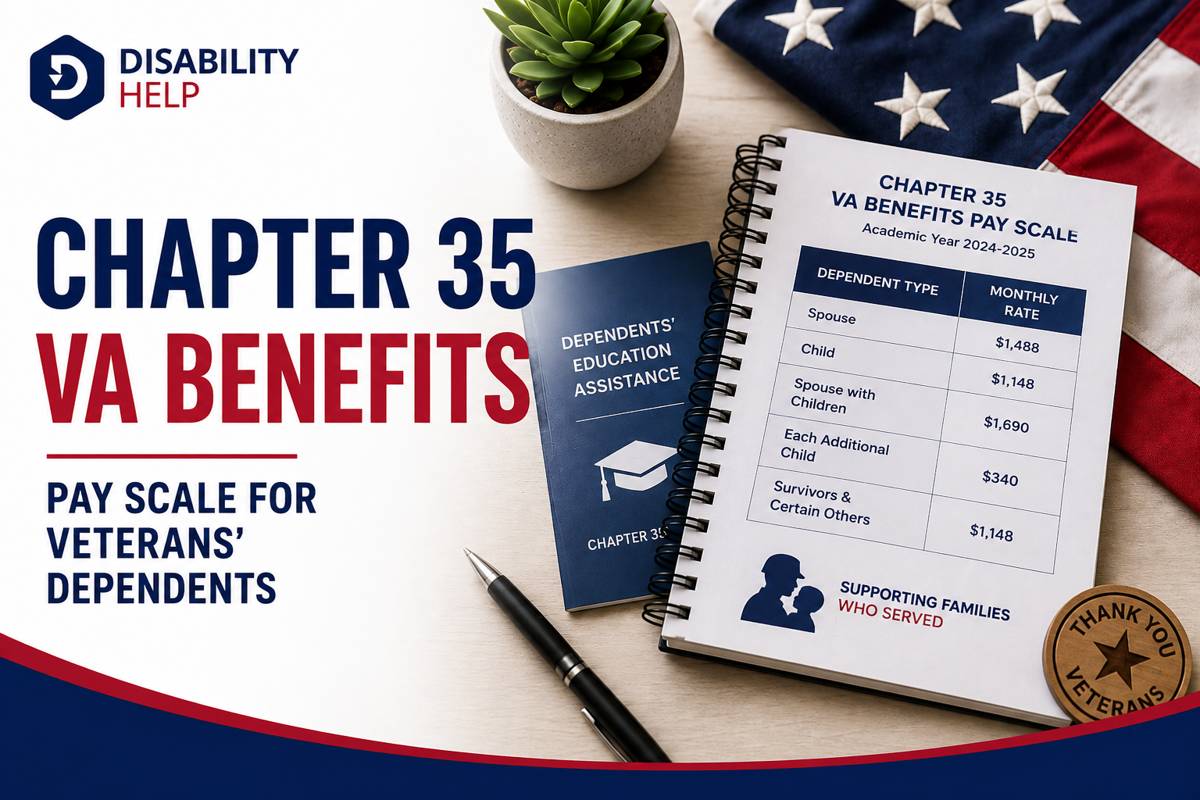
The Chapter 35 VA benefits pay scale 2026 pays eligible veterans' dependents up to $1,574.00 per month for full-time college enrollment during the academic year that runs October 1, 2025 through September 30, 2026, with lower monthly amounts for part-time study, trade school, and apprenticeships. If you are the spouse or child of a veteran who is permanently and totally disabled, or who died from a service-connected cause, this benefit can cover a large share of your education costs. The U.S. Department of Veterans Affairs pays this money directly to you, not to your school.
This guide breaks down every rate tier, the two rule changes that took effect in 2026, and the steps that keep your payments arriving on time. Because eligibility starts with the veteran's rating, it also helps to review the 2026 VA disability pay chart alongside these education rates.
Key Takeaways
- Full-time monthly rate: The Chapter 35 VA benefits pay scale 2026 pays $1,574.00 per month for full-time college study through September 30, 2026.
- Paid straight to you: The VA sends DEA payments to the dependent, not the school, so you decide how to cover tuition, housing, and books.
- High school benefit ends: Starting August 1, 2026, Chapter 35 stops covering new high school, GED, tutoring, and remedial programs under Public Law 117-328.
- Monthly verification is mandatory: Since January 2026, every Chapter 35 beneficiary must confirm enrollment each month or the VA holds the payment.
- Up to 36 months of support: Most beneficiaries receive 36 months of benefits for college, trade school, apprenticeships, or on-the-job training.
- A 2.8% COLA is coming: The confirmed 2.8% cost-of-living adjustment projects a full-time rate near $1,618 for the October 2026 academic year.
- One application form: First-time applicants file VA Form 22-5490 online at VA.gov using the veteran's Social Security number or VA file number.
How Much Does the Chapter 35 Pay Scale 2026 Pay Each Month?
The Chapter 35 pay scale 2026 sets a full-time college rate of $1,574.00 per month, a 3/4-time rate of $1,244.00, and a 1/2-time rate of $912.00 for the period October 1, 2025 through September 30, 2026. Your exact payment depends on two things: the type of training you pursue and how many courses you take.
The VA bases your monthly amount on your training time. A dependent taking a full course load receives the full rate. A dependent taking fewer courses receives a smaller share. Payments are also prorated by the day. If your term starts on the 20th of a month, you receive roughly one-third of that month's rate, because you were enrolled for about ten days. Two students at different schools with the same training time receive the same monthly amount, since Chapter 35 pays by enrollment level rather than by tuition cost.
These are the official monthly rates for college and university courses, drawn from the VA's Chapter 35 rates page.
| Enrollment Level | Monthly Rate (Oct 2025 - Sep 2026) |
|---|---|
| Full-time | $1,574.00 |
| 3/4-time | $1,244.00 |
| 1/2-time | $912.00 |
| Less than 1/2-time, more than 1/4-time | $912.00 (or tuition and fees, whichever is less) |
| 1/4-time or less | $393.50 (or tuition and fees, whichever is less) |
Trade and vocational schools follow the same monthly tiers, measured by scheduled clock hours instead of course load. On-the-job training and apprenticeships work differently. The payment steps down as you progress through the program, and you must work at least 120 hours each month to receive the full amount for that stage.
| Training Duration | Monthly Rate (Oct 2025 - Sep 2026) |
|---|---|
| Months 1 to 6 | $999.00 |
| Months 7 to 12 | $751.00 |
| Months 13 to 18 | $493.00 |
| 19 months or more | $251.00 |
Two Big Chapter 35 Changes Every Family Should Know in 2026
Two changes reshape Chapter 35 in 2026: the VA stops paying for new secondary education programs on August 1, 2026, and every beneficiary must verify enrollment each month starting January 2026. Both changes affect whether and when your payments arrive, so families should plan around them now.
The high school benefit ends August 1, 2026
Public Law 117-328 changed the definition of an eligible educational institution to exclude secondary schools. As a result, DEA benefits will no longer pay for high school coursework, GED-level training, tutoring, or academic remediation for any program that starts on or after August 1, 2026. The VA confirmed this change in a June 2026 announcement. Students who began a secondary program before that date can keep receiving benefits through the end of that academic term, but not for later terms.
The broader program continues. College degrees, vocational training, apprenticeships, and on-the-job training all remain fully covered. As Military.com reported, families whose 18-year-olds are chasing a credential through a high school program should check whether a community college or vocational school offers the same credential, since those paths stay eligible.
Monthly enrollment verification is now required
Since January 2026, every Chapter 35 beneficiary must verify enrollment at the end of each month to receive payment. This replaces the old system, where the school certified the term and payments went out automatically. If you do not verify, the VA holds your payment until you do. You can confirm enrollment through any of these methods, according to the VA's enrollment verification guidance:
- Text message: opt in when you begin using benefits, then reply "YES" each month.
- Email: follow the verification link the VA sends to the address on file.
- Online: sign in to your VA.gov account and use the enrollment verification tool.
- Phone: call the Education Call Center at 1-888-442-4551.
- Ask VA: submit your enrollment dates through the Ask VA online portal.
Verification opens on the last day of each enrollment month. To verify for March, for example, the earliest you can act is March 31. Once you verify, payment processing usually takes five to seven days.
Who Qualifies for Chapter 35 Benefits?
You qualify for Chapter 35 as the spouse or child of a veteran who is permanently and totally disabled from a service-connected condition, who died from a service-connected cause, or who died in the line of duty. The veteran or service member must meet one qualifying condition, and you must meet the dependent rules that apply to your relationship.
The veteran or service member meets the standard if any one of these is true:
- Permanently and totally disabled due to a service-connected disability.
- Died from a service-connected disability, or died from any cause while rated permanently and totally disabled.
- Died in the line of duty, or is missing in action or captured by a hostile force for more than 90 days.
- Hospitalized or receiving treatment for a service-connected permanent and total disability and likely to be discharged for it.
Time limits changed for events dated August 1, 2023 and later. The table below compares how the clock works for children and spouses. You can read more about how VA disability compensation works to understand how the veteran's rating drives your eligibility.
| Beneficiary | Eligible before Aug 1, 2023 | Eligible on or after Aug 1, 2023 |
|---|---|---|
| Child | Starts at 18 or after high school or GED; generally up to 8 years and must finish before age 26 (extensions to 31 for military service) | Starts at any age; no time limit to use benefits |
| Spouse | Usually 10 years to use benefits; 20 years if the service member died on active duty | No time limit to use benefits |
Dependency and IndemnityA legal principle requiring one party to compensate another for harm or loss, relevant in disability... Compensation, or DIC, interacts with DEA differently by relationship. A child who receives DIC must give it up to use DEA. A spouse can receive both DEA and DIC at the same time. Divorce ends a spouse's DEA eligibility, and remarriage generally does too, with limited exceptions.
What Will the Chapter 35 Pay Scale Look Like After the 2026 COLA?
The full-time Chapter 35 rate should rise for the academic year starting October 1, 2026, because the VA confirmed a 2.8% cost-of-living adjustment for 2026. Applying that 2.8% increase to the current $1,574.00 full-time rate projects a new full-time rate of roughly $1,618 per month. The VA typically publishes official education rates in August, so treat this figure as a projection until then.
The Social Security Administration announced the 2.8% COLA on October 24, 2025, and federal law ties VA benefit increases to that figure. Disabled American Veterans reported that the 2.8% adjustment applies across VA disability compensation, Dependency and Indemnity Compensation, and related benefits, and that it sits above the roughly 2.6% average of the past decade.
Your entitlement period sets how long the money lasts. You receive 36 months of benefits if your school or training started on or after August 1, 2018, and 45 months if it started before that date. Part-time enrollment stretches those months across a longer calendar, since you use entitlement more slowly.
How to Apply for Chapter 35 Benefits and Keep Payments Coming
Applying for Chapter 35 takes one form and a Certificate of Eligibility. Follow these steps to start payments and avoid a gap once they begin:
- Confirm the veteran's eligibility. The VA documents permanent and total status or service-connected death in the rating decision. If it is not established yet, apply for that first.
- Gather your information. You need the veteran's Social Security number or VA file number and details about your school or training program.
- File VA Form 22-5490 online. Submit the Dependents' Application for VA Education Benefits at VA.gov.
- Send your Certificate of Eligibility to your school. Give the COE to your school certifying official so enrollment can be certified.
- Verify enrollment every month. Confirm your enrollment at the end of each month so the VA releases your payment.
You can start the application on the VA's apply-for-DEA page. Full program details, including current rates and eligibility rules, live on the VA's Survivors' and Dependents' Educational Assistance page.
One trust point worth stating plainly: legitimate VA education benefits never require an upfront fee. Accredited Veterans Service Organizations and the VA itself help for free. Be cautious of any company that charges to "apply for" a free government benefit. If your case turns complicated, such as a denied eligibility determination or an overpayment notice, a VA-accredited representative can help at no cost. For decisions that carry legal or financial weight, confirm your specific situation with the VA or an accredited representative before you act.
Key Chapter 35 Terms, Defined
- DEA (Survivors' and Dependents' Educational Assistance): The formal name for Chapter 35, a VA education benefit for the spouses and children of certain disabled or deceased veterans.
- Permanent and total (P&T) disability: A VA rating meaning a service-connected condition is both total (100%) and not expected to improve. It is the usual trigger for Chapter 35.
- Prorated payment: A partial monthly payment based on the number of days you were enrolled that month, used when a term starts or ends mid-month.
- Certificate of Eligibility (COE): The letter the VA mails after approving your application, which you give to your school to confirm your benefit.
- Entitlement period: The total months of benefits you can use, either 36 or 45 months depending on when your training first began.
- DIC (Dependency and Indemnity Compensation): A separate tax-free VA payment for survivors, which spouses can hold alongside DEA but children cannot.
Expert Insight on the 2026 Benefit Changes
The 2026 COLA arrives at a time of real financial pressure on military families. DAV Washington Headquarters Executive Director Jim Marszalek said the financial strain from rising costs "has been significant" for veterans and their families, framing the 2.8% adjustment as a needed step to protect the purchasing power of earned benefits.
In practice, the two rule changes matter more than the rate change for most dependents this year. A family counting on the high school benefit for an 18-year-old needs a new plan before August 1, 2026, because that specific use is ending. A college student who has relied on automatic payments needs a calendar reminder for the last day of each month, since a missed verification now stops the deposit. Both problems are simple to avoid once you know they exist, which is exactly why families should confirm their verification method and their program's eligibility before the term starts.
Making the Most of Your 2026 Chapter 35 Benefits
Chapter 35 remains one of the more valuable education benefits available to veterans' dependents, paying up to $1,574.00 per month for full-time study through September 2026. As of 2026, two changes deserve your attention: the high school benefit ends August 1, and monthly enrollment verification is now required to keep payments flowing. Confirm your eligibility, file VA Form 22-5490, and set a monthly reminder to verify, and your benefit should arrive without interruption.
To see how the veteran's rating shapes your family's full benefit picture, review the 2026 VA disability pay chart and confirm your details directly with the VA.
Frequently Asked Questions
Does Chapter 35 pay for high school after August 1, 2026?
No. Starting August 1, 2026, Chapter 35 no longer covers new high school, GED, tutoring, or remedial programs. Students who began a secondary program before that date can finish that term on benefits, but not later terms. College, vocational training, and apprenticeships remain fully covered.
How much is the Chapter 35 full-time rate for 2026?
The full-time college rate is $1,574.00 per month for October 1, 2025 through September 30, 2026. The 3/4-time rate is $1,244.00 and the 1/2-time rate is $912.00. The VA pays this directly to the dependent, not the school.
Do I have to verify my enrollment every month?
Yes. Since January 2026, all Chapter 35 beneficiaries must verify enrollment at the end of each month by text, email, VA.gov, phone, or Ask VA. If you do not verify, the VA holds your payment until you complete the step, then processes it within five to seven days.
Can a spouse receive both DEA and DIC at the same time?
Yes. A spouse can receive both Dependency and Indemnity Compensation and DEA education benefits together. A child, by contrast, must give up DIC to use DEA. This is one of the clearest differences between how the two relationships are treated.
How long do Chapter 35 benefits last?
Most beneficiaries receive 36 months of benefits, which applies when training first began on or after August 1, 2018. Training that started before that date qualifies for 45 months. Part-time enrollment spreads those months over a longer period.