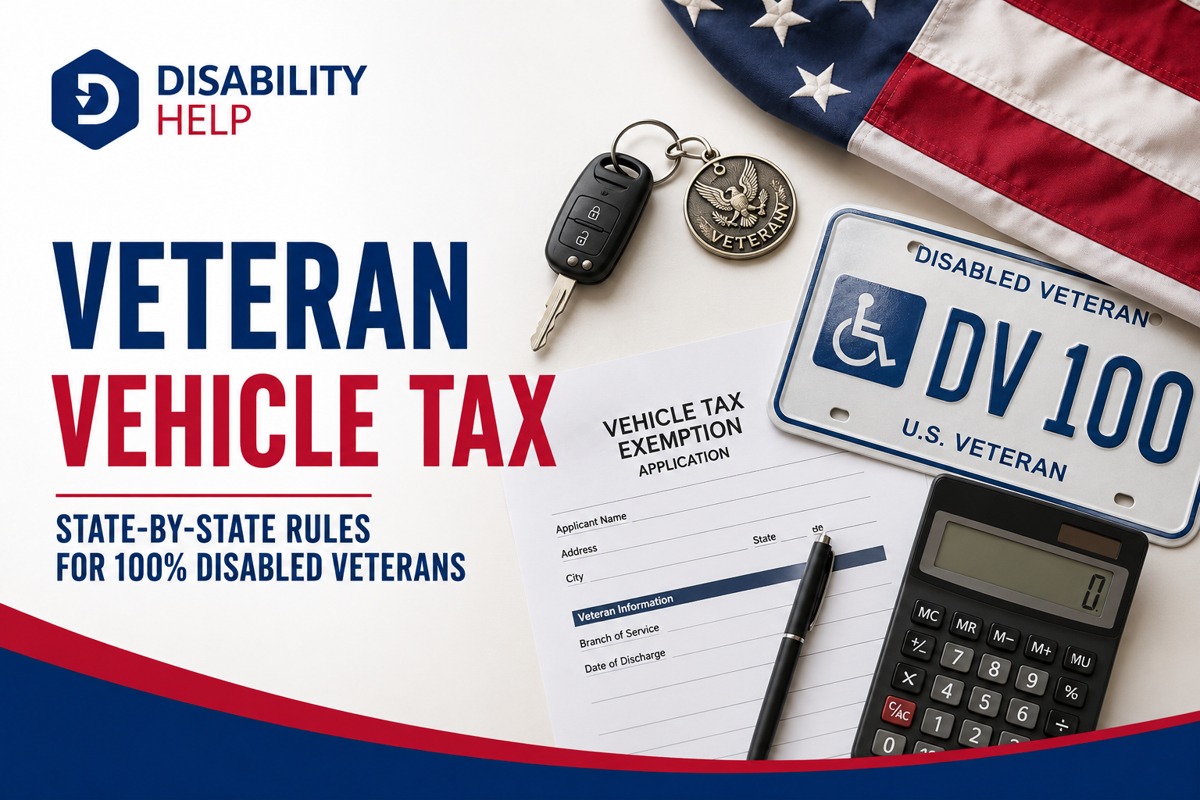
Do 100 disabled veterans pay sales tax on vehicles? In most cases, yes, but the answer changes the moment you cross a state line. There is no federal sales tax exemption for vehicles purchased by 100% disabled veterans. The U.S. Department of Veterans Affairs pays an automobile allowance of up to $27,074.99 in 2026, and the portion the VA covers is automatically tax-free, but your portion is taxed under your state's rules (VA special benefit allowance rates).
A handful of states, including Virginia, Massachusetts, Oklahoma, Minnesota, and Tennessee, fully exempt qualifying 100% disabled veterans from vehicle sales or use tax on one vehicle. Most other states tax your purchase the same as any other buyer.
This guide breaks down the federal context, the state-by-state rules, the documentation you need, and the exact steps to claim the exemption.
Key Takeaways
- No federal exemption: There is no federal sales tax exemption on vehicle purchases for 100% disabled veterans. State law controls whether you pay.
- VA-paid portion is tax-free: When the VA Automobile Allowance covers part of the purchase, that portion is a sale to the U.S. government and is not subject to state sales tax.
- 2026 VA allowance: The VA Automobile Allowance pays up to $27,074.99 toward a specially equipped vehicle, with renewals every 10 years under the 2023 AUTO Act.
- Strict state list: Virginia, Massachusetts, Oklahoma, Minnesota, and Tennessee offer full vehicle sales or use tax exemptions for 100% service-connected disabled veterans.
- One-vehicle limit: Almost every state with an exemption limits it to one passenger vehicle or pickup truck per qualifying veteran at a time.
- Paperwork is mandatory: You need your VA Benefit Summary Letter showing a 100% permanent and total rating, plus the state-specific exemption form, at the time of titling.
- Apply before titling: Most states want the exemption claimed at the point of titling. Refund claims after the fact are slower and not always available.
Is There a Federal Sales Tax Exemption for 100% Disabled Veterans on Vehicles?
No, there is no federal sales tax exemption for vehicles purchased by 100% disabled veterans. The federal government does not impose a national sales tax, so vehicle sales tax is set entirely at the state level. Federal law only affects the equation through the VA Automobile Allowance, which makes the VA-paid portion of a vehicle purchase tax-free as a sale to the U.S. government.
If you are a 100% service-connected disabled veteran living in a state without its own exemption, you generally pay the same sales or use tax rate as any other buyer on the portion of the vehicle you fund yourself. Pennsylvania, for instance, taxes vehicle purchases by disabled veterans the same as any other buyer. Louisiana takes the same position on sales tax, though it does offer registration fee relief for some disabled veterans. New Jersey only exempts the purchase if the VA or the state Department of Military and Veterans Affairs provides funds directly for the purchase.
A common misconception is that a 100% VA rating triggers automatic tax relief on every major purchase. It does not. Each benefit, whether a property tax break, a vehicle registration discount, or a vehicle sales tax exemption, has to be created by a separate state law and claimed with separate paperwork. The U.S. Department of Veterans Affairs lists vehicle-related benefits on a state-by-state basis, with no uniform federal program.
To check what your state offers, start with two sources: the VA's state benefit summaries on VA.gov, and your state's Department of Motor Vehicles or Department of Revenue website. Together, they show whether your state has a specific vehicle sales or use tax exemption, what disability rating it requires, and how to apply.
How the VA Automobile Allowance Changes the Taxable Amount
The VA Automobile Allowance reduces the sales tax you owe because the VA-funded portion of the purchase is treated as a sale to the U.S. government, not to you. State law generally exempts sales to the federal government from sales tax. So even in states without a disabled veteran sales tax exemption, the VA's portion is tax-free.
Here is what that looks like in practice. Imagine you buy a $35,000 specially equipped pickup truck. The VA pays $27,074.99 of that as your automobile allowance grant in 2026. Your portion is $7,925.01. If your state's vehicle sales tax rate is 7%, you owe tax on the $7,925.01 you paid, not the full $35,000. That is roughly $555 in sales tax instead of $2,450. The federal benefit shrinks your taxable base by about 77% in this example.
The 2026 VA Automobile Allowance pays up to $27,074.99 for a specially equipped vehicle, effective October 1, 2025. The Advancing Uniform Transportation Opportunities for Veterans Act (the AUTO Act), signed into law in January 2023, also changed how often you can use the benefit. Before the AUTO Act, veterans could receive the automobile grant only once in a lifetime. Now, qualifying veterans can apply for the grant every 10 years, which makes the federal tax-free portion available for vehicle replacements over time.
To qualify for the VA Automobile Allowance, you must have a service-connected disability that includes at least one of the following conditions: loss or permanent loss of use of one or both feet, loss or permanent loss of use of one or both hands, permanent decreased vision in both eyes (20/200 or less in the better eye with glasses, or a visual field defect reducing peripheral vision to 20 degrees or less), severe burn injury, amyotrophic lateral sclerosis (ALSAmyotrophic Lateral Sclerosis, a progressive neurodegenerative disease affecting nerve cells in the ...), or ankylosis in one or both knees or hips (the last condition qualifies only for the adaptive equipmentDevices that assist individuals with disabilities in performing ADLs, such as grab bars or shower ch... grant, not the automobile grant).
You apply by filing VA Form 21-4502 before purchasing the vehicle. The VA pays the seller directly after approval.
Which States Exempt 100% Disabled Veterans From Vehicle Sales Tax?
A small number of states offer a full vehicle sales or use tax exemption for 100% service-connected disabled veterans. Each state has its own rating requirement, vehicle limitations, and application process. The table below summarizes the most generous state programs as of 2026.
| State | Tax Exempted | Rating Required | Vehicle Limits | Source |
| Virginia | Sales and Use Tax | 100% service-connected, permanent, and total | One passenger vehicle or pickup under 10,000 lbs. Motorcycles, RVs, trailers, and ATVs are excluded. | Virginia DMV |
| Massachusetts | Sales tax and excise tax | 100% VA rating or unemployable (TDIU) | One non-commercial passenger vehicle or pickup. Requires DV plates. | Mass.gov (HERO Act) |
| Oklahoma | Sales tax | 100% disabled veteran or unremarried surviving spouse | Must register in the Oklahoma Veterans Registry. Use Form 701-31 at the sale. | Oklahoma Tax Commission |
| Minnesota | Motor Vehicle Sales Tax | 100% total service-connected disability | Passenger autos, one-ton pickups, RVs, and motorcycles. In effect since 2024. | Minnesota Dept. of Revenue |
| Tennessee | County Motor Vehicle Privilege Tax | 100% permanent, total service-connected, or former POW | New or used vehicles. Apply to the county collector with proof of disability. | Tennessee Dept. of Veterans Services |
| Georgia | State sales and use tax on the vehicle | 100% totally and permanently service-connected disabled with statutory award | One vehicle the veteran owns. Typically with DV plate. | Georgia Dept. of Veterans Service |
| Hawaii | Motor vehicle taxes | Totally disabled veteran with VA-subsidized car | Applies to vehicles purchased with VA automobile allowance. | VA News |
| Kansas | Sales tax on up to $24,000 in annual purchases | 100% permanent and total, or TDIU | Effective July 1, 2026. Vehicles are EXCLUDED from this exemption. | Kansas Office of Veterans Services |
Three points are worth noting. First, this list is not exhaustive, and some states have additional or narrower programs (for example, sales tax exemptions only on VA-adapted vehicles). Second, eligibility rules differ even when the headline benefit looks the same. Massachusetts requires DV plates and limits the benefit to one non-commercial vehicle under its 2024 HERO Act, while Tennessee waives the county motor vehicle privilege tax but not the state sales tax.
Third, some states with widely circulated 'new exemption' claims have not actually enacted them. Texas HB 235, for example, was filed in the 2025 special legislative session with an intended January 1, 2026, effective date, but the bill did not advance and is not an active law as of 2026. Always verify with your state's tax authority before assuming an exemption applies.
States that do not offer a vehicle sales tax exemption for 100% disabled veterans include Pennsylvania, Louisiana, New Jersey (except when the VA or state agencyThe capacity of individuals with disabilities to act independently and make their own choices. provides the purchase funds directly), Vermont (except for vehicles modified through VA-funded adaptive equipment), and Kansas (which explicitly excludes vehicles from its general disabled veteran sales tax exemption, taking effect July 1, 2026). If you live in one of these states, you generally pay full sales tax on your portion of the purchase, even with a 100% VA rating.
How to Claim a Disabled Veteran Vehicle Sales Tax Exemption Step by Step
The application process varies by state, but the underlying sequence is consistent. The key is to apply at the right point in the purchase. Most states want the exemption claimed at titling or registration, not after. Here is the standard process to follow.
- Confirm your VA disability rating in writing. Log in to your VA.gov account, go to 'Disability,' and download your current VA Benefit Summary Letter. This document is the primary proof of your 100% service-connected, permanent, and total rating that every state requires.
- Verify your state's specific exemption rules. Visit your state DMV or Department of Revenue website to confirm whether your state offers an exemption, what rating it requires (some accept Total Disability Individual Unemployability, or TDIU; some do not), and which vehicle types qualify.
- Register on any required state veterans registry. Oklahoma, for example, requires you to register in the Oklahoma Veterans Registry and obtain a 100% Disabled Veteran Sales Tax Exemption Permit before claiming the benefit at a dealership.
- Gather your supporting documents. You typically need your VA Benefit Summary Letter, your DD-214 discharge papers, the vehicle's title or bill of sale, proof of residency (such as a driver's license), and the state-specific exemption form (for example, Virginia's SUT3 or Oklahoma's Form 701-31).
- Submit the exemption form at the time of titling. In Virginia, you bring the SUT2 titling application, the SUT3 exemption form, and your VA letter to the Virginia DMV. In Massachusetts, you apply for Disabled Veteran (DV) plates through the RMV, and the exemption applies automatically once the vehicle is registered with the DV plate. In Oklahoma, you complete Form 701-31 and present your exemption permit number to the dealer at the point of sale.
- Keep your records. Save copies of everything you submitted, the dealer's receipts showing tax was not charged on the exempt portion, and your title documents. If your state limits the exemption to one vehicle, you may need to prove the prior vehicle was sold or traded before claiming the exemption again.
- If you missed the window, file a refund claim. Some states allow a sales tax refund if you paid tax at purchase and were eligible at the time. The refund process is generally slower than claiming the exemption upfront, and not every state offers it. Contact your state's Department of Revenue to confirm the deadline and required documents.
Key Terms to Know Before You Apply
Several terms come up repeatedly in the disabled veteran tax exemption rules. Knowing them prevents missed deadlines and rejected applications.
Service-Connected Disability. A disability that the VA has officially linked to military service. State exemptions almost always require service connection. A 100% disability rating that is not service-connected usually does not qualify.
Permanent and Total (P&T) Rating. A VA designation meaning your 100% rating is both total (full disability) and permanent (not expected to improve). Some states, like Virginia, specifically require a P&T rating, not just a 100% schedular rating.
Total Disability Individual Unemployability (TDIU). A VA status that pays disability compensation at the 100% rate even when the schedular rating is below 100%, because the veteran cannot maintain substantial gainful employmentWork that provides a living wage and is within the capacity of an individual, including those with d... due to service-connected disabilities. Massachusetts and Kansas treat TDIU as equivalent to 100% for their exemptions. Some other states do not.
VA Automobile Allowance. A payment (renewable every 10 years under the AUTO Act) of up to $27,074.99 in 2026 toward a specially equipped vehicle for qualifying veterans. Applied for using VA Form 21-4502. Paid directly to the seller.
Disabled Veteran (DV) License Plate. A specialty plate issued by many states to qualifying disabled veterans. In states like Massachusetts and Georgia, having the DV plate is what activates the sales or excise tax exemption. Other states allow the exemption without DV plates.
Sales and Use Tax (SUT). The combined state tax on the sale (sales tax) or first use (use tax) of a vehicle. Some states use the terms interchangeably. Others apply the use tax when a vehicle is brought in from out of state. A SUT exemption for disabled veterans covers both.
Real-World Example: How the Numbers Add Up
Take a 100% service-connected disabled veteran in Virginia buying a $40,000 pickup truck under 10,000 pounds. He qualifies for both the VA Automobile Allowance and Virginia's full SUT exemption.
The VA pays $27,074.99 of the purchase price directly to the dealer. Virginia's SUT exemption removes the sales and use tax on the remaining $12,925.01 because Virginia exempts the entire vehicle from SUT for a qualifying 100% P&T veteran. Virginia's motor vehicle SUT rate of 4.15% on a $40,000 vehicle would normally be $1,660. The veteran pays $0 in vehicle SUT and $0 in tax on the VA-paid portion. Net out-of-pocket savings: $1,660 in sales tax plus the $27,074.99 in vehicle cost offset.
Now apply the same purchase in a non-exempt state like Pennsylvania. The VA still pays $27,074.99, which is still tax-free as a sale to the federal government. But Pennsylvania charges its 6% sales tax on the veteran's $12,925.01 portion: about $776 in state sales tax. So the location of the purchase changes the out-of-pocket tax bill by hundreds, sometimes thousands of dollars, on the same vehicle for the same veteran with the same federal benefits.
For caregivers helping a veteran with this process, the takeaway is simple. The title of the vehicle matters as much as which model you choose. If a qualifying veteran has a choice (for example, a recent move or a vehicle purchased near a state line), the registration state can produce significant tax differences.
Where to Go From Here
As of 2026, the rules for 100% disabled veteran vehicle sales tax exemptions are still set state by state, and they shift regularly as state legislatures act. Confirm your state's current rule with your DMV or Department of Revenue before you make a purchase, and apply for the VA Automobile Allowance using VA Form 21-4502 before signing any sales contract so the VA portion is paid directly to the seller.
If your situation involves more than a vehicle purchase (for example, you are also applying for SSDI, working through a workers' compensation claim, or seeking workplace accommodationsModifications or adjustments in healthcare settings to support patients with disabilities. under the ADA), broader disability benefitsFinancial assistance provided to individuals who are unable to work due to a disability, such as Soc... guidance can help you understand how these systems fit together.
If your case is complex, or you have been denied an exemption you believe you qualify for, a veterans benefits attorney or an accredited Veterans Service Officer (VSO) can review your situation. Many offer free initial consultations. Understanding how veteran tax exemptions, SSDI, SSI, workers’ compensationA form of insurance providing wage replacement and medical benefits to employees injured on the job,..., and disability rights laws intersect can significantly affect your overall financial picture, especially if you’re navigating multiple benefits simultaneously.
For help with income‑based benefits that might be impacted by settlement income or other awards, check out our guide on social security disability benefits (SSDI).
Frequently Asked Questions
Do 100 disabled veterans pay sales tax on vehicles in every state?
No. There is no national rule. Each state sets its own policy, and most states do not exempt 100% disabled veterans from vehicle sales tax. As of 2026, only a small group of states (including Virginia, Massachusetts, Oklahoma, Minnesota, Tennessee, and Georgia) provide a full vehicle sales or use tax exemption for qualifying veterans, each with its own rules.
Is the VA Automobile Allowance taxable income?
No. The VA Automobile Allowance is not taxable income and is not reported on your federal tax return. The portion of the vehicle purchase that the VA pays is treated as a sale to the U.S. government and is not subject to state sales tax. Only the portion you fund yourself may be subject to state sales tax, depending on your state's rules.
Does an 'unemployability' rating (TDIU) count as 100% for vehicle sales tax exemption?
Sometimes. Massachusetts and Kansas both treat TDIU as equivalent to a 100% rating for their disabled veteran sales tax exemptions. Virginia requires a 100% permanent and total schedular rating, which is a stricter standard. Always check your specific state's rules before assuming TDIU qualifies.
Can a surviving spouse claim the disabled veteran vehicle sales tax exemption?
Yes, in some states. Oklahoma extends the sales tax exemption to unremarried surviving spouses of qualifying disabled veterans. Kansas's exemption (effective July 1, 2026) covers surviving spouses if the veteran passed away on or after that date and the spouse has not remarried. Other states limit the exemption to the veteran alone. Check the state-specific rule.
What if my state taxed the purchase and I qualified for the exemption?
You may be able to file a refund claim with your state's Department of Revenue. Refund eligibility, deadlines, and required documentation vary by state. Some states (like Virginia) prefer the exemption be claimed at the point of titling, and refund processing is slower. Contact your state tax authority promptly. The window to claim a refund is usually limited.
Does a personal injury settlement or workers' compensation award affect my VA Auto Allowance or state vehicle tax exemption eligibility?
No. Eligibility for the VA Automobile Allowance and state disabled veteran sales tax exemptions is based on your VA disability rating and service connection, not on settlements or workers' comp awards. However, settlements may affect other benefits, such as Supplemental Security Income (SSI), that have income or asset limits. If you also receive Social Security disability benefits, review how a settlement may be treated separately.