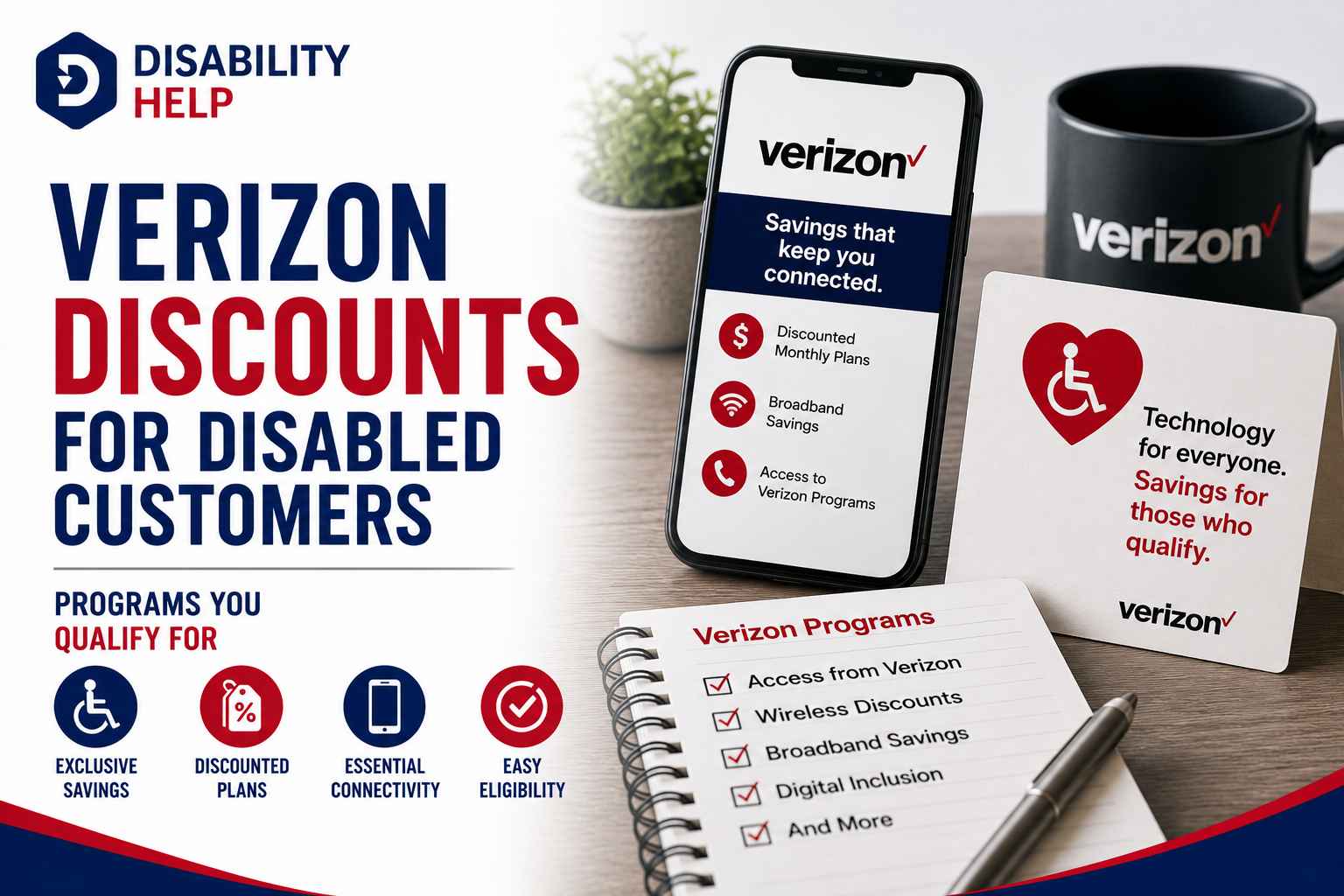
A Verizon discount for disabled customers does not come as one single line item on your bill. Verizon does not sell a standalone disability plan. Instead, it offers a set of programs that lower your cost or protect your service: the federal Lifeline discount, the Verizon Forward home internet credit, billing safeguards through the Special Protections Program, and free accessibilityThe design of products, devices, services, or environments to be usable by people with disabilities.... features for customers who are deaf, hard of hearing, blind, or have a motion disability. Knowing which one fits your situation is the difference between paying full price and cutting your bill by $30 or more a month.
More than 1 in 4 U.S. adults, over 70 million people, reported having a disability in 2022, according to CDC data. Many live on fixed incomes where a phone or internet bill competes with rent and medication. This guide walks through every Verizon program a disabled customer can use in 2026, who qualifies, how much you save, and exactly how to apply.
Key Takeaways
- No single disability plan: Verizon does not offer one standalone disability discount. Savings come from Lifeline, Verizon Forward, and free accessibility services combined.
- Lifeline provides up to $9.25/month: This federal discount applies to one phone or internet service if you get SSI, MedicaidA U.S. government program that provides health coverage to eligible low-income individuals, includin..., SNAP, or meet income limits.
- Verizon Forward cuts up to $30/month: Stacked with Lifeline, eligible households can get home internet for about $20 a month or less.
- Special Protections stop shutoffs: Qualifying customers may avoid having Verizon phone service blocked or turned off during payment trouble and may receive priority repair service.
- Accessibility features cost nothing: Free 411 calls, text-only plans, Real-Time Text, 711 relay, and Braille or large-print bills are available on request.
- ACP has ended: The Affordable Connectivity Program stopped in April 2024, and Verizon Forward is Verizon’s current low-cost home internet discount for eligible customers.
Is There a Verizon Discount Specifically for Disabled Customers?
No. Verizon does not offer a single, standalone discount labeled for disability. What it offers instead is a network of programs that disabled customers qualify for: a federal phone and internet discount (Lifeline), a home internet credit (Verizon Forward), billing protections (the Special Protections Program), and a set of free accessibility services. Most disabled customers qualify for more than one.
This matters because searching for a "disability discount" can leave you thinking nothing exists. The savings are real; they are just spread across separate programs with separate applications. A person who receives Supplemental Security Income (SSI), for example, automatically meets the eligibility test for both Lifeline and Verizon Forward, which can be combined.
Verizon frames these offerings around accessibility and financial assistance rather than disability status alone. That means eligibility often turns on either a documented medical condition (for accessibility services and the Special Protections Program) or income and benefit enrollment (for Lifeline and Verizon Forward). The rest of this guide separates the two paths so you can find the ones that apply to you.
How Much Does Lifeline Save Disabled Verizon Customers?
Lifeline gives eligible low-income households a discount of at least $9.25 per month on one qualifying phone or internet service, according to the Federal Communications Commission. Households on qualifying Tribal lands can receive up to $34.25 per month. The discount applies to a single service per household, not both phone and internet.
You qualify for Lifeline if your household income is at or below 135% of the Federal Poverty Guidelines, or if you participate in a federal assistance program. The Social Security Administration confirmed in March 2026 that people receiving SSI are eligible. Qualifying programs include:
- Supplemental Security Income (SSI)
- Medicaid
- Supplemental Nutrition Assistance Program (SNAP)
- Federal Public Housing Assistance (FPHA)
- Veterans Pension and Survivors Benefit
You apply through the federal National Verifier first, run by the Universal Service Administrative Company. Once approved, you give your application ID to Verizon to apply the discount. Verizon offers Lifeline-supported wireless service in parts of Iowa, North Dakota, New York, and Wisconsin, and applies the discount to qualifying home phone or Fios service where available.
Verizon Programs for Disabled Customers Compared
The table below compares the four main programs side by side so you can match your situation to the right one. Read the eligibility column first: some programs require a documented disability, while others depend on income or benefit enrollment.
| Program | What You Get | Who Qualifies | How to Apply |
|---|---|---|---|
| Lifeline | At least $9.25/month off one phone or internet service | SSI, Medicaid, SNAP, FPHA, Veterans Pension, or income at or below 135% of poverty guidelines | Apply at National Verifier, then enroll with Verizon |
| Verizon Forward | Up to $30/month off Fios, 5G Home, or LTE Home internet | Lifeline enrollment, or SNAP, Medicaid, SSI, WIC, or a recent Pell Grant | Apply online after internet service is active |
| Special Protections Program | No service shutoff during hardship, plus priority repair | Age 62+, legally blind, documented long-term disability, or 100% P&T veteran | Mail the paper application to Verizon |
| Accessibility Services | Free 411, text-only plans, RTT, 711 relay, alternate-format bills | Deaf, hard of hearing, speech-disabled, blind, or motion disability | Call Verizon accessibility support |
Lifeline and Verizon Forward can be combined. When stacked, eligible households can reduce the net cost of home internet to about $20 a month or less, based on Verizon Forward program details published by Verizon.
How to Apply for a Verizon Disability Discount Step by Step
Applying is straightforward once you know which program you are targeting. Follow these steps in order. The first two apply to almost everyone, and the rest depend on which program fits your needs.
- Identify your eligibility path. Decide whether you qualify through a documented disability (for accessibility services and Special Protections) or through income and benefits like SSI, Medicaid, or SNAP (for Lifeline and Verizon Forward).
- Gather your documents. For medical programs, you may need a signed letter from a licensed physician, optometrist, or audiologist. For financial programs, collect proof of benefit enrollment such as an award letter or your benefit card.
- Apply for Lifeline first. Complete the National Verifier application at LifelineSupport.org. Approval is often immediate, but document review can take up to two business days.
- Add Verizon Forward. After your Verizon internet service is active, apply online for Verizon Forward. If approved, you must click the link in your confirmation email and follow the prompts, or the discount will not apply.
- Mail the Special Protections form if eligible. Download the application, complete it, and mail it to Verizon at PO Box 16804, Newark, NJ 07101-6804.
- Call accessibility support for plan changes. To set up a text-only plan, Real-Time Text, or alternate-format billing, contact the accessibility team directly rather than standard customer service.
What the Special Protections Program Does for Disabled Customers
The Special Protections Program shields qualifying customers from losing their landline or Fios service during a temporary financial hardship and flags their account for priority repair. It is one of Verizon's least-publicized safeguards, and it is mandated in states like New York under utility consumer rules.
Under the program, Verizon places a special status on your account. If you cannot pay your bill on time because of a short-term hardship, Verizon is restricted from suspending or terminating your service. For someone who relies on a phone line for medical alerts, telehealth, or emergency contact, that protection prevents a dangerous disconnection. Enrolled accounts also move ahead of standard residential accounts when service needs to be restored after an outage or equipment failure.
To qualify, the account holder or a permanent household resident must meet at least one of these criteria:
- Be 62 years of age or older
- Be legally blind
- Have a documented long-term physical or mental disability that limits major life activities
- Have a long-term disability, be blind, or be age 62 or older, as listed on Verizon’s Special Protections application.
Enrollment is by mail. You download and complete the official application, then mail it to Verizon at PO Box 16804, Newark, NJ 07101-6804. The U.S. Department of Justice ADA resource outlines the broader disability protections that programs like this one support, though Verizon's program is a company offering rather than an ADA requirement.
Free Accessibility Features and Key Terms to Know
Verizon provides several accessibility services at no extra charge for customers who are deaf, hard of hearing, speech-disabled, blind, or have a motion disability. These are not discounts in the dollar sense, but they remove costs and barriers that other customers do not face. Here are the core features and what each term means:
Directory Assistance Exemption: Free 411 calls for customers with a documented visual or motion disability that prevents using a printed or online directory. 411 normally carries a per-use charge.
Nationwide Messaging Plans: Text-only wireless plans for deaf, hard-of-hearing, or speech-impaired customers. These plans drop voice minute charges and provide data and unlimited text at a reduced rate.
Real-Time Text (RTT): A built-in feature on modern iOS and Android phones that sends characters the instant you type them, rather than waiting for you to press send. It replaces older Teletypewriter (TTY) devices and needs no extra hardware.
Telecommunications Relay Service (TRS): A free service reached by dialing 711. A relay operator translates typed TTY text into voice for the other party and back, supported on any Verizon phone.
Alternate-Format Billing: On request, Verizon provides monthly bills, brochures, and contracts in Braille, large print, audio CD, or MP3 at no additional charge.
To request any of these, contact Verizon's dedicated accessibility support, described in the Verizon Accessibility Resource Center. The Federal Communications Commission also requires relay services like 711 across all carriers, so this is a protected right, not a courtesy.
What to Watch For When Applying
In our experience helping readers compare benefit programs, the most common mistake is assuming a single application covers everything. It does not. Lifeline runs through a federal portal, Verizon Forward runs through Verizon after your internet is active, and Special Protections is a paper form mailed to New Jersey. Missing the final "apply the discount" click on Verizon Forward is the single most frequent reason a credit never shows up.
Watch the calendar, too. Lifeline requires annual recertification, and Verizon Forward eligibility can require reverification after a promotional period. Set a reminder so a lapse does not quietly raise your bill. The FCC notes that only one Lifeline benefit is allowed per household, defined as people who live together and share income and expenses, so a multi-adult home should confirm who holds the benefit before a second person applies.
Be alert to scams. Legitimate government programs like Lifeline never charge a fee to apply, and disability attorneys work on contingency rather than upfront fees. If a service asks you to pay to "unlock" a free Verizon or federal discount, treat it as a warning sign and report it to the Federal Trade Commission.
Start With the Verizon Program That Fits Your Situation
The phrase "Verizon discount for disabled" hides a simple truth: the savings exist; they are just split across separate programs. As of 2026, your strongest move is to apply for Lifeline first, add Verizon Forward once your home internet is active, and mail the Special Protections application if a documented disability or 100% P&T veteran status applies to you. Layer in the free accessibility features, free 411, text-only plans, Real-Time Text, 711 relay, and alternate-format bills, and the total value far exceeds any single discount line.
Disability benefitsFinancial assistance provided to individuals who are unable to work due to a disability, such as Soc... and consumer protections work the same way: you rarely qualify for just one, and the right combination depends on your specific situation. Start with Lifeline if you receive SSI, Medicaid, SNAP, or another qualifying benefit, then check whether Verizon Forward can lower your home internet bill.
If you have a long-term disability, are blind, or are age 62 or older, review Verizon’s Special Protections form for phone-service safeguards and priority repair. For more ways to stay connected at a lower cost, read our guide on free phones for disabled individuals.
Frequently Asked Questions
Does Verizon offer a discount for people on disability?
Verizon does not have a single disability discount, but disabled customers can use Lifeline (at least $9.25/month off phone or internet), Verizon Forward (up to $30/month off home internet), and free accessibility services. People on SSI, Medicaid, or SNAP qualify for the financial programs.
Can I combine Lifeline and Verizon Forward?
Yes. Lifeline and Verizon Forward can be stacked on the same account. Combined, eligible households can lower the net cost of qualifying home internet to roughly $20 a month or less, depending on the plan and any other discounts already applied.
What happened to the Affordable Connectivity Program?
The Affordable Connectivity Program (ACP) ended in April 2024 when federal funding ran out. It provided up to $30 a month for internet. Verizon Forward was created to replace it, offering a similar discount to households that participate in qualifying assistance programs.
Do I have to prove my disability to get a Verizon discount?
It depends on the program. Lifeline and Verizon Forward depend on income or benefit enrollment, not a disability diagnosis. The Special Protections Program and accessibility services like free 411 require documentation of a qualifying disability, such as a letter from a licensed physician.
How do disabled veterans qualify for Verizon protections?
A veteran rated 100% Permanent and Total (P&T) by the Department of Veterans Affairs qualifies for the Special Protections Program. You submit a copy of your VA benefit summary letter showing the 100% P&T rating along with the program application mailed to Verizon.
What phone number do I call for Verizon accessibility help?
Verizon operates dedicated accessibility centers separate from general customer service. The mobile and wireless accessibility line handles plan enrollment and device settings, and the Center for Customers with Disabilities handles Fios, home, and landline questions, including alternate-format billing and the Special Protections Program.
- "Lifeline." Verizon, https://www.verizon.com/solutions-and-services/lifeline/.
- "Affordable Connectivity Program." Federal Communications Commission, https://www.fcc.gov/acp.