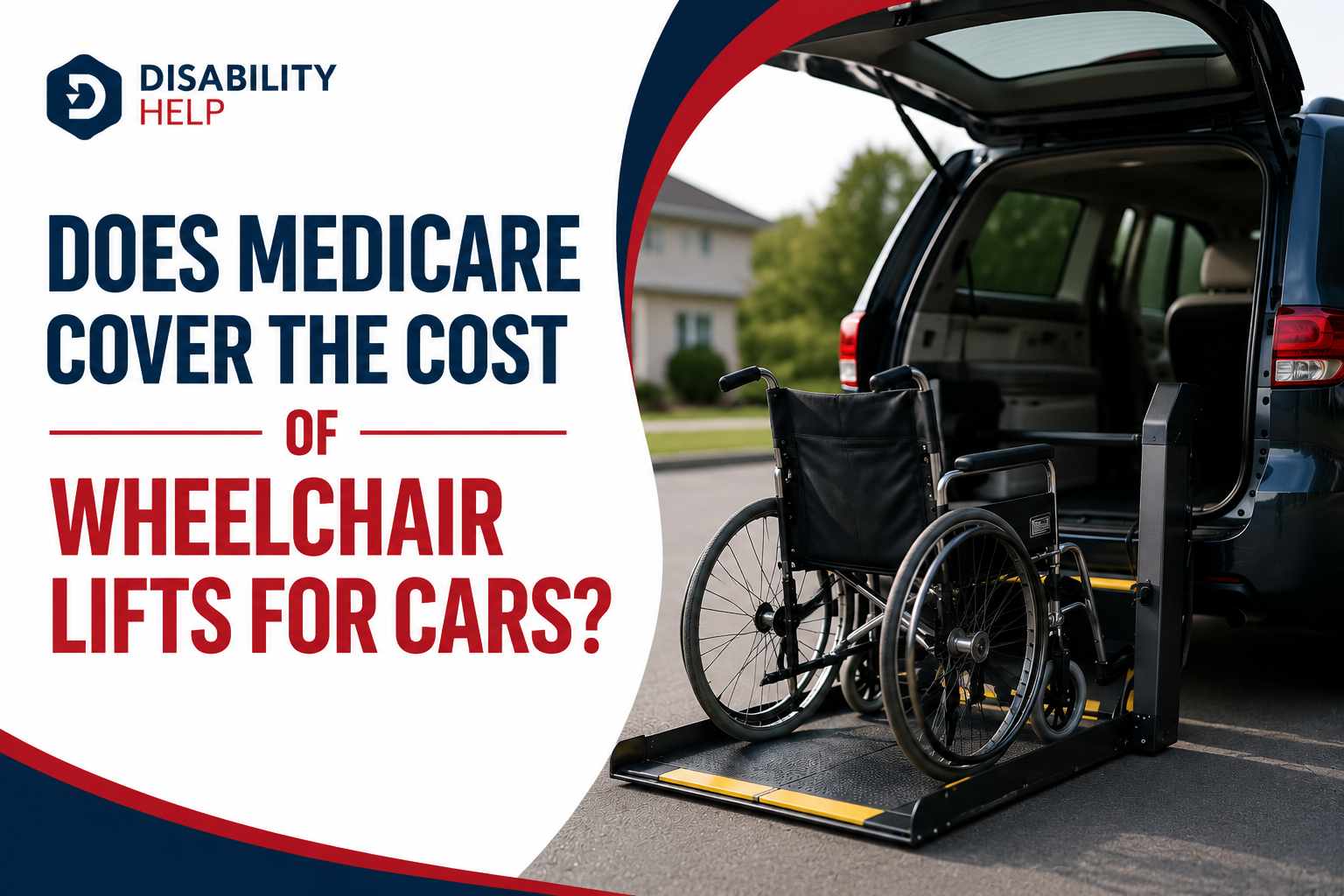
No. Original MedicareA U.S. federal health insurance program for people aged 65 and older, and for some younger people wi... does not pay for wheelchair lifts for cars, because it treats them as vehicle modifications rather than home-use medical equipment. That one classification drives the entire answer. Still, a denial of the lift itself does not mean you are out of options. Medicare Part B may cover the adaptive controls that let you drive, and after you meet the 2026 Part B deductible of $283, it pays 80% of approved equipment.
This guide explains what Medicare will and will not pay for, how Medicare Advantage differs, how to appeal a denial, and which other programs (VA, MedicaidA U.S. government program that provides health coverage to eligible low-income individuals, includin..., and grants) help cover a lift.
Key Takeaways
- Original Medicare says no: Medicare does not cover wheelchair lifts for cars because it classifies them as vehicle modifications, not home-use durable medical equipment.
- Adaptive driving controls may qualify: Medicare Part B can cover hand controls and similar driving aids when a doctor documents that they are medically necessary.
- You pay 20% after the deductible: Once you meet the 2026 Part B deductible of $283, Medicare pays 80% of approved adaptive equipmentDevices that assist individuals with disabilities in performing ADLs, such as grab bars or shower ch..., and you pay 20% coinsurance.
- Medicare Advantage sometimes helps: Some Part C plans offer supplemental benefits for vehicle or home modifications, so check your plan's coverage document directly.
- Veterans have stronger options: The VA offers an automobile allowance of up to $27,074.99 in 2026, plus adaptive equipment grants that can fund a vehicle lift.
- Medicaid and grants fill the gap: State Medicaid waivers, nonprofit grants, and assistive technology loans help cover lifts that can run $1,000 to $20,000 or more.
Why Medicare Does Not Cover Wheelchair Lifts for Cars
Medicare does not cover wheelchair lifts for cars because federal rules require durable medical equipment to be used mainly inside your home. A car lift attaches to a vehicle and works outside the home, so it falls outside that definition. The classification, not the price, is the real barrier.
To qualify as durable medical equipment (DME), an item must be durable enough for repeated use, serve a medical purpose, be useful mainly to someone who is sick or injured, last at least three years, and be used in the home. Medicare spells out these criteria for items like wheelchairs and scooters on Medicare.gov. A vehicle lift meets several of these tests but fails the home-use requirement, which is the one that controls coverage.
Medicare places vehicle lifts, hoists, and ramps in the category of vehicle modifications or convenience items. Because these parts bolt onto the vehicle and serve you outside the home, they do not count as portable medical equipment. The same logic explains why Original Medicare also declines to pay for a wheelchair-accessible van or a vehicle ramp.
This is consistent across the mobility industry. Vehicle manufacturers that build accessible vans, including BraunAbility, confirm that Medicare covers the wheelchair that keeps you mobile at home, but not the equipment that gets that chair into your car.
What Medicare Does Pay For: Adaptive Driving Equipment
Medicare Part B may cover portable equipment that helps you operate a vehicle, such as hand controls, when a doctor documents that the equipment is medically necessary for essential activities like reaching medical appointments. The key difference is that this equipment helps you drive the car, while a lift helps you load a wheelchair into it.
When Medicare approves these items, it pays 80% of the Medicare-approved amount after you meet the annual Part B deductible, which is $283 in 2026. You pay the remaining 20% as coinsurance. If you carry a Medicare Supplement (Medigap) policy, that plan may pick up the 20% share.
The adaptive driving equipment Medicare may cover includes hand controls for braking and acceleration, steering knobs and spinners, left-foot accelerators, power seat bases that help you transfer into the driver's seat, and wheelchair securement systems that lock a chair in place inside the vehicle. Each item must be prescribed and tied to a medical need, not to comfort or convenience.
Wheelchair Lifts vs. Adaptive Equipment: What Medicare Covers
The clearest way to see Medicare's logic is to compare the equipment that gets you into a vehicle against the equipment that lets you drive it. The table below shows what Original Medicare covers, the typical 2026 price range, and why each item lands where it does.
| Equipment | Medicare Coverage | Typical Cost | Why |
|---|---|---|---|
| Vehicle wheelchair lift | Not covered (Original Medicare) | $1,000 - $20,000+ | Treated as a vehicle modification, used outside the home |
| Hand controls | May be covered (Part B) | $200 - $800 | Medically necessary aid to operate the vehicle |
| Steering knob / spinner | May be covered (Part B) | $10 - $15 | Assists steering for a documented condition |
| Left-foot accelerator | May be covered (Part B) | Varies by vehicle | Lets you accelerate with the left foot |
| Power seat base | May be covered (Part B) | $1,000 - $2,500 | Helps you transfer into the driver's seat |
| Wheelchair securement | May be covered (Part B) | Varies by system | Secures the chair safely inside the vehicle |
| Vehicle or home ramp | Not covered (Original Medicare) | From about $2,000 | Counts as a modification; some Advantage plans cover home ramps |
Cost ranges reflect 2026 mobility-market pricing and vary by vehicle, brand, and installation.
How to Get Medicare to Approve Adaptive Driving Equipment
Approval for adaptive driving equipment follows a defined path. Skipping a step is one of the most common reasons a claim is denied, so complete each one in order before you buy anything.
- Get a mobility evaluation. Schedule a face-to-face assessment with a physical therapist, occupational therapist, or physician, usually including a driving performance test, to confirm you can operate the vehicle safely.
- Obtain a written prescription. Ask a Medicare-enrolled provider for a prescription that states the medical necessity of the equipment and how it relates to essential activities.
- Use a Medicare-enrolled supplier. Buy from a supplier enrolled in Medicare that accepts assignment, meaning it agrees to charge only the Medicare-approved amount.
- Confirm coverage before purchase. Verify with the supplier and your provider that the specific item meets Medicare's criteria, since not every adaptive product qualifies.
- Keep your paperwork. Save the prescription, invoices, and any Medicare Summary Notices. You will need them if Medicare denies the claim and you decide to appeal.
Can a Medicare Advantage Plan Pay for a Wheelchair Lift?
A Medicare Advantage (Part C) plan might. These plans come from private insurers, must cover everything Original Medicare covers, and can add supplemental benefits on top. In recent years, the Centers for Medicare & Medicaid Services has let plans offer expanded benefits for chronically ill enrollees, and some now include allowances for home and vehicle modifications that Original Medicare excludes.
Coverage varies widely from plan to plan. With roughly 5,600 Medicare Advantage plans available across the country in 2026, the only reliable way to confirm a vehicle-lift benefit is to read your plan's Evidence of Coverage document or call the plan administrator and ask directly. Request the answer in writing so you have a record if you later need to dispute a denial.
How to Appeal a Medicare Denial for Vehicle Equipment
If Medicare or a Medicare Advantage plan denies coverage for adaptive equipment, you have the right to appeal, and the process runs through five levels. Each level has its own deadline and, at the higher levels, a minimum dollar amount your claim must meet.
- Redetermination. Ask the Medicare Administrative Contractor (MAC) to review the decision within 120 days of your denial notice. There is no minimum claim amount at this level.
- Reconsideration. If the redetermination is unfavorable, request a review by a Qualified Independent Contractor (QIC) within 180 days.
- Administrative Law Judge (ALJ) hearing. Request a hearing within 60 days. For 2026, your claim must meet a minimum amount in controversy of $200.
- Medicare Appeals Council review. If the ALJ decision disappoints you, ask the Appeals Council to review it within 60 days.
- Federal district court. The final level is a federal court review, available within 60 days when the amount in controversy reaches $1,960 for 2026.
You do not have to do this alone. Free, personalized help is available from your State Health InsuranceA system for paying for medical services, often covering preventive, diagnostic, and treatment costs... Assistance Program (SHIP) at 1-800-677-1116, and you can appoint a trusted representative to handle the appeal for you.
Other Ways to Pay for a Wheelchair Lift
Because Medicare rarely covers a vehicle lift, most people fund it through a mix of other programs. A lift can cost anywhere from about $1,000 for a basic hitch-mounted carrier to $20,000 or more for a heavy-duty platform, so it is worth checking every source below.
Veterans Affairs (VA) Benefits
Veterans with service-connected disabilities have the strongest options. Eligible veterans may receive a one-time automobile allowance of up to $27,074.99 in 2026 toward a specially equipped vehicle, plus separate adaptive equipment grants that can pay for lift equipment and power steering. Qualifying conditions include loss or loss of use of a hand or foot, certain severe burns, and amyotrophic lateral sclerosis (ALSAmyotrophic Lateral Sclerosis, a progressive neurodegenerative disease affecting nerve cells in the ...). The current rates and rules are published by the U.S. Department of Veterans Affairs.
Medicaid Waivers
Medicaid coverage varies by state, and many programs go further than Medicare. Home and Community-Based ServicesPrograms that provide support to individuals with disabilities in their own communities, rather than... (HCBS) waivers fund supports that keep people out of institutional care, and many states list home and vehicle modifications among the services those waivers can cover.
Nonprofit Grants
Several national organizations award grants for mobility equipment. Bridge to Mobility focuses specifically on helping people afford wheelchair-accessible vehicles. The Multiple Sclerosis Foundation's Brighter Tomorrow Grant, the Bryon Riesch Paralysis Foundation, and Help Hope Live all offer financial assistance or fundraising support for mobility needs. Apply early, because many grant cycles have limited funds.
Loans and Tax Relief
State Assistive Technology (AT)Devices or software used to increase, maintain, or improve the functional capabilities of individual... programs often provide low-interest loans for mobility equipment, including vehicle lifts. The cost of a lift may also count as a deductible medical expense under IRS Publication 502, which can ease the out-of-pocket burden at tax time.
Key Terms to Know
Durable Medical Equipment (DME): Equipment that withstands repeated use, serves a medical purpose, and is used mainly in the home. Wheelchairs qualify; vehicle lifts do not.
Medical necessity: The standard a doctor must document for Medicare to pay. The equipment is needed to treat or manage a health condition, not merely to add convenience.
Coinsurance: Your share of an approved cost. For most Part B equipment, you pay 20% after the deductible, and Medicare pays 80%.
Medigap: Medicare Supplement Insurance is sold by private companies that can cover the 20% coinsurance Medicare leaves you to pay.
HCBS waiverA legal provision that allows states to forego certain requirements of federal law, often used in th...: A Medicaid Home and Community-Based Services waiver that funds supports, sometimes including vehicle modifications, to keep people living at home instead of in an institution.
Amount in controversy: The minimum dollar value a denied claim must reach to advance to an ALJ hearing ($200 in 2026) or to federal court ($1,960 in 2026).
What This Looks Like in Practice
Consider an illustrative example that shows how these pieces fit together. A 58-year-old with multiple sclerosis still drives but can no longer lift a power wheelchair into the trunk. On Original Medicare, the request for a vehicle lift is denied, exactly as the rules predict, because the lift is a vehicle modification.
Working with an occupational therapist, the same person gets a prescription for hand controls and a steering knob, which Part B approves as medically necessary driving aids. Medicare pays 80% after the $283 deductible. To fund the lift itself, the family applies through a state Medicaid HCBS waiver and a mobility nonprofit, and combines that with a low-interest assistive technology loan. The lift gets paid for, just not by Medicare. This scenario is illustrative and does not represent a guaranteed result, since every coverage decision depends on individual facts.
Medicare Won’t Cover the Lift - But Funding Still Exists
Original Medicare does not cover the cost of wheelchair lifts for cars, because it treats them as vehicle modifications instead of home-use medical equipment. That answer is firm, but it is far from the whole picture. Medicare Part B can still pay for the adaptive controls that let you drive, and a Medicare Advantage plan may add a modification benefit that Original Medicare lacks.
As of 2026, the strongest funding usually comes from outside Medicare: a VA automobile allowance of up to $27,074.99 for eligible veterans, state Medicaid waivers, nonprofit mobility grants, and assistive technology loans.
For a deeper breakdown of disability benefitsFinancial assistance provided to individuals who are unable to work due to a disability, such as Soc..., mobility rights, and financial assistance programs beyond Medicare, explore what public transportation options are available for wheelchair users.
Frequently Asked Questions
Does Medicare ever cover wheelchair lifts for cars?
Original Medicare does not cover vehicle wheelchair lifts because it classifies them as vehicle modifications rather than home-use durable medical equipment. The only realistic Medicare path is a Medicare Advantage plan that offers a supplemental vehicle-modification benefit, which you would need to confirm with your specific plan.
Will Medicare pay for a wheelchair-accessible van or ramp?
No. Original Medicare excludes accessible vans and vehicle ramps for the same reason it excludes lifts: they are modifications used outside the home. Some Medicare Advantage plans cover home ramps as an aging-in-place benefit, but vehicle ramps and vans generally remain the owner's responsibility.
Does Medicare cover hand controls for driving?
Medicare Part B may cover hand controls when a Medicare-enrolled provider documents that they are medically necessary and you complete a mobility evaluation. After the 2026 Part B deductible of $283, Medicare pays 80% of the approved amount and you pay the remaining 20%.
How much does a wheelchair lift for a car cost?
Vehicle wheelchair lifts commonly run from about $1,000 for a basic hitch-mounted carrier to $5,000 for inside-mounted platform lifts. Heavy-duty vertical lifts that carry larger power chairs can reach $20,000 or more before installation, depending on capacity, brand, and vehicle.
Can Medicaid cover a wheelchair lift when Medicare will not?
Sometimes. Medicaid rules vary by state, and many Home and Community-Based Services waivers list vehicle modifications among covered services. Because waivers have limited slots and waitlists, contact your state Medicaid agencyThe capacity of individuals with disabilities to act independently and make their own choices. early to learn what your specific program covers.
Can veterans get help paying for a wheelchair lift?
Yes. Veterans with qualifying service-connected disabilities can apply for a VA automobile allowance of up to $27,074.99 in 2026 and adaptive equipment grants that cover lift equipment. The VA must approve the benefit before you purchase the vehicle or equipment, so apply first.