
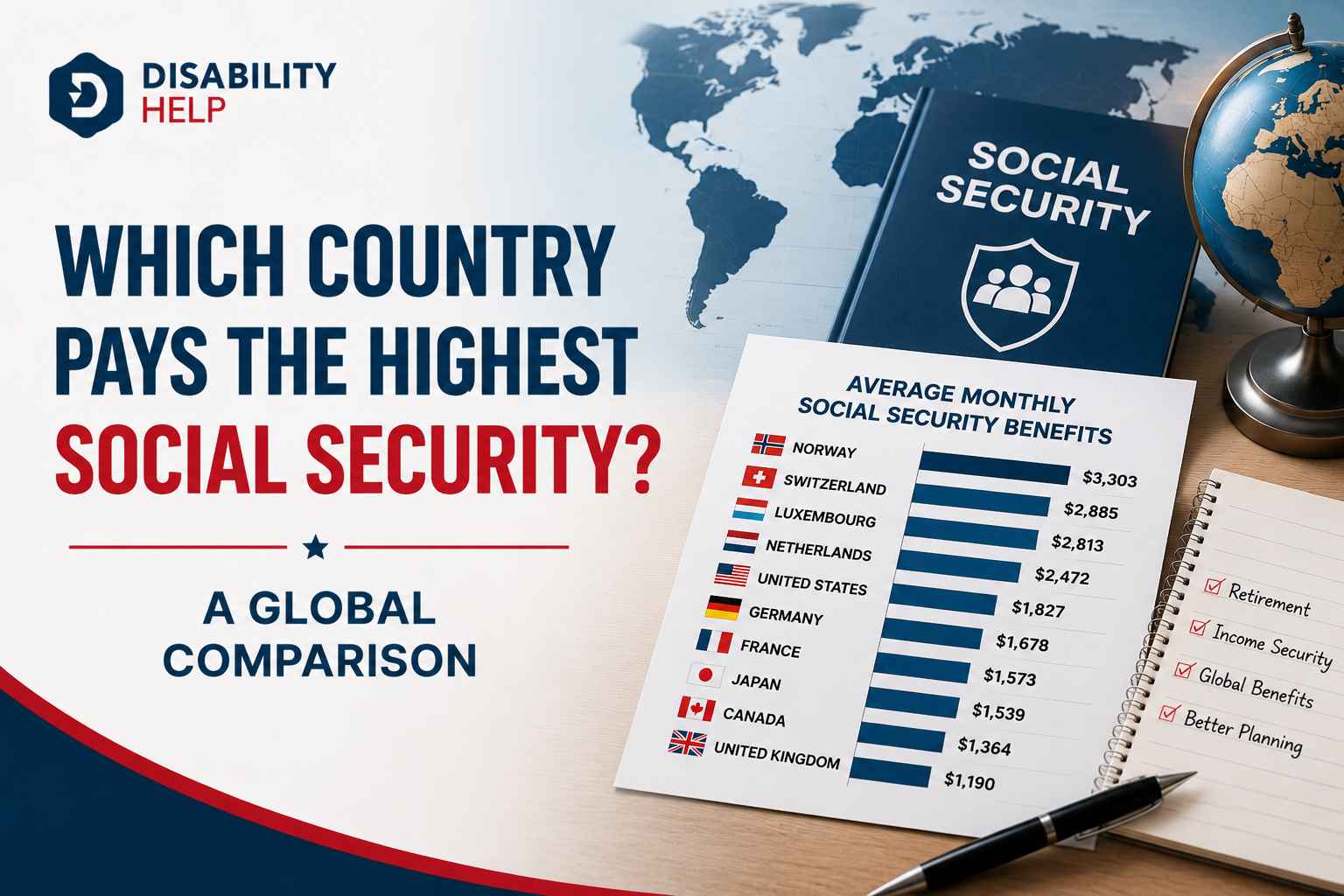
There is no single answer to which country pays the highest social security, because “highest” depends on how you measure it. By income replacement, the Netherlands leads, replacing 96% of an average worker’s net pay in retirement. By cash value, Luxembourg pays the most, averaging €34,413 per retiree each year. By overall system quality, the Netherlands, Iceland, and Denmark rank first.
That gap between metrics is the whole story. A country can send a large monthly check and still replace only a small share of your old salary, or replace nearly all of it on a modest amount. This guide ranks the highest-paying systems three ways, using 2025 OECD and Mercer data, and shows where the United States lands.
Key Takeaways
- No single winner: The answer to which country pays the highest social security shifts depending on whether you measure replacement rate, cash value, or system quality.
- Highest replacement rate: The Netherlands replaces 96% of an average worker’s net income in retirement, far above the OECD average of 63.2%.
- Highest cash payout: Luxembourg pays the most in absolute terms, averaging €34,413 per retiree each year, exactly double the EU average of €17,327.
- Best overall systems: The Netherlands, Iceland, and Denmark top the 2025 Mercer CFA Institute Global Pension Index for balancing generosity with sustainability.
- High benefits, high cost: Generous systems charge steep contributions; Austria takes 22.80% of gross pay, and Luxembourg 24% during working years.
- Where the US lands: The United States ranks 30th of 52 systems, with an average monthly SSDI benefit of $1,630 in 2026.
So Which Country Actually Pays the Most?
The Netherlands pays the most relative to prior income, replacing 96% of an average worker’s net wage. Luxembourg pays the most in raw cash, at €34,413 per year. For the strongest all-around system, the Netherlands, Iceland, and Denmark share the top tier. Your “winner” depends on which of those three questions matters to you.
These are not small differences. A Dutch retiree keeps almost the same standard of living they had while working, thanks to a flat-rate state pension plus mandatory workplace pensions. A Luxembourg retiree may not replace as high a percentage of pay, yet receives more euros because national wages and contribution rates are higher. Knowing which measure you care about is the first step to reading any pension ranking correctly.
What “Highest” Means: Replacement Rate vs. Absolute Value
“Highest social security” has three common definitions, and each produces a different leader. Economists most often compare replacement rates and absolute monetary amounts, then add a quality measure to weigh whether a system can keep paying.
Replacement rate is the share of your pre-retirement income that your pension replaces. The net replacement rate counts taxes and social contributions, so it reflects real take-home retirement income; the gross rate does not. Across the OECD, the net replacement rate for an average earner is 63.2% from mandatory schemes.
Absolute benefit amount is the actual money paid, in euros or dollars. This favors wealthy economies with high wages, since a 70% replacement rate on a high salary still beats a 96% rate on a low one. System quality measures whether benefits are adequate, sustainable, and well governed, which is what the Mercer CFA Institute index scores.
Which Countries Have the Highest Replacement Rates?
The Netherlands tops the replacement-rate ranking at 96% net, with Türkiye, Portugal, Greece, Luxembourg, Austria, and Spain all above 85%. That places every one of these countries more than 20 points above the OECD average, according to the OECD’s Pensions at a Glance 2025 report.
| Country | Net Replacement Rate | Gross Replacement Rate | System Type |
|---|---|---|---|
| Netherlands | 96.0% | 74.7% | Flat-rate + mandatory occupational |
| Türkiye | 94.4% | 69.1% | Earnings-related |
| Portugal | 92.7% | 72.4% | Earnings-related |
| Greece | 88.5% | 79.6% | Earnings-related |
| Luxembourg | 87.7% | 75.6% | Pay-as-you-go |
| Austria | 86.8% | 74.1% | Pay-as-you-go |
| Spain | 86.3% | 80.4% | Earnings-related |
Data source: OECD Pensions at a Glance 2025.
The Dutch result comes from two layers working together. A flat-rate state pension called the AOW provides a base, and mandatory occupational pensions, which cover almost every worker, stack on top. That combination is why an average Dutch worker can expect to retain nearly all of their working income after they stop working.
Which Countries Pay the Most in Cash?
Luxembourg pays the highest absolute pensions in the world. The average old-age pension there was €34,413 per beneficiary in 2023, according to Eurostat, exactly double the European Union average of €17,327. High national wages and a generous accrual formula drive that figure.
Austria follows closely and uses an unusual structure: pensions are paid 14 times a year, not 12. The average gross old-age pension for men is roughly €2,620 per month, which totals more than €36,000 annually. Women average about €1,563 per month, a gap that traces back to lower historical wages and shorter contribution records.
The Netherlands again ranks near the top on cash, even though its state pension alone is modest. The AOW pays a single retiree about €1,527.63 net per month plus a holiday allowance. Add the mandatory occupational pension that most Dutch workers carry, and total retirement income places Dutch retirees among the wealthiest in Europe.
Which Countries Have the Best Overall Pension Systems?
Generosity means little if a system runs out of money. The Mercer CFA Institute Global Pension Index 2025 scored 52 retirement systems, covering 65% of the world’s population, on adequacy, sustainability, and integrity. Five countries earned the top “A” grade in 2025, with Singapore becoming the first Asian system to reach it.
| Rank | Country | Index Score | Grade |
|---|---|---|---|
| 1 | Netherlands | 85.4 | A |
| 2 | Iceland | 84.0 | A |
| 3 | Denmark | 82.3 | A |
| 4 | Israel | A grade | A |
| 5 | Singapore | 80.0 | A (first in Asia) |
Data source: Mercer CFA Institute Global Pension Index 2025.
The top three repeat their 2024 placements. The Netherlands holds first even while it shifts from a collective benefit model to individual defined-contribution accounts, because its asset base and regulation stayed strong through the change. Iceland posted the highest sustainability score, and Finland led on integrity. No system scored below a D grade in 2025.
What Generous Benefits Cost Workers
High pensions are funded by high contributions during working years. In Austria, the total pension contribution is 22.80% of gross earnings, split between employees at 10.25% and employers at 12.55%. Luxembourg requires 24%, divided evenly three ways among the worker, the employer, and the government at 8% each.
These rates face pressure from aging populations. The OECD projects that Luxembourg’s number of pensioners will more than triple by 2070, while its effective retirement age sits near 60, among the lowest in the OECD. Holding benefits at today’s levels will likely require later retirement, higher contributions, or both. When you compare countries, weigh these five factors together rather than reading any one number alone:
- Replacement rate: how much of your old salary the pension restores, which signals lifestyle continuity.
- Absolute amount: the actual cash paid, which determines purchasing power regardless of percentage.
- Contribution rate: how much workers and employers pay in, which is the price of the benefit.
- Retirement age: when payments begin, since an early start raises lifetime cost and strains funding.
- Sustainability: whether the system can keep paying as the population ages and birth rates fall.
Where Does the United States Rank?
The United States ranks 30th of 52 systems on the 2025 Mercer index, with a score of 61.1 and a C+ grade. American Social Security replaces a smaller share of pre-retirement income than the European leaders, generally around 40% for an average earner, well below the Dutch 96%.
On absolute amounts, US benefits sit in the middle of the pack. The average monthly SSDI benefit is near $1,630 in 2026, while the maximum reaches $4,152 for workers with the highest lifetime earnings. Payments rose 2.8% in 2026 through the annual cost-of-living adjustment.
One reason US figures can confuse readers: “Social Security” in the United States covers retirement, survivors, and disability benefits under one agencyThe capacity of individuals with disabilities to act independently and make their own choices., paid from payroll taxes. That structure differs from the multi-pillar European systems that combine a state pension with mandatory workplace savings.
Expert Insight: Why the Top Systems Stay on Top
Analysts who score these systems point to design, not just spending. The Mercer CFA Institute report describes A-grade countries as those whose systems deliver “good benefits, are sustainable and have a high level of integrity.”
Tim Jenkins, a Partner at Mercer and lead author of the 2025 index, noted that systems with few investment restrictions tend to score higher, and that governments do better by promoting transparency and sound governance than by imposing mandates. The lesson for readers comparing countries: a high payout today is only as good as the system’s ability to keep paying it for decades.
What the Global Pension Rankings Really Show
Which country pays the highest social security comes down to your yardstick. The Netherlands wins on replacement rate at 96%, Luxembourg wins on cash at €34,413 a year, and the Netherlands, Iceland, and Denmark win on overall quality. The common thread among all of them is a public pension paired with mandatory workplace savings, funded by high contributions during working years.
As of 2026, the United States sits in the middle on most measures, which makes understanding your own benefits more valuable than chasing a global ranking. If you are figuring out what you qualify for, start with the difference between SSDI and SSI and work from there.
Frequently Asked Questions
Which country has the best pension system in the world?
The Netherlands has the best-rated pension system, with a top score of 85.4 on the 2025 Mercer CFA Institute Global Pension Index. Iceland and Denmark follow. These systems combine a strong state pension with mandatory workplace savings, which produces high benefits that remain financially sustainable.
Does the US pay one of the highest social security benefits?
No. The United States ranks 30th of 52 systems on the 2025 Mercer index with a C+ grade. US Social Security replaces roughly 40% of an average worker’s income, compared with 96% in the Netherlands. Average monthly SSDI is near $1,630 in 2026, a mid-range absolute amount globally.
What is a good pension replacement rate?
Financial planners often target a replacement rate of 70% or higher to maintain your standard of living in retirement. The OECD average is 63.2% net for an average earner. Countries like the Netherlands, Portugal, and Austria exceed 85%, while the United States falls below the OECD average.
Why does Luxembourg pay such high pensions?
Luxembourg pays the highest cash pensions, averaging €34,413 per year, because of high national wages and a generous accrual formula. Workers, employers, and the government each contribute 8%, for a 24% total. The trade-off is long-term strain, since the pensioner count is projected to more than triple by 2070.
Which country pays the highest social security to retirees in cash?
Luxembourg pays the highest absolute social security, at an average €34,413 per beneficiary in 2023, double the EU average. Austria ranks next, paying men an average over €36,000 per year across 14 monthly installments. The Netherlands also ranks high once mandatory workplace pensions are added to the state pension.