Schools fight IEPs mainly because of money, not malice. Special education is expensive, and the federal government covers less than 13% of the extra cost despite a 50-year promise to pay 40%, according to the Congressional Research Service. That funding gap, combined with severe staffing shortages, pushes some districts to delay, limit, or deny services even when your child clearly qualifies. The good news: the law is on your side, and you have specific tools to fight back.
This guide explains the budget pressures, staffing gaps, and legal fears that drive school pushback, then walks you through the documentation and dispute steps that actually move a district.
Key Takeaways
- Funding drives resistance: Federal IDEA funding sits below 13% of special education's extra cost, far under the 40% Congress promised in 1975.
- Staffing shortages limit services: 45 states reported special educationCustomized educational programs designed to meet the needs of students with disabilities. teacher shortages in 2024-25, so districts often shrink an IEP to match staff they actually have.
- Disputes are rising fast: Written state complaints jumped 22% in 2023-24 to 9,927 filings, a 79% rise over the prior 10-year average.
- FAPE is not optional: Courts have ruled that staff shortages and tight budgets are not legal excuses for failing to provide a free appropriate public education.
- Documentation wins cases: Written records, independent evaluations, and measurable goals are the tools that force a district to deliver promised services.
- Most disputes settle early: In 2022-23, roughly 73.8% of due processThe legal requirement that the state must respect all legal rights owed to a person, including fair ... complaints were resolved without a hearing, often through mediation or facilitated IEP meetings.
How Big and How Expensive Is Special Education?
Special education now serves about 8.2 million students ages 3 to 21, roughly 15.9% of all public school students in 2023-24. The number of IDEA-eligible students rose 3.8% in a single year, adding 301,991 students, according to a Council for Exceptional Children analysis of federal data. More students mean more cost, and that cost is where resistance starts.
Services such as speech therapy, occupational therapy, specialized transportation, and one-on-one paraprofessionals carry real price tags. The federal fiscal 2025 budget estimated that fully funding IDEA would cost about $46.3 billion, leaving a gap of roughly $31 billion between what schools receive and what full funding would provide. The Congressional Research Service pegged the nationwide IDEA shortfall at $23.92 billion in a recent school year. Districts cover that gap from their own budgets, which sets up the conflict you feel in IEP meetings.
The makeup of disabilities also shapes the fight. Specific learning disabilities, including dyslexiaA learning disorder characterized by difficulty reading due to problems identifying speech sounds an..., account for the largest share of students. Speech or language impairments, chronic health problems, and autism follow. Milder or harder-to-measure conditions invite more disagreement, because eligibility and the right level of support are easier for a district to dispute.
What Are the Real Reasons Schools Push Back on IEPs?
School resistance usually traces to four systemic pressures: tight budgets, staffing shortages, fear of legal precedentA principle or rule established in previous legal cases that is binding or persuasive in subsequent ..., and disputes over whether a child's needs are real. Understanding which one you are facing tells you how to respond. Here is what sits behind the pushback, with the data that explains each driver.
Budget Constraints and Funding Gaps
Money is the most common reason a district limits an IEP. Because federal funding covers less than 13% of special education's extra cost, the rest falls on state and local budgets that are often already stretched. The National Education Association notes that this shortfall passes costs to states and localities and shortchanges services for every student. When your child needs a high-cost service, like a dedicated behavioral aide or a residential placement, the budget pressure intensifies.
Some state funding formulas add a strange twist. When a state pays a flat per-child premium for special education, a district can have an incentive to identify more students with mild needs while resisting the small number of students who need intensive, expensive support. The result you experience: easy approval for low-cost accommodationsModifications or adjustments in healthcare settings to support patients with disabilities., hard resistance for the services that cost real money.
Staffing Shortages and Capacity Limits
A district cannot deliver a service it has no one to provide. In 2024-25, 45 states reported special education teacher shortages, and 48 states plus Washington, D.C. employed 365,967 teachers who were not fully certified for their assignments, per the Learning Policy Institute. Special education was the single most common shortage area nationwide.
Staffing gaps explain a pattern many parents notice. When speech pathologists, behavior specialists, or special education teachers are missing, administrators may propose vague accommodations or push for general education placement without real support, because the staff for a stronger IEP simply are not there. A 2024 Government Accountability Office review found that some students with disabilities had services delayed or skipped because of these shortages, with districts sometimes relying on unqualified staff.
Fear of Setting a Costly Precedent
Administrators think about the next meeting, not just yours. Granting an expensive service to one child can prompt fear that other families will request the same support, raising caseloads and locking in future costs. That worry pushes some districts into a defensive posture during negotiations, even when the evidence supports your child's need. It is not personal. It is a budget calculation playing out in your meeting.
Disputes Over Invisible Disabilities
Schools sometimes lean on classroom observation to argue a child is “doing fine” and does not need an IEP. This happens most with invisible disabilities such as high-functioning autism, ADHD, and certain learning differences. A child can earn passing grades while struggling badly with executive function, emotional regulation, or sensory processing. Because the struggle does not show up as failing marks, a district may argue that a less formal Section 504A provision of the Rehabilitation Act of 1973 that prohibits discrimination based on disability in p... plan is enough, which costs the school far less than specialized instruction.
IEP vs. 504 Plan: Why the Difference Fuels Pushback
Districts often steer families toward a 504 plan instead of an IEP because a 504 plan requires fewer resources and carries lighter procedural duties. Both protect your child, but they come from different laws and deliver different things. The table below shows why a school might prefer the cheaper option, and what you give up if you accept it without a fight.
| Feature | IEP (under IDEA) | 504 Plan (under Section 504) |
|---|---|---|
| Governing law | Individuals with Disabilities Education Act | Section 504 of the Rehabilitation Act of 1973A U.S. law that prohibits discrimination based on disability in federal programs and services, inclu... |
| What it provides | Specialized instruction plus related services and accommodations | Accommodations to access general education, no specialized instruction |
| Eligibility test | One of 13 disability categories that requires special education | Any disability that limits a major life activity |
| Cost to the district | Higher: staff, therapy, progress monitoring | Lower: mostly accommodations |
| Written goals | Required, measurable annual goals | Not required |
| Procedural safeguards | Extensive: evaluations, consent, due process | Fewer formal requirements |
If your child needs specialized instruction to make progress, an IEP is the correct tool, and a 504 plan is not a substitute. You can read more about the federal framework behind these plans in our explainer on the federal law that governs IEPs.
How Do You Fight Back When a School Resists an IEP?
You fight school resistance with documentation, independent evidence, measurable goals, and the dispute tools IDEA gives you, in that order. Most disputes never reach a hearing, so the goal is to build a record strong enough that the district chooses to settle. Follow these five steps.
- Document every interaction in writing. After any phone call or meeting, send an email summarizing what was said and agreed. A written trail is what holds up if the dispute escalates to mediation or a due process hearing, and it removes the “that never happened” defense.
- Request an Independent Educational Evaluation (IEE). If the school's assessment minimizes your child's needs, you have the right to an IEE at public expense. An outside expert's findings give you objective data to counter the district's classroom observations.
- Insist on measurable goals. Vague goals let a school claim success without delivering real help. Push for data-driven goals with specific benchmarks, so progress can be proven or disproven with numbers, not opinions.
- Use early dispute resolution before litigation. Facilitated IEP meetings and state-sponsored mediation are free or low-cost and often work. In 2022-23, about 73.8% of due process complaints were resolved without a hearing, many through mediation.
- Escalate to a written state complaint or due process if needed. A written state complaint triggers a state investigation, and a due process complaint sends your case to an impartial hearing officer. These are the formal tools that force compliance when negotiation fails.
Key Special Education Terms You Need to Know
A few terms come up in every IEP dispute. Knowing them lets you hold a district to the standard the law sets, instead of the standard the school finds convenient.
- IDEA: The Individuals with Disabilities Education Act, the 1975 federal law that guarantees a free appropriate public education to eligible children with disabilities ages 3 to 21.
- FAPE: Free Appropriate Public Education. Specially designed instruction is provided at no cost that meets your child's individual needs. This is the core promise a district cannot legally skip.
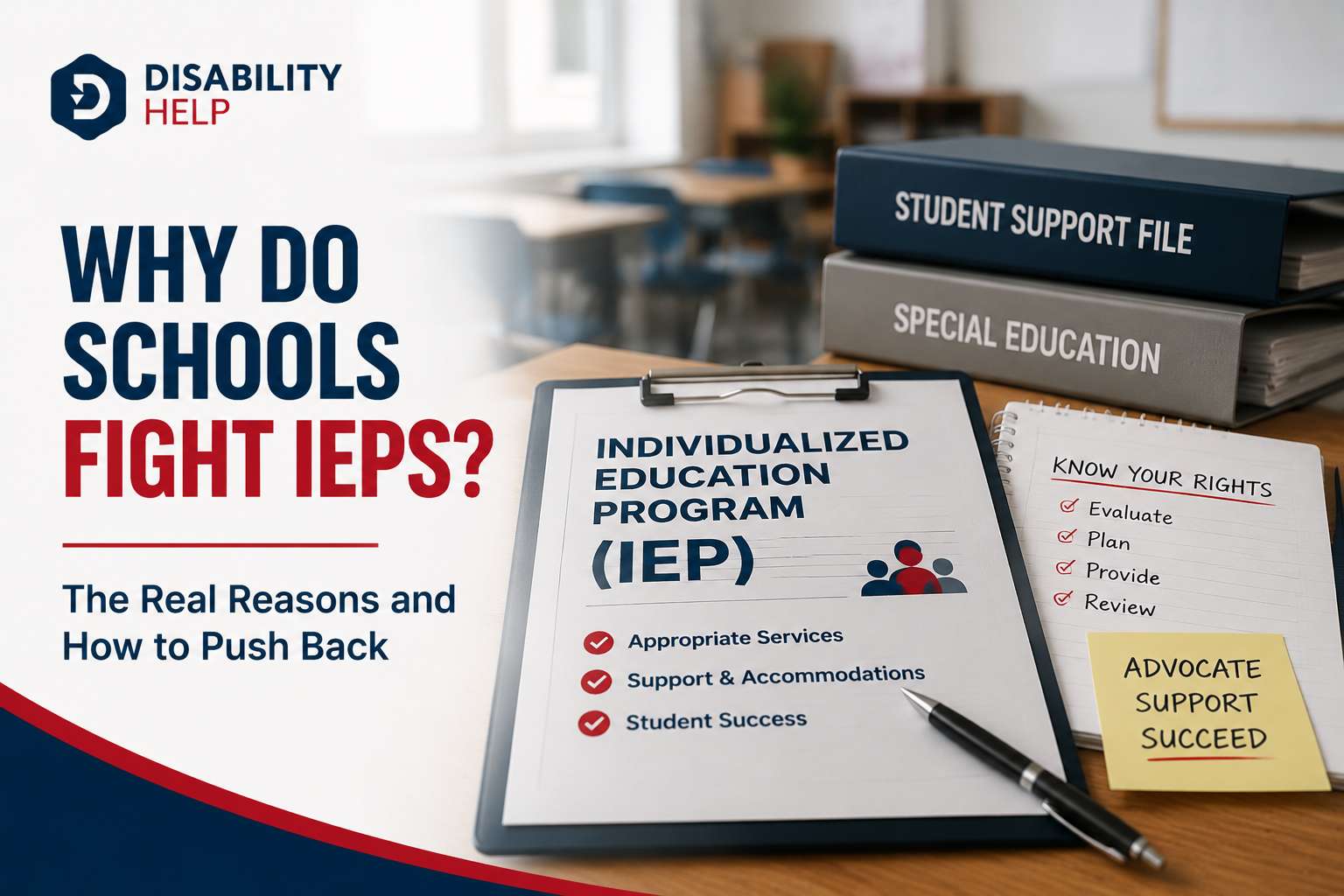
- IEP: Individualized Education Program. The legally binding document that lists your child's needs, measurable goals, and the specific services the school must provide.
- LRE: Least Restrictive Environment. The rule that students learn alongside non-disabled peers whenever appropriate, with supports in place.
- IEE: Independent Educational Evaluation. An outside assessment you can request at public expense when you disagree with the school's evaluation.
- Due process hearing: A quasi-judicial proceeding where an impartial officer reviews evidence and issues a binding decision in a special education dispute.
What Does the Law Say When Schools Cite Money or Staffing?
The law is blunt on this point: budget and staffing problems are not legal defenses for denying FAPE. Federal courts established that principle decades ago and continue to apply it. In the 1972 cases P.A.R.C. v. Pennsylvania and Mills v. Board of Education, courts ruled that schools could not use insufficient funds as an excuse to deny children with disabilities a public education. That holding still governs your IEP meeting today.
Recent rulings reinforce it. In a 2024 Pennsylvania case, an autistic student did not receive the services listed on the IEP because of staff shortages, and the court ruled that staffing problems were not an excuse for failing to provide FAPE. AdvocacyThe act of arguing in favor of, supporting, or defending the rights and interests of individuals or ... experts see the same structural problem nationwide. As Candace Cortiella, founder and director of The Advocacy Institute, has noted, the special education population is growing faster than at any point in decades, adding pressure that districts are not funded to absorb.
Families are responding by filing more formal disputes. Written state complaints rose 22% in 2023-24 to 9,927 filings, a 79% jump over the prior decade's average, according to a K-12 Dive report on data from the Center for Appropriate Dispute Resolution in Special Education. When teachers and even districts themselves begin filing complaints, the problem is structural, not a matter of individual families being difficult.
Which IEP Issues End Up in Formal Disputes?
When parents and schools reach an impasse, the disagreements cluster around a few predictable issues. A review of more than 200 recent due process cases in New Jersey shows where the conflict concentrates, and it maps almost perfectly onto the systemic pressures above.
| Primary Issue in Due Process | Share of Cases |
|---|---|
| Reimbursement, compensatory education, or private placement | Highest |
| Denial of Free Appropriate Public Education (FAPE) | Very high |
| Inappropriate IEP or failure to provide required supports | High |
| Least Restrictive Environment or placement dispute | Moderate |
| Procedural violations | Moderate |
The pattern is clear. Disputes overwhelmingly center on whether the child is receiving FAPE, whether the services are appropriate, and who pays for private placement when a public school falls short. Those are funding and capacity questions in legal clothing.
Turning School Resistance Into Services for Your Child
School resistance to IEPs is rarely about malice. It grows from chronic underfunding, a special education teacher shortage that 45 states reported in 2024-25, and a fear of setting costly precedents. None of those pressures change the core mandate: every eligible child is entitled to a free appropriate public education built around individual needs.
As of 2026, families are pushing back harder and winning more, with formal complaints up sharply and courts holding firm that money and staffing are not excuses. Your strongest move is preparation. Document everything, secure independent evaluations, demand measurable goals, and use the dispute tools the law provides.
If your child's disability may also shape future eligibility for benefits, start connecting the medical and school record now using our guide to qualifying conditions, so the evidence you build today protects your child well beyond the classroom.
Frequently Asked Questions
Why would a school deny an IEP if my child clearly needs one?
Most denials trace to cost and capacity, not your child's actual need. Because federal IDEA funding covers less than 13% of special education's extra cost, districts absorb the rest from local budgets. When staff are short, a school may also limit an IEP to match the people it has rather than what your child requires.
Can a school legally refuse services because of budget or staffing?
No. Federal courts have ruled since 1972 that insufficient funds are not a lawful excuse to deny a free appropriate public education, and a 2024 Pennsylvania ruling held that staff shortages do not excuse failing to deliver IEP services. Budget pressure is real, but it does not erase your child's legal right to FAPE.
What is the difference between an IEP and a 504 plan?
An IEP under IDEA provides specialized instruction plus related services and measurable goals. A 504 plan under Section 504 provides accommodations to access general education but no specialized instruction. Schools sometimes steer families toward a 504 plan because it costs less and carries lighter procedural duties.
How do I prove my child needs more than the school is offering?
Build objective evidence. Request an Independent Educational Evaluation at public expense, document every communication in writing, and insist on measurable, data-driven goals. Outside expert findings and a written record are what counter a district's subjective claim that your child is doing fine.
What happens if mediation does not resolve the dispute?
You can file a written state complaint, which triggers a state investigation, or a due process complaint, which sends your case to an impartial hearing officer for a binding decision. Most disputes still settle before a hearing, but these formal tools exist to force compliance when negotiation fails.