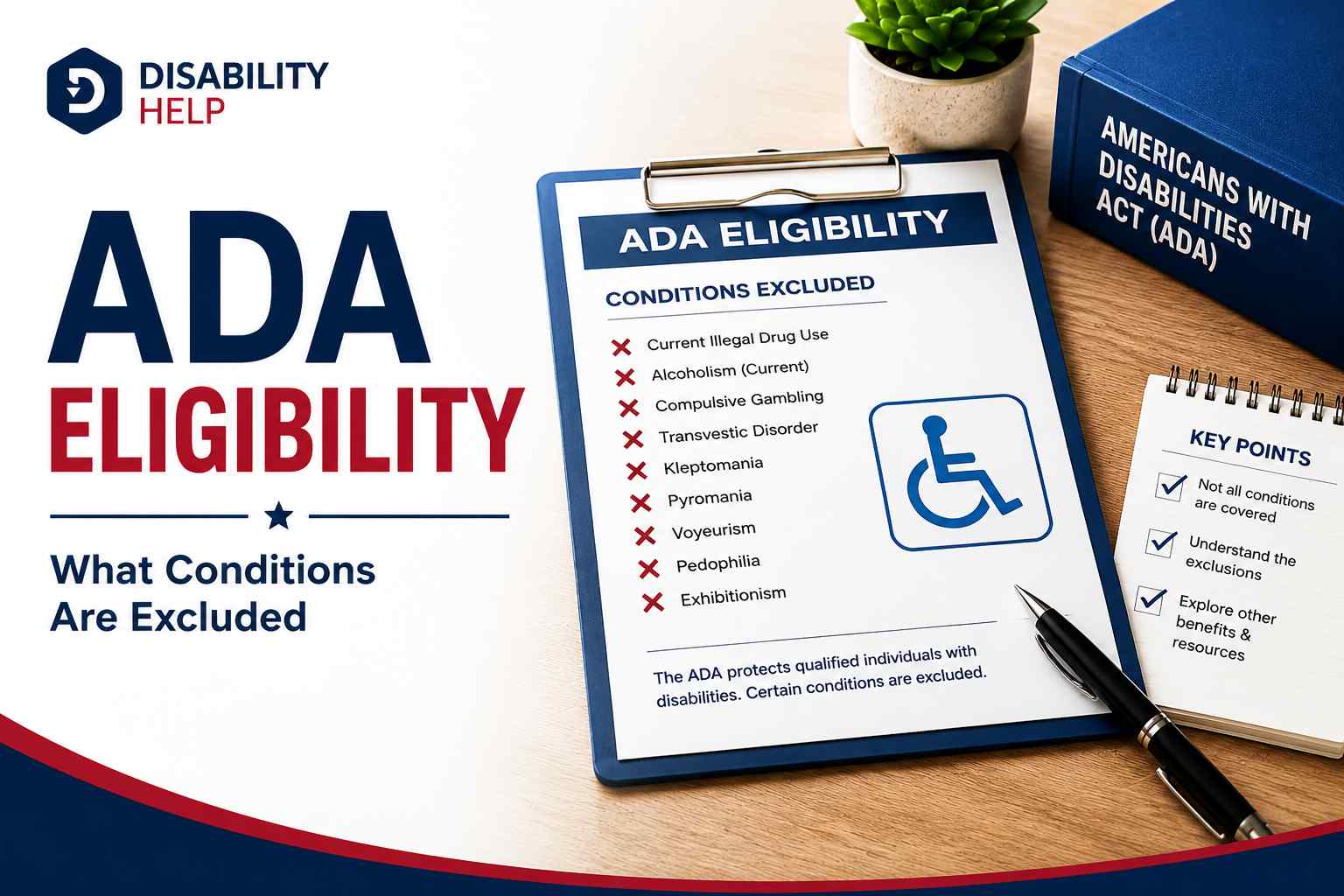
The Americans with Disabilities Act protects people with physical and mental impairments that substantially limit a major life activity, but it does not cover every health issue, behavior, or personal trait. Conditions not considered a disability under the ADA include sexual behavior disorders, current illegal drug use, compulsive gambling, kleptomania, pyromania, ordinary personality traits, and impairments that are both transitory and minor, such as a common cold or a sprained wrist.
In fiscal year 2025, the EEOC reported 88,201 new discrimination charges, a 9.2% increase, and resolved 90,743 charges, a 4% increase in resolutions over FY 2024. In FY 2024, the agencyThe capacity of individuals with disabilities to act independently and make their own choices. received 88,531 new charges, a 9.2% increase from FY 2023. Knowing where ADA coverage ends matters just as much as knowing where it begins, especially if you are preparing an accommodation requestA formal request made by an employee with a disability for reasonable adjustments to their work envi... or responding to one.
This guide walks you through every category the law excludes and the exceptions that turn an apparent exclusion into a protected condition.
Key Takeaways
- Statutory exclusions are explicit: Under 42 U.S.C. § 12211, the ADA excludes compulsive gambling, kleptomania, pyromania, current illegal drug use, and several sexual behavior disorders.
- Transitory and minor impairments are excluded: Conditions lasting six months or less AND objectively minor (colds, flu, simple sprains) fall outside the ADA's protections.
- Normal traits are not disabilities: Height, weight, eye color, left-handedness, and ordinary personality traits like a quick temper do not qualify as ADA impairments.
- Current illegal drug use is excluded, but recovery is protected: Workers in supervised treatment or taking prescribed medications such as buprenorphine retain ADA protection.
- Mitigating measures do not erase coverage: A condition controlled by medication, like epilepsyA neurological disorder marked by recurring seizures. or diabetesA chronic condition where the body cannot produce or properly use insulin, leading to high blood sug..., is still a disability under the 2008 ADA Amendments Act.
- Gender dysphoria may now qualify: The Fourth Circuit's ruling in Williams v. Kincaid distinguished gender dysphoria from older statutory exclusions, opening the door to ADA protection.
How the ADA Defines a Disability (and Why the Definition Drives Every Exclusion)
A person has a disability under the ADA if they have a physical or mental impairmentA loss or abnormality of a body structure or function, whether physical, mental, or sensory, often a... that substantially limits one or more major life activities, a record of such an impairment, or are regarded as having such an impairment. Everything the law excludes flows from that definition. If a condition does not fit one of the three prongs, the ADA does not apply.
Congress broadened the definition in 2008 with the ADA Amendments Act. The EEOC's final rule implementing the ADAAA instructs courts to focus on whether discrimination occurred, not on whether the impairment is severe enough to qualify. The phrase "substantially limits" is not meant to be demanding, and impairments that are episodic or in remission still count if they would limit a major life activity when active.
Three categories sit outside that broad reach: conditions Congress wrote out of the statute by name, conditions that are too brief and too mild to count, and traits that are not impairments in the first place. Each category has its own rules, and each has exceptions you need to understand if you are weighing whether to request an accommodationAdjustments or modifications provided to individuals with disabilities to ensure equal access and pa... or to challenge a denial.
For a side-by-side look at conditions that do qualify, see our companion guide on what qualifies as an ADA disability.
Conditions the ADA Excludes by Statute
Federal law itself names several conditions and behaviors that are not disabilities, regardless of how severe they appear or how much they limit daily life. The exclusions sit in 42 U.S.C. § 12211, and they are not subject to interpretation by employers or courts. If a condition is on that list, the ADA does not protect it.
Sexual behavior disorders and identity-related exclusions
The statute carves out transvestism, transsexualism, pedophilia, exhibitionism, voyeurism, gender identity disorders not resulting from physical impairments, and other sexual behavior disorders. It also states that homosexuality and bisexuality are not impairments and therefore not disabilities under the ADA.
Recent case law has narrowed one of those categories. In Williams v. Kincaid, the Fourth Circuit held that gender dysphoria, which involves clinically significant distress from incongruence between sex assigned at birth and gender identity, is medically distinct from the older statutory term "gender identity disorders." The court allowed an ADA claim to proceed, and other jurisdictions are watching the issue closely.
Compulsive behaviors
Compulsive gambling, kleptomania, and pyromania are listed in the statute and not protected as disabilities. Employers can take action based on theft, arson, or workplace gambling without engaging in the ADA's interactive accommodation process.
Current illegal drug use
Psychoactive substance use disorders resulting from current illegal use of drugs are excluded. The EEOC defines "current" as use recent enough to justify a reasonable belief that the drug use is ongoing. An employer that fires or refuses to hire someone for current illegal drug use is not violating the ADA.
The exclusion is narrow on purpose. Workers who have completed a supervised rehabilitationThe process of helping individuals with disabilities achieve and maintain their optimal physical, se... program, who are participating in one and no longer using illegally, or who are taking legally prescribed medications for opioid use disorder, including methadone or buprenorphine, are protected under the ADA. The Department of Justice's guidance on opioid use disorder lays out the line between excluded use and protected recovery.
The "Transitory and Minor" Exception: When Short-Term Conditions Fall Outside ADA Protection
An impairment is not a disability under the "regarded as" prong if it is BOTH transitory AND minor. Transitory means lasting or expected to last six months or less. Minor is not defined in the statute, so courts decide it case by case, looking at severity, treatment required, surgical interventionMedical treatment involving an operation to correct or treat a health condition., and post-operative care.
Both qualifiers must apply. An impairment that is short but severe still counts. The Fourth Circuit confirmed this in Summers v. Altarum Institute, where a worker who fractured his leg in multiple places and could not walk for several months had ADA protection because the injury, though transitory, was not minor.
Examples that typically meet both prongs and therefore fall outside ADA coverage include:
- Common colds, seasonal flu, and stomach bugs
- Minor sprains, strains, and bruises
- Simple fractures that heal within the expected timeframe
- Appendicitis and other minor surgeries with quick, uncomplicated recovery
- Mild seasonal allergies
Complications can move a condition from excluded to protected. If a broken leg heals poorly and leaves a permanent limp, or COVID-19 recovery extends past six months with lasting symptoms, the impairment may meet the actual-disability standard. The ADA National Network's brief on the "regarded as" prong walks through how courts apply the two-part test.
Physical Traits, Personality Traits, and Lifestyle Factors That Are Not Disabilities
The ADA covers impairments, not characteristics. A characteristic is a normal variation of human appearance, temperament, or circumstance. The law treats these as outside its scope, even when they cause real-world disadvantage.
Normal physical characteristics
Eye color, hair color, left-handedness, and height or weight within the normal range are not disabilities. Normal pregnancy is also excluded, though pregnancy-related medical complications like preeclampsia or hyperemesis gravidarum may qualify because they involve a physiological disorder. Severe obesity tied to an underlying physiological condition can qualify; weight alone without a medical cause cannot.
Personality traits and behavioral patterns
The EEOC's enforcement guidance on psychiatric disabilities is direct on this point. Irritability, chronic lateness, poor judgment, and a quick temper are not, by themselves, mental impairments. Stress is also not an impairment, although stress can be a symptom of an underlying condition that is covered.
The distinction matters at work. If an employee shows up late repeatedly and gives no medical reason, the employer can apply attendance policies the same way it applies them to anyone else. If the lateness is a documented symptom of a diagnosed mental health condition like major depressive disorder, the employer must consider reasonable accommodation, though conduct rules that are job-related and consistent with business necessity still apply.
Socioeconomic and cultural factors
Lack of education, cultural disadvantage, economic disadvantage, and old age are not disabilities under the ADA. Aging itself is not an impairment. Medical conditions associated with aging, like arthritisInflammation of the joints, leading to pain, stiffness, and limited movement., hearing lossPartial or total inability to hear sounds in one or both ears., or vision loss, may qualify, but the calendar alone does not trigger coverage.
What the ADA Covers vs. What It Excludes: A Side-by-Side Comparison
The following comparison shows how similar-sounding conditions can land on opposite sides of the ADA's coverage line. The deciding factor is almost always whether a physiological or psychological disorder is present, and how it affects major life activities.
| Category | Generally Covered by the ADA | Generally NOT Covered by the ADA |
|---|---|---|
| Physical conditions | Diabetes, epilepsy, cancer (including in remission), MS, severe arthritis | Common cold, mild seasonal allergies, simple sprains, normal pregnancy |
| Mental health | Major depressive disorder, bipolar disorderA mental health condition characterized by extreme mood swings, including manic and depressive episo..., PTSD, schizophreniaA severe mental health disorder characterized by delusions, hallucinations, and disorganized thinkin..., severe anxiety | Ordinary stress, irritability, poor judgment, a quick temper |
| Duration | Episodic or in-remission conditions that limit life activities when active | Impairments that are both transitory (6 months or less) AND minor |
| Substance use | Recovery from substance use disorder, treatment with prescribed MOUD | Current illegal use of drugs |
| Physical traits | Severe obesity linked to an underlying physiological disorder | Eye color, hair color, left-handedness, height/weight in normal range |
| Compulsions | OCD when it substantially limits major life activities | Compulsive gambling, kleptomania, pyromania (statutory exclusion) |
| Life circumstances | Diagnosed medical or psychological conditions associated with aging | Old age itself, poverty, lack of education, and cultural disadvantage |
Drug Use, Recovery, and the Line Between Excluded and Protected
The ADA's treatment of substance use is one of the most misunderstood parts of the law. People assume any substance use disorder is excluded. That is not how the statute works.
Current illegal use of drugs is excluded. Anything else may be protected. A worker in a supervised rehabilitation program who is no longer using illegally is covered. A worker taking buprenorphine, methadone, or naltrexone under a licensed clinician's supervision is covered, even if those medications appear on a drug test, because legally prescribed use is not illegal use. Alcohol use disorder is treated differently because alcohol is legal; employers can prohibit on-the-job intoxication, but the underlying disorder may qualify for ADA protection.
The exclusion has a time element. "Current" means recent enough to support a reasonable belief that drug use is ongoing. There is no fixed number of weeks. An employer who relies on a month-old positive drug test to refuse hire is on shakier ground than one acting on a test from this week.
6 Common Misconceptions About Conditions Not Covered by the ADA
Most disputes over ADA coverage start with a misunderstanding. The following six errors come up repeatedly in EEOC charges, employer policies, and accommodation denials.
- "Temporary impairments are never covered." False. A temporary impairment is excluded only if it is also minor. A severe broken leg that limits walking for several months qualifies as an actual disability, as the Fourth Circuit held in Summers v. Altarum Institute.
- "If medication controls the symptoms, the condition does not qualify." False. The ADAAA explicitly bars consideration of mitigating measures, with one exception for ordinary eyeglasses. An employee with controlled epilepsy or insulin-managed diabetes is still protected.
- "Mental health conditions are too subjective for ADA coverage." False. Diagnosed mental health conditions, including depressionA mental health condition marked by persistent feelings of sadness and loss of interest., PTSD, bipolar disorder, and schizophrenia, are covered when they substantially limit a major life activity. Ordinary personality traits are not.
- "Past drug use disqualifies a worker forever." False. Once a worker is no longer engaging in current illegal use and is in or has completed treatment, the ADA protects them from discrimination based on their history of addiction.
- "Pregnancy is automatically covered." False. Normal pregnancy is not a disability under the ADA. Pregnancy-related complications like gestational diabetes, preeclampsia, or hyperemesis gravidarum may qualify because they involve physiological disorders.
- "A condition that does not appear on the ADA's list is not protected." False. There is no master list. The ADA defines disability by function, not by diagnosis. Any condition that substantially limits a major life activity may qualify, even if you have never seen it named anywhere.
Important Nuances: Mitigating Measures, Episodic Conditions, and Gender Dysphoria
Three areas of ADA law have shifted significantly since the original 1990 statute, and they routinely flip what looks like an exclusion into protection.
Mitigating measures cannot defeat coverage
Before 2008, courts often denied ADA claims by pointing to medication, prostheticsArtificial devices that replace missing body parts, such as limbs, often used after amputations., or other adjustments that controlled an impairment. The ADAAA reversed that approach. Coverage is determined as if the mitigating measure were not in place, with the narrow exception of ordinary eyeglasses or contact lenses.
Episodic and in-remission conditions remain covered
Cancer in remission, asthma, multiple sclerosis, lupusAn autoimmune disease where the immune system attacks the body's tissues, causing inflammation and d..., and bipolar disorder are all covered when they would substantially limit a major life activity in their active state. The fact that symptoms are absent on a given day does not remove ADA protection.
Gender dysphoria has emerged as a covered condition in several circuits
The statutory exclusion for "gender identity disorders" was written in 1990, before gender dysphoria was recognized as a distinct medical diagnosis. In Williams v. Kincaid, the Fourth Circuit ruled that gender dysphoria is not the same condition Congress excluded. Other federal courts have followed, and the EEOC has stated that gender dysphoria can be an ADA disability when it substantially limits a major life activity.
Why Excluded Conditions Sometimes End Up Protected: A Case Example
The clearest way to see how these rules play out is to follow a real fact pattern. In Williams v. Kincaid, a transgender woman with gender dysphoria was held in a Virginia jail. She experienced severe distress when housed with male inmates and was denied her prescribed hormone treatment. After her release, she sued under the ADA. The lower court dismissed the claim, citing the statutory exclusion for "gender identity disorders."
The Fourth Circuit reversed in August 2022. The court drew a sharp distinction between the 1990 exclusion and the modern diagnosis of gender dysphoria, which the DSM-5 defines around clinically significant distress rather than identity itself. The opinion noted that Congress in 1990 had no concept of gender dysphoria as a medical condition, and that the statutory list of "gender identity disorders" does not capture conditions discovered or reclassified later.
The lesson reaches beyond gender dysphoria. The ADA's exclusions are read narrowly. Medical understanding evolves. Conditions once dismissed as personality, lifestyle, or behavior are now recognized as physiological or psychological disorders. If you are weighing whether an apparent exclusion applies to your situation, the question is not what the statute said in 1990 but how courts and the EEOC interpret it today. The EEOC's annual enforcement reports track how ADA claims and outcomes are shifting year over year.
Knowing Where ADA Coverage Ends Protects Your Next Step
The Americans with Disabilities Act draws clear lines around what counts as a disability and what does not. Statutory exclusions like compulsive gambling and current illegal drug use leave no room for interpretation. The "transitory and minor" exception removes routine short illnesses from coverage. Normal traits, stress, and life circumstances stay outside the law. But the exceptions to those exclusions, mitigating measures, episodic conditions, severe-but-temporary impairments, gender dysphoria, and recovery from substance use, are where many real cases actually live.
As of 2026, the EEOC is still processing tens of thousands of disability charges each year, and the law continues to develop in courts and agency guidance.
Not sure what to do after an ADA denial? If your employer says your condition is not a disability, you still have options. Learn how to document what happened, request reconsideration, and understand your filing deadlines in our guide on what to do if you face disability discrimination at work.
Frequently Asked Questions
Is the common cold considered a disability under the ADA?
No. The common cold is both transitory (it lasts well under six months) and minor. It meets the textbook definition of an excluded short-term impairment. Most other routine viral and bacterial illnesses fall into the same bucket, including seasonal flu, stomach bugs, and uncomplicated sinus infections.
Does pregnancy qualify as a disability under the ADA?
Normal pregnancy is not a disability under the ADA because it is not a physiological disorder. Pregnancy-related medical complications like preeclampsia, gestational diabetes, or hyperemesis gravidarum may qualify when they substantially limit a major life activity. The Pregnant Workers Fairness Act provides separate, distinct protections that often overlap with ADA accommodation rights.
Are personality traits like a bad temper or chronic lateness covered?
No. The EEOC has stated clearly that ordinary personality traits, including irritability, chronic lateness, poor judgment, and a quick temper, are not mental impairments. If those behaviors are symptoms of a diagnosed mental health condition like major depressive disorder, the underlying diagnosis may be protected, but the trait itself is not.
Can a temporary injury ever qualify as a disability?
Yes. A temporary impairment qualifies if it is severe enough to substantially limit a major life activity, even if it heals within months. Courts have found severe leg fractures, post-surgical limitations, and prolonged COVID-19 recovery to meet the ADA's actual-disability standard. The "transitory and minor" exception requires both prongs; a short but severe impairment is still covered.
Is current illegal drug use ever protected?
No. Current illegal drug use is one of the few categorical exclusions in the ADA. Employers can take adverse action based on current illegal use without engaging the interactive process. Once a worker enters supervised treatment, stops using illegally, or is taking a legally prescribed medication for opioid use disorder, ADA protection applies.
What should I do if my employer says my condition is not a disability?
Get the denial in writing and read it carefully. Many denials misapply the "transitory and minor" exception or the mitigating measures rule. You can request reconsideration with supporting medical documentation, file a charge with the EEOC within 180 days (or 300 days in states with a fair employment agency), or consult an employment attorney.