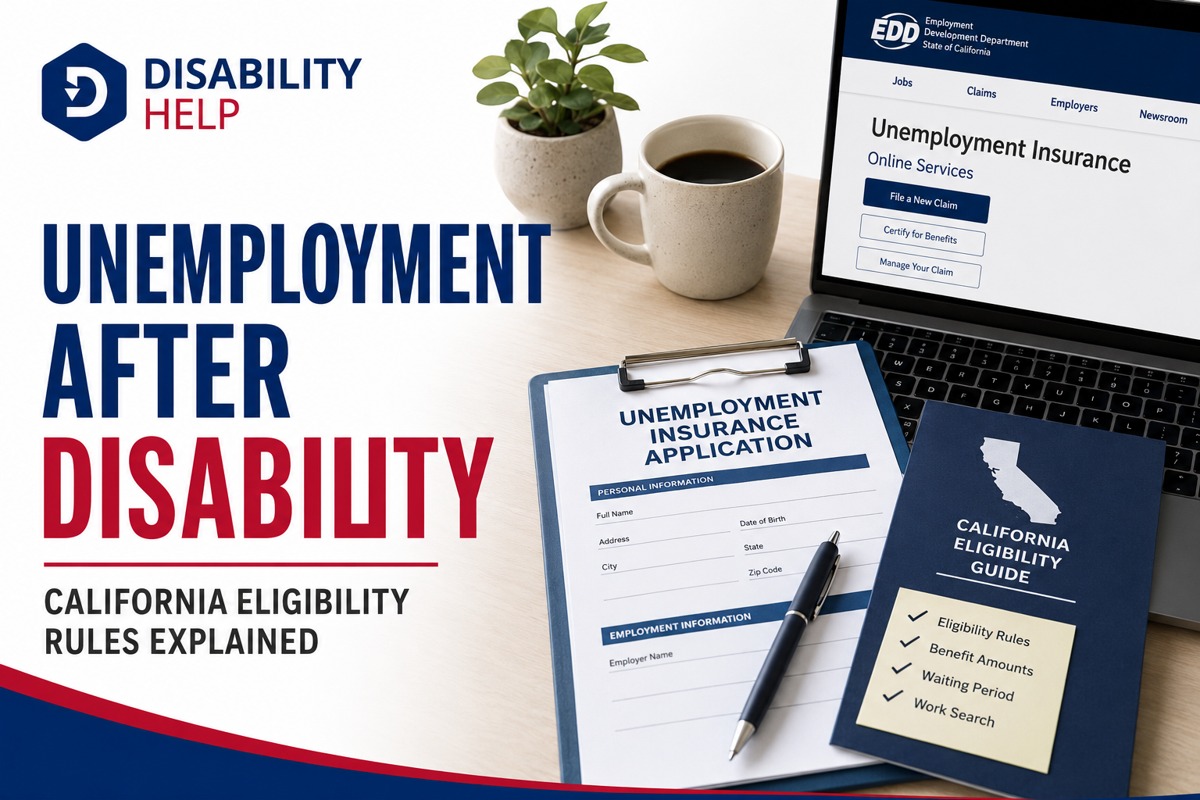
Yes, you can apply for unemployment after disability in California if your medical condition has improved enough that you are physically able to work, available for work, and actively looking for it. The California Employment Development Department (EDD) treats State Disability Insurance (SDI) and Unemployment Insurance (UI) as separate programs with opposite core requirements, which is why the transition demands careful timing, the right documentation, and a clear sense of what changes the moment your disability claim ends.
California's unemployment rate sat at roughly 5.5% in early 2026, with more than a million Californians using the UI system at any given time, according to reporting on EDD data. A meaningful share of those claimants are coming directly off an SDI claim.
This guide walks through what changes the day your SDI ends, what the EDD will require you to prove, how to time your UI application to avoid a denial for overlapping benefits, and what to do if you still have medical restrictions or your previous job is no longer waiting for you.
Key Takeaways
- The two programs conflict by design: SDI pays you for being unable to work; UI pays you for being able and available, so you cannot collect both at the same time.
- Medical clearance is the trigger: You become eligible for UI the moment your doctor releases you to work, whether for full duty or restricted duty, you can work around.
- Restrictions do not disqualify you: Work restrictions don't block UI as long as a substantial field of suitable employment exists within those limits.
- 2026 benefit amounts differ sharply: California SDI pays up to $1,765 per week in 2026; UI pays $40 to $450 per week for up to 26 weeks, capped at $11,700 total.
- Timing protects your claim: Apply for UI the business day after your final SDI payment posts so the EDD systems do not flag overlapping benefits.
- Base period wages still apply: You need at least $1,300 in your highest base period quarter (or $900 plus 1.25 times the high quarter total) to qualify for any UI benefit.
- CalJOBS registration is required: You must register on CalJOBS and post a resume within 21 days of receiving your UI award notice, or risk losing benefits.
The Simple Answer: Yes, With One Key Condition
You can apply for unemployment after disability in California once your doctor has certified that you are able to return to work and your previous job is no longer available to you. The EDD has confirmed this transition directly in its Benefit Determination Guide, which states that when SDI benefits end because the claimant has been medically released, there is usually no "able and available" issue blocking the UI claim (EDD Able and Available, AA 235).
The transition is simple in concept and trickier in practice. You move from one program that pays you because you cannot work to another that pays you because you can. The shift in your status is what makes the new claim valid, and that shift has to be documented before the EDD will approve UI benefits.
Most workers who transition between SDI and UI describe the process as smoother than expected once they have the right paperwork and timing in place. The ones who struggle almost always hit the same three problems: applying while still on SDI, missing the base period wage threshold, or failing to document work search activity during the first certification.
Why SDI and UI Have Opposite Eligibility Rules
SDI and UI are both EDD programs, but they were built for opposite circumstances. State Disability InsuranceA form of insurance that provides income to individuals who are unable to work due to a disability. exists to replace wages for workers who cannot work because of a non-work-related illness, injury, or pregnancy. Unemployment Insurance exists to replace wages for workers who are out of work through no fault of their own but who remain physically able to take a job, per the EDD UI eligibility rules.
Because of that, the same person cannot satisfy both programs at the same time. To collect SDI, you have to demonstrate to your medical provider that you cannot perform the duties of your regular job. To collect UI, you have to certify every two weeks that you are physically able to work, available for work, looking for work, and ready to accept a job offer right away.
The transition is built around the moment that status flips. The day your doctor signs off on a return-to-work certification, you are no longer eligible for SDI, but you become potentially eligible for UI, assuming your job is no longer available, and you meet the base period wage requirements covered below.
What Eligibility Requirements Must You Meet for UI After Disability?
To qualify for UI after disability in California, you must meet five separate requirements set by the EDD: you must be unemployed through no fault of your own, physically able and available to work, looking for work each week, ready to accept work immediately, and have earned enough wages in your base period to set up a valid claim, according to the EDD eligibility page.
The "able and available" requirement is where most SDI-to-UI claimants get tripped up. It does not mean fully recovered. It means medically cleared to perform some category of work that has a substantial field of employment open to it. A construction worker cleared to return only to light-duty positions can still satisfy "able and available" by showing they are searching for office or admin jobs that fit the restrictions.
The base period requirement is a wage history test. California uses two possible base periods: the Standard Base Period (the first four of the last five completed calendar quarters before your claim begins) and the Alternate Base Period (the four most recently completed calendar quarters), which is used only if you do not qualify under the Standard. To qualify under either, you need at least $1,300 in your highest base period quarter, or $900 in your highest quarter plus total base period earnings of at least 1.25 times that high quarter.
SDI vs. UI in California: Side-by-Side Comparison
Here is a direct comparison of the two California EDD programs side by side, so you can see exactly what changes when you transition from one to the other in 2026.
| Program Feature | State Disability Insurance (SDI) | Unemployment Insurance (UI) |
| Core eligibility | Unable to work due to non-work-related illness, injury, or pregnancy | Unemployed through no fault of your own and able and available for work |
| 2026 weekly benefit range | Up to $1,765 per week | $40 to $450 per week |
| 2026 wage replacement rate | 70% to 90% of base period wages | Roughly 50% of high-quarter wages |
| Maximum duration | Up to 52 weeks per claim | Up to 26 weeks per benefit year |
| Maximum total benefit | Up to approximately $91,780 | $11,700 |
| Medical certification | Required (physician or practitioner) | Not required, except a return-to-work note when transitioning from SDI |
| Work search requirement | None | Required to document every two weeks |
| Waiting period | 7 days non-payable (potentially waived if claim exceeds 14 days) | 1 week non-payable |
Sources: EDD 2026 Contribution Rates and Benefit Amounts, EDD UI calculator page, EDD Disability Insurance Benefit Payment Amounts.
How to Transition From SDI to UI: A Step-by-Step Process
Here is the step-by-step process the EDD expects you to follow when moving from disability to unemployment in California:
- Get medical clearance in writing. Ask your physician or practitioner to write a return-to-work certification that specifies whether you are cleared for full duty or for modified duty with restrictions. If you have restrictions, ask the doctor to list what you CAN do (for example, sit for 8 hours, lift up to 15 pounds, use a computer) rather than only listing what you cannot.
- Notify the EDD that your disability has ended. Complete the Disability Status section of your final Claim for Continued Disability BenefitsFinancial assistance provided to individuals who are unable to work due to a disability, such as Soc... form, or call the EDD disability line and select the return-to-work option, per the EDD's end-of-benefits guidance.
- Wait for your final SDI payment to fully post. Do not apply for UI while a disability payment is still pending. The EDD systems will flag the overlap and may deny the UI claim or delay it for weeks.
- Apply for UI online through myEDD. Submit your unemployment claim the next business day after the final SDI payment clears. List your last employer even if you have not worked there since your disability began.
- Watch for your Notice of Unemployment Insurance Award (DE 429Z). This document confirms your weekly benefit amount, your benefit year, and your work search instructions.
- Register with CalJOBS within 21 days. You will receive a Notice of Requirement to Register for Work (DE 8405). Missing this deadline can stop your benefits before they start.
- Begin documenting work search activity immediately. Track every application, every employer contacted, every job fair attended, every CalJOBS posting reviewed. You will report this every two weeks during certification.
- Certify for benefits every two weeks. Answer the questions honestly, especially about whether you were physically able and available for work each day of the period, and what work you performed if any.
What If You Have Work Restrictions or Cannot Return to Your Old Job?
You can still qualify for unemployment after disability in California if you have permanent or temporary work restrictions, as long as a substantial field of employment exists for someone with your skill set within those restrictions. The EDD Benefit Determination Guide is explicit on this point: medical restrictions for which good cause has been shown do not by themselves disqualify a claimant, provided they remain available to a substantial field of work.
The case that most often goes wrong is the one where the worker is cleared to return to work, but the previous employer cannot accommodate the restrictions, and the worker fails to clearly demonstrate they are searching for jobs that DO fit. For example, a warehouse worker with a 25-pound lifting restriction who only applies for warehouse positions will likely be denied. The same worker applying for inventory clerk, dispatch, or admin roles in the logistics sector will typically be approved.
If your previous employer cannot reinstate you and cannot accommodate your restrictions, that counts as job loss through no fault of your own for UI purposes. Document everything in writing: your restrictions, your employer's inability to accommodate, any interactive process discussions under the ADA if your employer has 15 or more employees, and your active search for suitable alternative work. These records are what the EDD will rely on if your claim is questioned.
Common Mistakes That Cause UI Denials After Disability
Most UI denials following an SDI transition fall into a small number of predictable categories. Avoiding them is the single most important thing you can do during the transition.
The most common denial reason is applying for UI while still on SDI. The EDD's two systems share data, so a UI application submitted before the final disability payment has cleared will frequently get flagged for overlapping benefits and rejected. The fix is mechanical: wait until you can see your final SDI payment posted in your myEDD account, then apply the next business day.
The second most common denial is a base period wage shortfall. If you were on disability for many months, your Standard Base Period may include quarters where you had little or no earnings. Ask the EDD to evaluate your claim under the Alternate Base Period if the standard one does not qualify you. The Alternate Base Period uses your four most recently completed quarters, which can help if you worked recently or had earnings during the early part of your disability claim.
The third common denial is a failure to demonstrate an active job search consistent with your restrictions. The EDD does not publish a required number of weekly applications, but two to three quality applications per week for positions within your medical limitations is generally considered reasonable. Document every contact, every application, every interview, and every CalJOBS activity.
Key Terms You Need to Know
State Disability Insurance (SDI): California program that pays partial wages to workers temporarily unable to work due to a non-work-related illness, injury, or pregnancy. In 2026, SDI pays up to $1,765 per week.
Unemployment Insurance (UI): A California program that pays temporary wages to workers who are unemployed through no fault of their own, physically able to work, and actively seeking employment. In 2026, UI pays $40 to $450 per week.
Base Period: The 12-month earnings window the EDD uses to determine whether you qualify for benefits and how much you receive. California uses both a Standard Base Period and an Alternate Base Period.
Able and Available: The EDD two-part eligibility standard for UI. You must be physically able to perform some category of work AND ready to accept a suitable job offer immediately.
Work Search: The active job-seeking activity the EDD requires of all UI claimants. You document this every two weeks during the benefit certification process.
CalJOBS: California online job search platform. UI claimants must register and post a resume within 21 days of receiving their UI award notice.
Suitable Work: Work that matches your skills, experience, training, and physical capabilities. If you have medical restrictions, suitable work is work that fits within those restrictions.
A Real-World Example of an SDI-to-UI Transition
Consider a 38-year-old warehouse worker in Bakersfield who suffered a slipped disc and went on SDI for four months in early 2026. His SDI claim paid about $1,400 per week based on his base period wages. His doctor released him in May with a permanent restriction of no lifting over 25 pounds and no repetitive bending. His employer cannot accommodate the restrictions, and his position has already been filled.
He waits until his final SDI payment posts on a Thursday and applies for UI online the following Monday. His UI weekly benefit comes out to $450, the 2026 maximum, because his high-quarter wages were above $11,700. He registers with CalJOBS within five days, posts his resume, and begins applying for inventory clerk, shipping coordinator, and dispatch roles. He logs every application.
Two weeks later, he certifies for his first benefit period. Three to four weeks after applying, his first UI payment lands in his bank account. The financial gap between his last SDI payment and his first UI payment was about three weeks. He continues collecting UI for 14 weeks while job searching, then accepts an inventory clerk position with a logistics company that matches his medical restrictions.
This is the textbook version of how the transition is supposed to work. The two things that made it work were the documentation (a doctor's note specifying what he COULD do, not just what he could not) and the timing (waiting for SDI to fully close before opening the UI claim).
Moving From SDI to UI? Confirm Your Work Status Before You File
You can apply for unemployment after disability in California, and most workers who do it correctly are approved. The transition is built around one critical moment: the day your doctor releases you to work. Everything before that moment belongs to SDI. Everything after belongs to UI, assuming your job is no longer available, and you meet the base period and work search requirements.
As of 2026, with the SDI maximum at $1,765 per week and the UI maximum still capped at $450, the financial drop is real, but the transition itself is navigable. Plan for a two to four-week income gap, get your medical documentation in order before your last disability payment posts, and apply the moment your SDI claim closes.
For more help understanding what happens when California disability benefits end, read Disability Help’s guide on what happens when my California state disability runs out.
Frequently Asked Questions
Can I apply for unemployment after disability in California if I still have medical restrictions?
Yes, you can apply for unemployment after disability in California with permanent or temporary medical restrictions, provided a substantial field of suitable employment exists within those limitations. The EDD evaluates whether you remain available to a meaningful labor market, not whether you are 100% recovered. Bring a doctor's note that lists what you CAN do, not just what you cannot.
How long is the gap between SDI ending and UI starting in California?
Most claimants experience a two to four-week gap between their final SDI payment and their first UI payment. Some of that gap reflects the one-week UI waiting period plus normal claim processing time. Plan for at least three weeks of no income, and apply for UI the business day after your final SDI payment clears to keep the gap as short as possible.
Can my UI claim be denied because I was on disability?
No. Having received SDI does not, by itself, disqualify you from UI. The EDD treats them as separate claims with separate eligibility tests. The denials that happen during this transition are usually caused by applying too early (before the final SDI payment posts), failing to meet base period wage requirements, or failing to demonstrate active work search within your medical restrictions, not by the prior disability claim itself.
What if my old job is not available when my SDI ends?
If your previous employer cannot reinstate you or cannot accommodate your medical restrictions, your separation generally counts as job loss through no fault of your own for UI purposes. Document your restrictions, your employer's inability to accommodate, and any interactive process discussions under the ADA. Apply for UI as soon as your SDI ends and explain the situation honestly in your application.
How much will I receive on UI compared to my SDI payment?
Significantly less in most cases. California SDI pays 70% to 90% of your base period wages, up to $1,765 per week in 2026. California UI pays roughly 50% of your high-quarter wages, capped at $450 per week. If you were earning the SDI maximum, your weekly income will drop by about $1,300 when you transition. Budget accordingly before your SDI ends.
Do SDI payments count as wages for the UI base period?
No. SDI benefits are not considered wages for UI base period calculations. If you were on disability for an extended time, your Standard Base Period may not contain enough wages to qualify. Ask the EDD to evaluate your claim under the Alternate Base Period, which uses your four most recently completed calendar quarters and may capture earnings the standard window misses.
- "Americans with Disabilities Act." U.S. Department of Justice, [Date of Access, e.g., "2 Nov. 2023"]. https://www.ada.gov/.
- "ADA: Your Employment Rights as an Individual With a Disability." U.S. Equal Employment Opportunity Commission, [Date of Access, e.g., "2 Nov. 2023"]. https://www.eeoc.gov/publications/ada-your-employment-rights-individual-disability.
- "Disability Insurance." State of California Employment Development Department, [Date of Access, e.g., "2 Nov. 2023"]. https://edd.ca.gov/en/Disability/Disability_Insurance.
- "Americans with Disabilities Act." ScienceDirect, [Date of Access, e.g., "2 Nov. 2023"]. https://www.sciencedirect.com/topics/nursing-and-health-professions/americans-with-disabilities-act.
- "Fact Sheet: How Unemployment Insurance Benefits Are Computed." State of California Employment Development Department, [Date of Access, e.g., "2 Nov. 2023"]. https://edd.ca.gov/siteassets/files/pdf_pub_ctr/de8714ab.pdf.