California State Disability InsuranceA form of insurance that provides income to individuals who are unable to work due to a disability. (SDI) is a state program that replaces part of your wages when a non-work-related illness, injury, or pregnancy keeps you from working. In 2026, it pays eligible workers $50 to $1,765 per week for up to 52 weeks. You qualify if you cannot do your regular work for at least eight consecutive days, you lost wages because of the condition, you were working or looking for work when it began, you earned at least $300 in SDI-taxed wages during your base period, and a licensed medical provider certifies your disability. The California Employment Development Department (EDD) runs the program, and every covered worker funds it through a 1.3% payroll deduction listed as CASDI on your paystub.
This guide covers each eligibility rule, the exact filing window, how your payment is calculated, and what to do if your claim is denied. If your condition may become long-term, you can also compare SDI with federal Social Security Disability Insurance (SSDI).
Key Takeaways
- Benefit range in 2026: California State Disability Insurance pays eligible workers $50 to $1,765 per week for up to 52 weeks per claim.
- Six requirements to qualify: You must miss 8 or more consecutive workdays, lose wages, be employed or job-seeking, earn $300 in base-period wages, and get medical certification.
- Immigration status does not matter: Workers of any immigration status, including undocumented workers, can receive SDI if they meet the other rules.
- File between day 9 and day 49: Filing earlier than nine days or later than 49 days after your disability starts can delay or disqualify your claim.
- Wage replacement reaches 90%: Lower and middle-income earners now receive up to 90% of wages, up from the old 60 to 70% rate, under Senate Bill 951.
- A seven-day waiting period applies: The first seven days of every claim are unpaid, so your first payable day is the eighth day of the claim.
- You have 30 days to appeal: If the EDD denies your claim, you can appeal with Form DE 1000A within 30 days of the determination notice.
What Is California State Disability Insurance?
California State Disability Insurance is a short-term wage-replacement program for workers who cannot do their job because of a non-work-related health condition. It covers illness, injury, pregnancy, childbirth recovery, surgery, and certain licensed rehabilitationThe process of helping individuals with disabilities achieve and maintain their optimal physical, se... stays. Workers' compensation covers job-related injuries; SDI covers everything else.
The program is funded entirely by employees. Employers pay nothing into it. In 2026, the withholding rate is 1.3% of your wages with no wage cap, up from 1.2% in 2025. Because Senate Bill 951 removed the taxable wage ceiling in 2024, the deduction now applies to every dollar you earn, so a worker making $100,000 pays $1,300 in SDI contributions for the year. You see this money on your paystub as CASDI.
SDI includes two parts: Disability Insurance for your own health condition, and Paid Family Leave for bonding with a new child or caring for a seriously ill relative. This guide covers the Disability Insurance side. Both are administered by the California EDD.
Who Qualifies for California SDI? The 6 Eligibility Requirements
You qualify for California SDI when you meet six requirements at the same time: an eight-day work loss, actual lost wages, active employment status, $300 in base-period wages, timely medical certification, and a qualifying non-work-related condition. Immigration status is not a factor.
- Eight-day work loss. You must be unable to do your regular or customary work for at least eight consecutive days. A condition that keeps you out for seven days or fewer does not qualify.
- Lost wages. You must have lost income because of the disability, meaning you are not working or you are working reduced hours. Full pay through sick leave can make you ineligible until that stops.
- Employed or job-seeking. You must have been working or actively looking for work when your disability began. Self-employed workers can qualify only if they enrolled in elective coverage, described later.
- $300 in base-period wages. You must have earned at least $300 in wages with SDI withheld during your base period, the 12-month window that ran 5 to 18 months before your claim starts.
- Medical certification. A licensed health professional must certify your disability. The certification has to reach the EDD within 49 days of your disability start date, or your claim can be denied.
- A non-work-related condition. Your condition cannot be a job injury covered by workers' compensation. Physical illness, mental health conditions, pregnancy, surgery recovery, and injuries away from work all qualify.
Doctors are not the only providers who can certify a claim. Nurse practitioners, physician assistants, chiropractors, podiatrists, optometrists, dentists, psychologists, and licensed midwives can all certify within their scope of practice. Midwives and nurse-midwives can independently certify normal pregnancy, childbirth, and postpartum conditions.
How Your Base Period Sets Your Eligibility and Payment
Your base period is a 12-month window of past earnings that the EDD uses to decide whether you qualify and how much you receive. It covers wages paid roughly 5 to 18 months before your claim begins, not your current paycheck. The exact quarter depends on the month your claim starts, as shown below.
| If Your Claim Begins | Base Period Used |
|---|---|
| January, February, or March | The 12 months ending the prior September 30 |
| April, May, or June | The 12 months ending the prior December 31 |
| July, August, or September | The 12 months ending the prior March 31 |
| October, November, or December | The 12 months ending the prior June 30 |
For example, a claim beginning February 14, 2026, uses a base period of October 1, 2024, through September 30, 2025, according to the EDD benefit payment guidance. You cannot change your base period after a valid claim is set up. If military service, an industrial disability, a labor dispute, or long-term unemployment reduced your base-period wages, you can ask the EDD about a special base period.
How Much Does California SDI Pay in 2026?
Your Weekly Benefit Amount is 70% to 90% of the wages you earned in the highest-paid quarter of your base period, up to a 2026 maximum of $1,765 per week and a minimum of $50. Lower and middle-income workers receive the higher 90% rate; higher earners receive 70%.
| Your Income Level (2026) | Weekly Benefit Amount |
|---|---|
| Very low base-period earnings (about $1,200 to $2,890 for the year) | $50 minimum |
| Low-to-middle income (roughly under $65,000 per year) | Up to 90% of your weekly wages |
| Higher income | 70% of weekly wages, up to the $1,765 maximum |
These figures apply to claims starting on or after January 1, 2026, and reflect the final phase of Senate Bill 951, which raised the replacement rate from the old 60 to 70% range. The 2026 state average weekly wage is $1,789, and the maximum weekly benefit rose from $1,681 in 2025 to $1,765 in 2026.
Working part-time during your claim reduces your payment only if your wages plus your benefit would top your normal pay. Say your regular weekly wage is $1,000, you earn $500 part time, and your calculated benefit is $600. Because $500 plus $600 exceeds $1,000 by $100, the EDD reduces your benefit by that $100, so you receive $500 that week. Overpayments from a past claim and late child or spousal support can also lower your payment.
How to Apply for California SDI: A Step-by-Step Guide
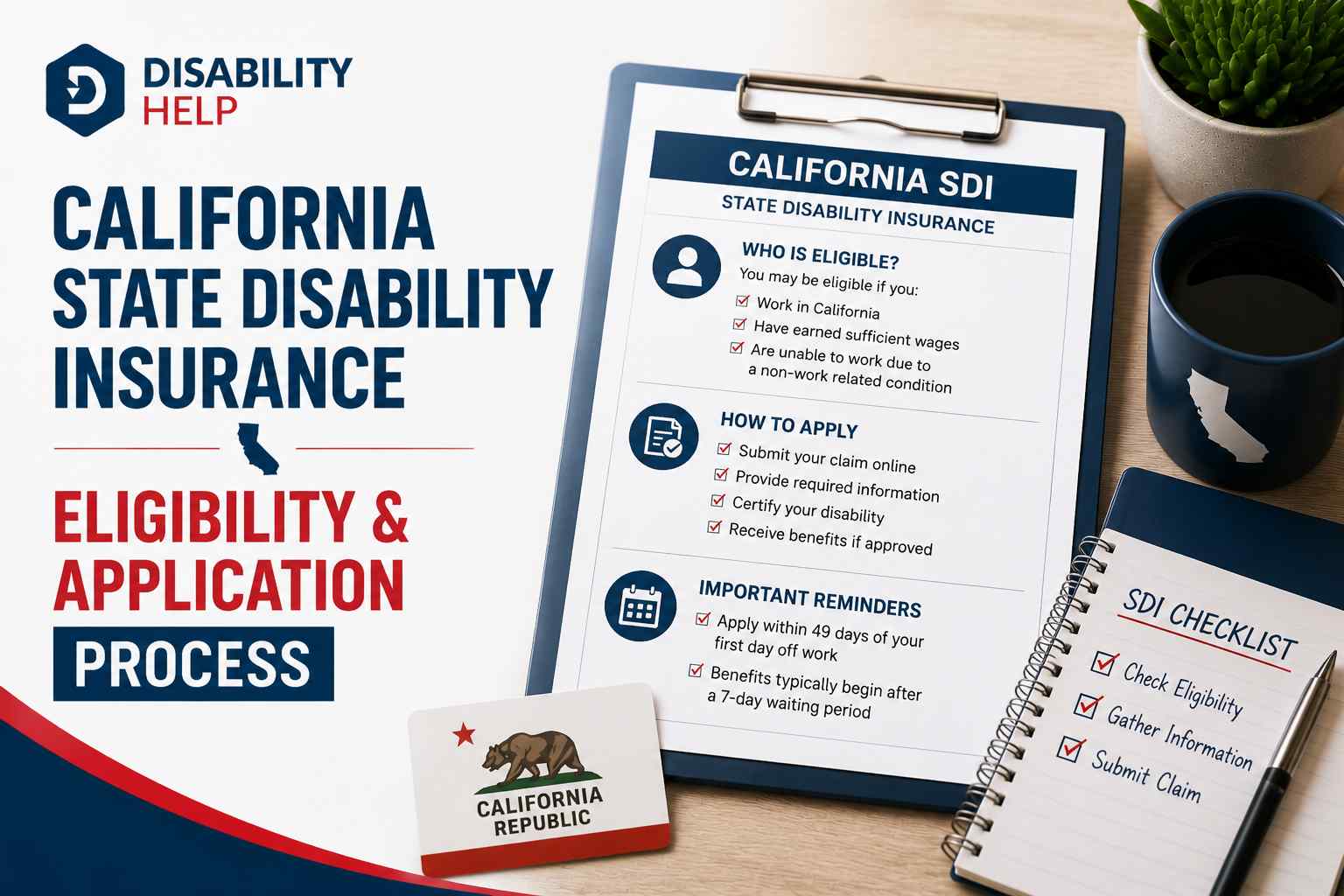
You apply for SDI online through myEDD, and the fastest, error-free path runs through five steps: gather your details, create your account, file within the 9-to-49-day window, get your provider to certify, then wait about 14 days for a decision. The EDD filing instructions walk through the online screens.
- Gather your information. Have your California ID or driver's license number, legal name, date of birth, Social Security number, employer name and address, last day you worked, and details of any wages or workers' compensation claim.
- Create a myEDD account. Register at myedd.edd.ca.gov, verify your email within 48 hours, set up multi-factor authentication, and confirm your identity through ID.me. This account opens SDI Online.
- File your claim in the right window. Submit no earlier than nine days and no later than 49 days after your disability begins. Choose direct deposit, debit card, or check, and save your receipt number for your provider.
- Have your provider certify. Give your health professional your receipt number so they can submit the medical certification through SDI Online within 49 days. Missing this deadline is a common reason claims fail.
- Wait for the determination. The EDD processes most claims in about 14 days. You may receive a Notice of Computation (DE 429D) estimating your benefit, then either an approval or a Notice of Determination (DE 2517) if you are denied.
You can also file by mailing the paper Claim for Disability Insurance Benefits (form DE 2501). The paper route is slower but helps if you lack a valid California ID or Social Security number, have recently changed your name, or have hit a technical problem online.
SDI vs. Workers' Compensation vs. SSDI: How They Differ
SDI, workers' compensation, and SSDI solve different problems, and mixing them up costs people benefits. SDI covers short-term non-work conditions, workers' compensation covers job injuries, and SSDI covers long-term disability from any cause. The table below lays out the main differences.
| Feature | California SDI | Workers' Compensation | SSDI (Federal) |
|---|---|---|---|
| What it covers | Non-work illness, injury, or pregnancy | Job-related injury or illness | Long-term disability from any cause |
| Who runs it | California EDD | Your employer's insurer | Social Security Administration |
| Duration | Short term, up to 52 weeks | Medical care plus wage benefits | Long term, ongoing |
| Work-related? | No | Yes | Not required |
| Can you combine? | Usually not at the same time; can supplement | Primary for work injuries | Possible if disability is long term |
You generally cannot collect SDI and workers' compensation for the same period. If your workers' compensation claim is denied or delayed, or if your workers' compensation payment is lower than your SDI benefit, SDI can fill the gap. The EDD places a lien to recover any SDI it pays while a workers' compensation case is pending, per its coordination rules.
Special Situations: Pregnancy, Part-Time Work, and Self-Employment
Several situations follow their own SDI rules. Pregnancy, reduced work schedules, and self-employment each change how and when you receive benefits.
Pregnancy and childbirth. You can receive SDI for up to four weeks before your due date and six weeks after a vaginal delivery, or eight weeks after a cesarean, when your provider certifies you cannot work. Medical complications can extend these periods. After you recover, you can move to Paid Family Leave to bond with your baby, and your established benefit amount carries over.
Part-time and intermittent work. You can keep receiving SDI while working part-time or intermittently, as long as you still lose wages. Report every hour and dollar to the EDD. Because partial payments stretch the total benefit, part-time claimants can sometimes receive benefits beyond the standard 52 weeks.
Self-employment. Independent contractors and self-employed workers are not covered automatically, but they can opt into the Disability Insurance Elective Coverage program. Per the EDD elective coverage FAQs, it requires at least $4,600 in annual net profit, a two-year commitment, and quarterly premiums, and benefits usually begin after six months of participation.
School employees. School staff generally cannot collect SDI during a school break if they receive full pay or do not normally work the break. They can qualify if they were scheduled to work during the break, such as summer school, or hold a second job outside the school.
Key California SDI Terms You Should Know
A few terms appear throughout the SDI process, and knowing them helps you read your notices correctly.
- CASDI. The line on your paystub shows your State Disability Insurance contribution. It confirms you paid into the program.
- Base period. The 12-month span of past wages, 5 to 18 months before your claim, that decides eligibility and payment.
- Weekly Benefit Amount (WBA). Your weekly SDI payment, set at 70 to 90% of your highest-quarter wages, up to $1,765 in 2026.
- Waiting period. The first seven unpaid days of every claim. Your eighth day is the first day the EDD pays.
- DIEC. Disability Insurance Elective Coverage is the opt-in program that lets self-employed workers buy into SDI and Paid Family Leave.
- Voluntary Plan. An employer-run private plan that replaces state SDI and must match or beat state benefits at no higher cost to you.
What to Do If Your SDI Claim Is Denied
If the EDD denies your SDI claim, you have 30 days from the date on the Notice of Determination (DE 2517) to appeal. You appeal with Form DE 1000A, which arrives with the denial. The EDD appeals process moves through several stages.
Start by completing the DE 1000A and explaining, in detail, why you believe you qualify. Attach any documents that support your case and mail it to the address on the notice. If you lost the form, send a signed letter with your name, claim ID or EDD customer account number, Social Security number, contact details, and your reason for appealing.
The EDD reviews your appeal first. If it still does not approve you, your appeal goes to the California Unemployment Insurance Appeals Board, which schedules a hearing before an Administrative Law Judge. Attend that hearing, because failing to appear results in dismissal. If you disagree with the judge, you can appeal to the Board within 30 days of the decision. While you wait, review your options for covering income during a disability decision.
Common Mistakes That Delay or Sink SDI Claims
In our experience helping readers work through California disability benefitsFinancial assistance provided to individuals who are unable to work due to a disability, such as Soc..., most problems trace back to a handful of avoidable errors, not to the strength of the underlying medical condition. The five below cause the most denials and overpayments.
- Filing outside the window. Filing before day nine or after day 49 can cost you benefits. Mark your disability start date and file inside that window.
- Missing the certification deadline. Your provider must submit the medical certification within 49 days. Hand them your receipt number early and confirm they filed it.
- Not reporting wages. Failing to report part-time wages or a return to work causes overpayments. Fraud overpayments carry a 30% penalty and up to 23 weeks of disqualification.
- Assuming SDI protects your job. SDI replaces wages but does not guarantee your job. Separate laws, such as FMLA or the California Family Rights Act, may protect your position. Understand how a waiting or elimination period works before you count on income.
- Paying someone to file. Applying for SDI is free through myEDD. Be cautious of any service that charges an upfront fee to file a free state claim on your behalf.
How to Protect Your Income While You Recover
California State Disability Insurance gives you a real financial cushion when a health condition stops you from working, but the benefit depends on meeting all six eligibility rules and filing within the 9-to-49-day window. As of 2026, the program pays $50 to $1,765 per week for up to 52 weeks, with up to 90% wage replacement for lower and middle-income workers. The EDD has already projected another increase for 2027, to a $1,791 maximum weekly benefit and a 1.3% to 1.4% rate change, so it is worth confirming current figures when you file.
If your condition is short-term, start your claim through myEDD and keep your receipt number ready for your provider. If it may last a year or more, learn how SSDI eligibility compares so you can plan for long-term support before your SDI benefits run out.
Frequently Asked Questions
How long does it take to get approved for California SDI?
The EDD processes most complete SDI claims in about 14 days. Complex claims or missing information can take longer. Filing online through SDI Online and making sure your provider submits the medical certification promptly are the fastest ways to avoid delays.
Can undocumented immigrants qualify for California SDI?
Yes. Citizenship and immigration status do not affect SDI eligibility. Workers of any immigration status, including undocumented workers, can receive benefits if they have paid into SDI and meet the other requirements, such as the $300 base-period earnings and medical certification.
Does California SDI protect my job?
No. SDI replaces part of your wages but does not give you the right to return to your job. Your position may be protected by other laws, such as the federal Family and Medical Leave Act or the California Family Rights Act, if you and your employer qualify under them.
Can I receive SDI and workers' compensation at the same time?
Usually not for the same period, because they cover different situations. If your workers' compensation claim is denied or delayed, or if its weekly payment is lower than your SDI benefit, SDI can supplement the difference. The EDD later recovers any overlap through a lien.
What happens if I miss the 49-day SDI filing deadline?
Filing more than 49 days after your disability begins can lead to disqualification unless you show good cause for the delay. If you missed the deadline for a valid reason, explain it clearly when you file, and be ready to provide documentation supporting the late submission.
How does the seven-day SDI waiting period work?
Every SDI claim has a non-payable seven-day waiting period at the start. The eighth day of your claim is the first day the EDD pays. Any wages your employer pays you during those first seven days do not conflict with your SDI benefits.