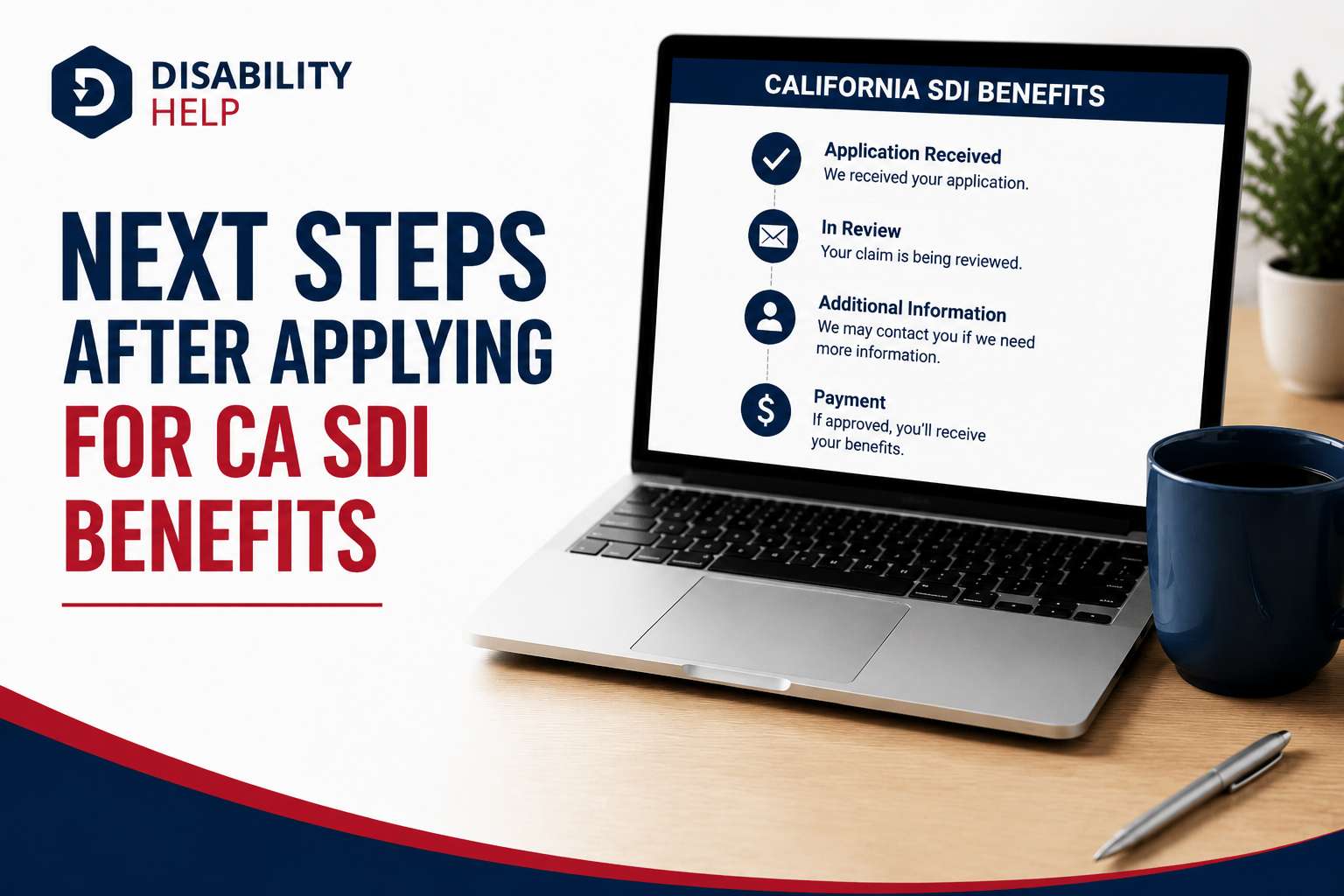
After you apply for California SDI benefits, the single most important thing to do is confirm your medical provider submits the medical certification (Part B) within 49 days of your disability start date, then monitor your myEDD account while the Employment Development Department processes your claim. The standard processing target is about 14 days once your file is complete. In 2026, SDI replaces 70% to 90% of your wages up to a maximum of $1,765 per week.
This guide walks you through every step that comes after you hit submit: certification, tracking, payments, ongoing eligibility, extensions, and what to do if your claim is denied.
Key Takeaways
- 49-day certification deadline: Your provider must submit the SDI medical certification within 49 days of your disability start date, or your claim can be denied.
- 14-day processing target: Once the EDD has both your application and the medical certification, the standard processing time is about 14 days.
- Seven-day unpaid wait: California SDI has a mandatory seven-day unpaid waiting period, so benefits begin accruing on the eighth day of your disability.
- 2026 benefit amount: California SDI pays 70% to 90% of your weekly wages in 2026, up to a maximum weekly benefit of $1,765.
- Certify to keep paying: You must return continued-eligibility forms within 20 days, or your SDI benefit payments stop until the form is processed.
- Report work and income: Failing to report a return to work or extra income causes an overpayment, plus a possible 30% penalty for a false statement.
- 30-day appeal window: If your SDI claim is denied, you have 30 days from the notice date to file a written appeal with the EDD.
Confirm Your Medical Certification Is Submitted on Time
Your claim does not move until the EDD has both parts of it: your application (Part A) and your provider's medical certification (Part B). The EDD will not process a claim with only the application on file, so confirming certification is the first action to take after you apply.
Your licensed health professional must certify your disability through SDI Online or the paper DE 2501 Part B form. You are responsible for making sure they complete and sign it within 49 days of the date your disability began. Missing that 49-day deadline can cost you benefits or disqualify the claim entirely, so treat it as a hard cutoff, not a target.
If you filed online, give your provider your EDD receipt number. That number lets them locate and certify your claim inside the myEDD system without delay. Be aware that providers are legally allowed to charge a fee for completing disability paperwork, so ask about that cost up front rather than being surprised by it later.
Track Your Claim Status and Understand the Timeline
Once the EDD has your complete file, the standard processing target is about 14 days. Real-world timelines run wider. Many straightforward claims clear in two to three weeks, but claims that need a second look can take six to eight weeks or longer, according to SDI Advisor's 2026 timeline analysis. The 14-day figure is how long the EDD takes to make a decision, not how long until money lands in your account.
The fastest way to monitor your claim is the SDI Online portal inside your myEDD account. Logging in shows real-time status, flags any missing information, and confirms when payments are issued. Check it regularly so you can respond the same day if the EDD requests something.
While you wait, you will receive a Notice of Computation (DE 429D) in the mail. This notice shows your potential weekly benefit amount based on past earnings. It is not an approval. It only states what you would receive if you meet every eligibility requirement, so do not treat the DE 429D as a green light to stop monitoring your claim.
How the Seven-Day Waiting Period Works
California SDI includes a mandatory seven-day unpaid waiting period at the start of every claim. The first seven calendar days of your disability are not payable, and your benefits begin accruing on the eighth day. Plan your finances around that gap. If you need to bridge income during the wait, it’s important to explore your options for what to do for income while waiting for disability.
Which EDD Forms and Notices Will You Receive?
After you apply, the EDD communicates almost entirely through named forms and notices. Knowing what each one means, and the deadline attached to it, keeps you from missing a step. The table below summarizes the documents most claimants encounter and what each requires from you.
| Form / Notice | What It Is | Your Deadline / Action |
|---|---|---|
| DE 2501 Part B | Medical certification your provider submits | Within 49 days of disability start |
| DE 429D | Notice of Computation showing potential weekly amount | Informational; not an approval |
| DE 2500E | Electronic Benefit Payment Notification for first payment | Review for accuracy |
| DE 2593 | Continued Eligibility Questionnaire (automatic pay) | Return within 20 days |
| DE 2500A | Claim for Continued Benefits (non-automatic pay) | Return within 20 days |
| DE 2525XX | Supplementary Certificate to extend benefits | Submit within 20 days |
| DE 2517 | Notice of Determination explaining a denial | Appeal within 30 days |
Source: EDD Disability InsuranceA form of insurance that provides income to individuals who are unable to work due to a disability. claim process and continued-benefits guidance.
7 Steps to Take Right After You Apply for SDI
These are the actions that keep an SDI claim moving from submission to first payment. Work through them in order, and revisit the list each time the EDD sends you a new form.
- Confirm certification within 49 days. Contact your provider and verify Part B was submitted through SDI Online or the DE 2501 paper form before the 49-day deadline.
- Create and log into myEDD. Use SDI Online to watch your claim status in real time and catch any request for missing information the same day it posts.
- Set up direct deposit. Direct deposit is only available if you filed through SDI Online, and it is the single fastest way to receive payment instead of waiting for a mailed debit card.
- Read every notice the EDD mails. The DE 429D, DE 2500E, and any request for information each carry instructions or deadlines you cannot skip.
- Watch the seven-day waiting period. Remember that benefits start on day eight, and budget for that unpaid first week.
- Return continued-eligibility forms within 20 days. Whether you get the DE 2593 or the DE 2500A, a late return stops your payments until it is processed.
- Report any change immediately. Tell the EDD the moment you recover, return to work in any capacity, or receive additional income, to avoid an overpayment.
How Your SDI Payments and Benefit Amount Work in 2026
Once your claim is approved, the EDD sends an Electronic Benefit Payment Notification (DE 2500E) detailing your first payment. You can receive benefits by direct deposit (SDI Online filers only), a prepaid debit card, or a paper check. If you did not choose direct deposit, the EDD issues a Money Network debit card by mail, which can add 7 to 10 business days before funds are usable.
Your Weekly Benefit Amount is based on the highest-earning quarter in your 12-month base period. Under Senate Bill 951, which took full effect in January 2025, the program now replaces 70% to 90% of your wages. Lower-income earners receive the 90% rate. For 2026, the maximum weekly benefit rose to $1,765, up from $1,681 in 2025. Over a full 52-week claim, that ceiling works out to roughly $91,780 in total benefits.
For most claimants, SDI benefits are not subject to state or federal income tax. The exception is when the benefits are paid as a substitute for Unemployment Insurance, in which case they may be taxable. You can confirm your situation through the EDD's Form 1099G guidance.
Key SDI Terms You Need to Know
California's SDI system runs on specific terms. Understanding them helps you read your notices correctly and avoid costly mistakes.
Base period: The 12-month span of past earnings the EDD uses to calculate your weekly benefit. It covers wages earned roughly 5 to 18 months before your claim start date, not your most recent paycheck.
Weekly Benefit Amount (WBA): The dollar amount you receive each week, set at 70% to 90% of your highest-quarter base-period wages, capped at $1,765 in 2026.
Waiting period: The first seven calendar days of your disability, which are unpaid. Benefits begin accruing on the eighth day.
Continued eligibility certification: The periodic confirmation that you remain disabled and unable to work, submitted on the DE 2593 or DE 2500A within 20 days.
Overpayment: Money the EDD paid you that you were not eligible to receive, usually after a return to work or extra income goes unreported. You must repay it.
Keep Your Benefits Active and Coordinate With Your Employer
To keep receiving SDI, you must periodically certify that you are still disabled and unable to work. If you are on automatic payments, the EDD sends a Disability Claim Continued Eligibility Questionnaire (DE 2593) after 10 weeks of benefits, and you must return it within 20 days. If you are not on automatic payments, you receive a Claim for Continued Disability BenefitsFinancial assistance provided to individuals who are unable to work due to a disability, such as Soc... (DE 2500A) every two weeks, due back within 20 days of receipt. A late form stops your payments.
Many employees supplement SDI with employer-provided sick time or vacation pay to reach 100% of their normal income. The EDD allows this coordination as long as your combined income from SDI plus your employer does not exceed your regular weekly wages. Report employer wages accurately, because if the combined total is higher than your normal earnings, the EDD reduces your SDI benefit. Your employer also receives a Notice to Employer of Disability Insurance Claim Filed (DE 2503) and must return it within two working days to verify your employment and wages.
Extending Benefits and Returning to Work
California SDI provides up to 52 weeks of benefits, or the total wages in your base period, whichever is less. If you reach your estimated recovery date but are not yet medically cleared, you must request an extension. With your final scheduled payment, the EDD sends a Physician/Practitioner's Supplementary Certificate (DE 2525XX). Your provider completes it to certify that your disability continues and to give a new recovery date, and it must be submitted within 20 days to avoid a lapse in payments.
Reporting rules are strict while you collect SDI. You are legally required to notify the EDD immediately if you recover, if you return to work full-time, part-time, or on modified duty, or if you receive any additional income. If you return part-time while still partially disabled, you may still qualify for reduced benefits, as long as your combined income does not exceed your regular wages.
The cost of getting this wrong is real. Failing to report a return to work or extra income creates an overpayment. If the EDD determines you made a false statement, you can face a 30% penalty on top of repaying the funds, plus disqualification from future benefits.
What to Do If Your SDI Claim Is Denied
If the EDD denies your claim, you receive a Notice of Determination (DE 2517) explaining the reason, along with an Appeal Form (DE 1000A). A denial is not the final word. Common denial reasons include a missing medical certification, insufficient base-period wages, or an application submitted past the 49-day deadline, and several of those are fixable on appeal.
You have the right to appeal in writing within 30 days of the date the notice was issued. If you miss that window, you can still appeal, but you must give a valid reason for the delay, which an Administrative Law Judge reviews. When you file, include a clear explanation of why you believe you are eligible and attach any missing documents or medical records that support your case. The EDD's State Disability Insurance appeals page explains exactly where to send your appeal.
A Note From Our Editorial Experience
In our experience covering disability benefits, the two mistakes that derail SDI claims most often are the same two every year: a medical certification that slips past the 49-day deadline, and a continued-eligibility form returned a few days late. Both are administrative, not medical, and both are completely avoidable. The claimants who fare best are the ones who treat myEDD like a checking account, logging in every few days, and who put every EDD deadline on a calendar the moment a notice arrives.
If your situation involves a long-term condition that may outlast the 52-week SDI maximum, that is the point to start researching federal Social Security Disability, because the application takes months and starting early protects you.
Putting It All Together
After you apply for California SDI, your job is to keep the claim moving and respond to the EDD on time. Confirm the medical certification within 49 days, monitor myEDD, plan for the seven-day unpaid wait, return every continued-eligibility form within 20 days, and report any change in work or income the moment it happens. As of 2026, with benefits reaching 90% of wages for lower earners and a $1,765 weekly cap, the program offers meaningful support, but only if you protect your claim through each deadline.
If your condition may keep you out of work long term, it is worth understanding how short-term state benefits connect to federal programs. Start with our Social Security Disability resources, or take the free disability benefits evaluation to see what you may qualify for next.
Frequently Asked Questions
How long does California SDI take to process after applying?
The EDD's standard processing target is about 14 days once it has both your application and your medical certification. In practice, many claims clear in two to three weeks, while claims that need extra review can take six to eight weeks or longer.
What happens if my doctor misses the 49-day certification deadline?
Missing the 49-day deadline can result in lost benefits or disqualification. If it happens, file your medical certification as soon as possible and include a written explanation, because the EDD may still consider the claim if there was good cause for the delay.
How much does California SDI pay in 2026?
In 2026, SDI replaces 70% to 90% of your weekly wages based on your highest base-period quarter, up to a maximum of $1,765 per week. Lower-income earners receive the higher 90% replacement rate.
Do I have to report going back to work part-time?
Yes. You must report any return to work, including part-time or modified duty, and any additional income immediately. You may still receive reduced SDI if your combined income stays below your regular wages, but unreported work creates an overpayment.
How do I appeal an SDI denial in California?
File a written appeal within 30 days of the date on your Notice of Determination (DE 2517), using the included Appeal Form (DE 1000A). Explain why you qualify and attach any missing medical records or documents that support your claim.
When do SDI benefit payments actually start?
Benefits begin accruing on the eighth day of your disability because of the seven-day unpaid waiting period. After approval, direct deposit usually posts within a few business days, while a mailed debit card can add 7 to 10 business days.