
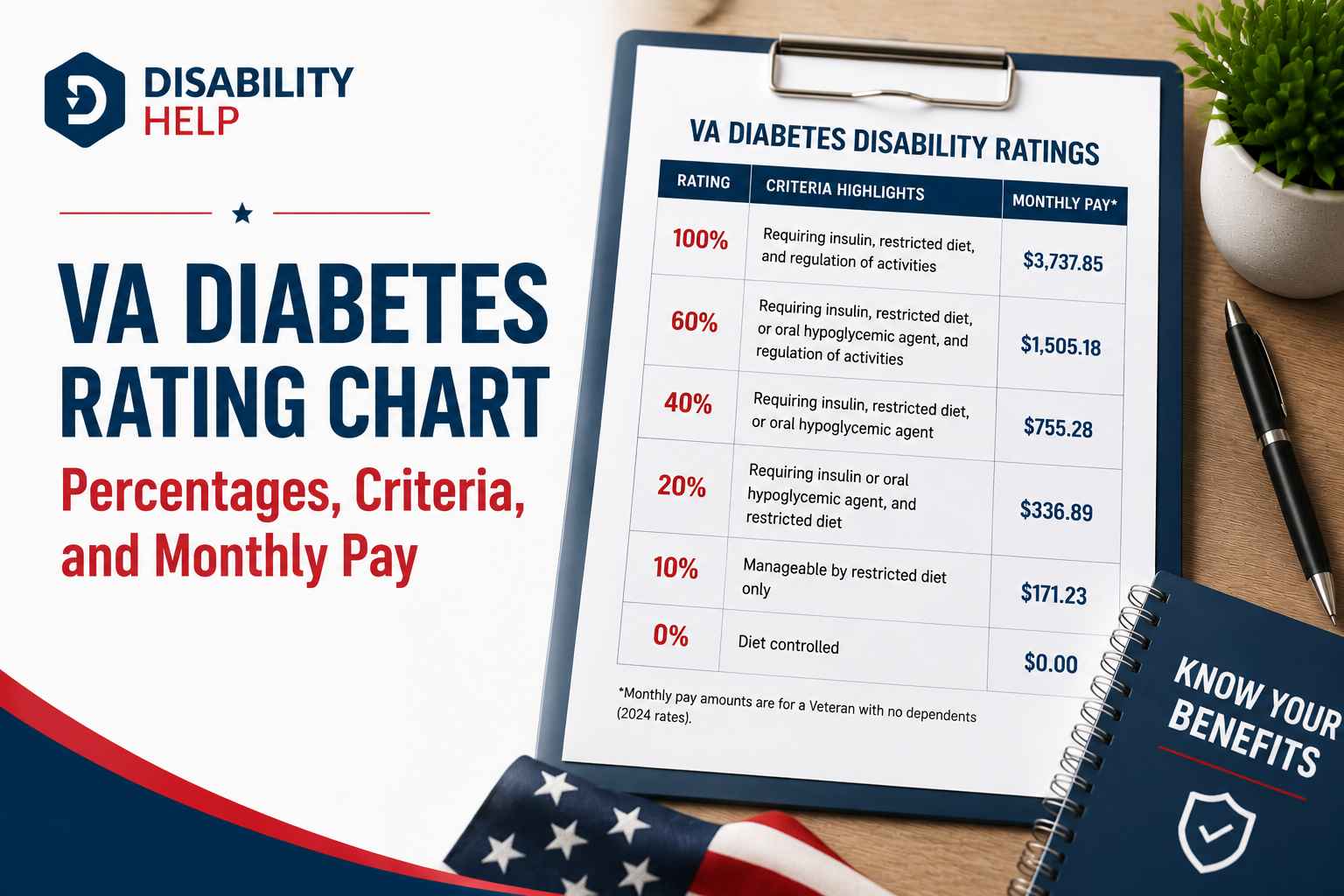
The VA diabetesA chronic condition where the body cannot produce or properly use insulin, leading to high blood sug... rating chart assigns a disability rating of 10%, 20%, 40%, 60%, or 100% under Diagnostic Code 7913, based on how much treatment your diabetes requires, whether you follow a restricted diet, whether a doctor has ordered you to limit activity, and how often complications or hospital visits occur. Diabetes affects close to 25% of veterans in VA care, roughly double the rate among U.S. adults.
This guide breaks down each rating level, the exact 2026 monthly pay, the secondary conditions that can raise your combined rating, and the evidence that moves a claim from one level to the next.
Key Takeaways
- Five rating levels: The VA diabetes rating chart sets compensation at 10%, 20%, 40%, 60%, or 100% under Diagnostic Code 7913 in 38 CFR 4.119.
- Treatment drives the rating: The VA rates the burden of managing diabetes (diet, medication, insulin, activity limits), not your A1C number by itself.
- The 40% jump hinges on activity limits: Moving from 20% to 40% usually depends on medical proof that a doctor restricted strenuous activity because of diabetes.
- 2026 pay ranges widely: A single veteran receives $180.42 a month at 10% and $3,938.58 a month at 100% after the 2.8% COLA that took effect December 1, 2025.
- Complications add up: Neuropathy, kidney disease, retinopathy, and erectile dysfunction can each carry a separate rating that combines with your diabetes rating.
- Type 2 can be presumptive: Veterans exposed to Agent Orange do not have to prove their Type 2 diabetes is service-connected.
How the VA Diabetes Rating Chart Works
The VA diabetes rating chart works by matching your required treatment and functional limits to a percentage under Diagnostic Code 7913. The VA weighs four things: the type of treatment (diet, oral medication, or insulin), dietary restriction, whether a doctor ordered you to regulate activity, and the frequency of complications or medical visits.
The rating schedule sits in 38 CFR 4.119, Diagnostic Code 7913. It was last amended in 2017 and remains the standard in 2026. It covers both Type 1 and Type 2 diabetes, because the VA applies the same criteria to each. The focus is treatment intensity, not the underlying type of diabetes.
The levels are cumulative. Each higher rating requires everything in the level below it, plus more. A veteran cannot reach 40% without first meeting the 20% criteria. When a record falls between two levels, the VA generally assigns the lower one.
Blood sugar numbers alone do not set the rating. A veteran with a high A1C who controls the condition with one daily pill and no activity restriction usually rates at 20%, not higher. What raises the rating is documented treatment intensity and functional limits, so the story in your medical records matters more than a single lab value.
VA Diabetes Rating Chart: Criteria and 2026 Monthly Pay
Here is the full VA diabetes rating chart for 2026, showing the criteria at each level and the monthly payment for a single veteran with no dependents. Payments reflect the 2.8% cost-of-living increase that took effect December 1, 2025.
| Rating | Criteria under Diagnostic Code 7913 | 2026 monthly pay (single veteran) |
|---|---|---|
| 10% | Diabetes managed by restricted diet only. | $180.42 |
| 20% | Insulin or an oral hypoglycemic agent, plus a restricted diet. | $356.66 |
| 40% | Insulin, a restricted diet, and regulation of activities. | $795.84 |
| 60% | Insulin, restricted diet, and regulation of activities, plus ketoacidosis or hypoglycemic episodes needing one or two hospitalizations a year or twice-monthly provider visits, plus noncompensable complications. | $1,435.02 |
| 100% | More than one daily insulin injection, restricted diet, and regulation of activities, plus episodes needing three or more hospitalizations a year or weekly provider visits, plus progressive weight and strength loss or compensable complications. | $3,938.58 |
Ratings of 10% and 20% pay a flat rate. Added pay for a spouse, child, or dependent parent begins at 30% and above, so a veteran at 40% with a qualifying spouse receives more than the single rate.
What Each VA Diabetes Rating Level Requires
Each level on the VA diabetes rating chart has specific requirements. Reading the exact language helps you see which level your records support and what is missing.
10% Rating: Diet Control Only
The 10% rating applies when you manage diabetes through a restricted diet alone, without insulin or oral medication. You need a confirmed diagnosis and records showing blood sugar control through diet. The VA does not require hospitalization or frequent provider visits at this level.
20% Rating: Medication Plus Diet
The 20% rating applies when you require insulin or an oral hypoglycemic agent such as metformin, along with a restricted diet. This is the most common rating for veterans with Type 2 diabetes who take medication. One insulin injection a day counts the same as several. The deciding factor is that medication is required for control.
40% Rating: Adding Regulation of Activities
The 40% rating requires insulin, a restricted diet, and regulation of activities. Regulation of activities means a doctor has told you to avoid strenuous work and recreation because of your diabetes. This single element is the most common sticking point on the entire chart, and it is where many veterans stall at 20%.
60% Rating: Complications and Frequent Care
The 60% rating requires everything at 40%, plus episodes of ketoacidosis or hypoglycemia that lead to one or two hospitalizations a year or twice-monthly visits to a diabetic care provider, along with complications that would not be separately compensable. This level reflects diabetes that is hard to control and needs frequent medical attention.
100% Rating: Severe, Poorly Controlled Diabetes
The 100% rating requires more than one insulin injection a day, a restricted diet, regulation of activities, and episodes needing at least three hospitalizations a year or weekly provider visits, plus either progressive loss of weight and strength or complications that would be compensable on their own. A standalone 100% schedular diabetes rating is rare. Most veterans reach 100% by combining diabetes with rated complications.
Secondary Conditions That Raise Your Combined Rating
Diabetes often causes other conditions, and under Note (1) of Diagnostic Code 7913, the VA rates compensable complications separately and then combines them with your diabetes rating. This is where total compensation often grows well beyond the base diabetes percentage.
| Secondary condition | Typical rating range | Diagnostic code |
|---|---|---|
| Peripheral neuropathy (rated per affected limb) | 10% to 80% | 8520 to 8521 |
| Diabetic nephropathy (kidney disease) | 0% to 100% | 7530 |
| Diabetic retinopathy | 10% to 60% | 6040 |
| Erectile dysfunction | 0% plus SMC-K | 7522 |
| Hypertension | 0% to 60% | 7101 |
The VA does not add ratings together. It combines them with the formula in 38 CFR 4.25 and rounds to the nearest 10%. A 40% diabetes rating and a 20% neuropathy rating combine to 52%, which rounds to 50% for pay, not 60%. Erectile dysfunction usually carries a 0% schedular rating but qualifies for Special Monthly Compensation (SMC-K), a set monthly amount (about $137 in 2026) added on top of your combined rating.
How to Move Up the VA Diabetes Rating Chart
Raising your rating means matching new medical evidence to the next level's criteria. These steps target the gaps that most often keep a diabetes claim at a lower percentage.
- Get the DBQ completed. Get a current Diabetes Mellitus DBQ completed. Ask your treating healthcare provider to complete the VA’s current Diabetes Mellitus Disability BenefitsFinancial assistance provided to individuals who are unable to work due to a disability, such as Soc... Questionnaire. The questionnaire documents insulin use, dietary restrictions, regulation of activities, hospitalizations, frequency of diabetic care, and related complications.
- Document the regulation of activities. Have your doctor state in the record that you must avoid strenuous activity because of diabetes, not another condition. This is the evidence that supports a 40% rating.
- Keep hospitalization and visit records. Save discharge summaries for ketoacidosis or severe hypoglycemia, and track twice-monthly or weekly provider visits. These support the 60% and 100% levels.
- File separately for complications. Claim neuropathy, kidney disease, retinopathy, and erectile dysfunction under their own diagnostic codes, so they combine with your diabetes rating.
- File within one year of worsening. The VA can set the effective date back to when evidence first showed the increase, but usually only if you file within one year of that date.
Key VA Diabetes Rating Terms, Defined
A few terms decide the outcome of most diabetes claims. Here is what they mean in plain language.
- Restricted diet: a specific eating plan a provider prescribes to control blood sugar, stricter than general healthy-eating advice.
- Regulation of activities: doctor-ordered avoidance of strenuous work and recreation because of diabetes. Required for a 40% rating and above.
- Ketoacidosis: a serious condition where the body produces high levels of blood acids called ketones, often requiring hospitalization.
- Combined rating: the single percentage the VA reaches after merging multiple ratings with the formula in 38 CFR 4.25.
- Presumptive service connection: when the VA assumes your condition is service-connected without requiring you to prove the link.
- DBQ: The Disability Benefits Questionnaire a provider completes to document your condition against the VA rating criteria.
A Real Example of the Regulation of Activities Rule
The gap between a 20% and a 40% diabetes rating usually comes down to one phrase: regulation of activities. In a Board of Veterans' Appeals decision (Citation Nr: 1418136), the Board explained that a veteran's own statement about limiting activity is not enough. A physician has to document that activity must be restricted, the restriction has to be tied to diabetes rather than another condition like arthritisInflammation of the joints, leading to pain, stiffness, and limited movement., and the note has to be specific about what to avoid.
In our experience reviewing veterans' diabetes claims, this is the single most common reason a rating stalls. A record that says a patient was advised to avoid strenuous exercise due to frequent hypoglycemic episodes supports the 40% level. A vague note that says a patient should limit activities does not. If you take insulin and follow a restricted diet but sit at 20%, the missing piece is almost always this documented activity restriction.
Presumptive Service Connection for Type 2 Diabetes
Type 2 diabetes is a presumptive condition for veterans exposed to Agent Orange, which means the VA assumes it is service-connected without a nexus letter. This has been the rule since 2001.
Qualifying service includes Vietnam between 1962 and 1975, the Korean DMZ during set periods, and certain Thailand air bases, with the PACT Act expanding the list of recognized exposure locations. Type 2 diabetes is also presumptive if you received a rating of at least 10% for it within one year of separation. A presumptive claim is often faster because you only have to show a current diagnosis and qualifying service.
Free help exists, and it is worth using. VA-accredited Veterans Service Organizations file claims at no cost, and accredited attorneys and agents cannot legally charge to prepare an initial claim. Be cautious of any company that asks for a large upfront fee to guarantee a higher rating. For an individual case, a VA-accredited representative or attorney can review whether your records match the next level on the chart.
Review Your Diabetes Rating and Supporting Evidence
The VA diabetes rating chart rewards documentation. As of 2026, the levels and criteria under Diagnostic Code 7913 have not changed, but the pay at each level rose 2.8% in December 2025, and the difference between a 20% and a 40% rating is more than $400 a month for a single veteran. If your records show insulin, a restricted diet, a documented activity restriction, or complications like neuropathy, your rating may be worth a second look.
For the next steps, read our guide on how to increase your VA disability rating to learn what medical and supporting evidence can strengthen an increased-rating claim
Frequently Asked Questions
What is the highest VA rating for diabetes?
The highest schedular rating for diabetes under Diagnostic Code 7913 is 100%, which pays $3,938.58 a month for a single veteran in 2026. It requires more than one daily insulin injection, a restricted diet, regulation of activities, frequent hospitalizations or weekly provider visits, and either progressive weight and strength loss or separately compensable complications.
Is diabetes a presumptive condition for VA disability?
Yes. Type 2 diabetes is presumptive for veterans exposed to Agent Orange, including many who served in Vietnam, the Korean DMZ, or qualifying Thailand bases. Presumptive status means you do not have to prove your diabetes was caused by service. You only need a current diagnosis and qualifying service to establish the connection.
Why is my VA diabetes rating stuck at 20%?
A 20% rating means the VA has evidence of insulin or oral medication plus a restricted diet, but not regulation of activities. To reach 40%, your medical records must show a doctor ordered you to avoid strenuous activity because of diabetes. Without that documented restriction, the VA keeps the rating at 20%.
Can I get separate VA ratings for diabetes complications?
Yes. Under Note (1) of Diagnostic Code 7913, complications such as peripheral neuropathy, kidney disease, retinopathy, and erectile dysfunction are rated separately and combined with your diabetes rating. Filing for these secondary conditions is often how veterans raise their total compensation above the base diabetes percentage.
How much does VA diabetes disability pay in 2026?
For a single veteran with no dependents in 2026, VA pays $180.42 per month at 10%, $356.66 at 20%, $795.84 at 40%, $1,435.02 at 60%, and $3,938.58 at 100%. These amounts have been effective since December 1, 2025. Additional compensation for eligible dependents begins when the veteran has a combined disability rating of at least 30%.
Does the VA rate Type 1 and Type 2 diabetes differently?
No. The VA rates both Type 1 and Type 2 diabetes under the same Diagnostic Code 7913. The rating depends on treatment requirements and functional limits, not the type of diabetes. Insulin use, dietary restriction, activity regulation, and complications determine the percentage for either type.