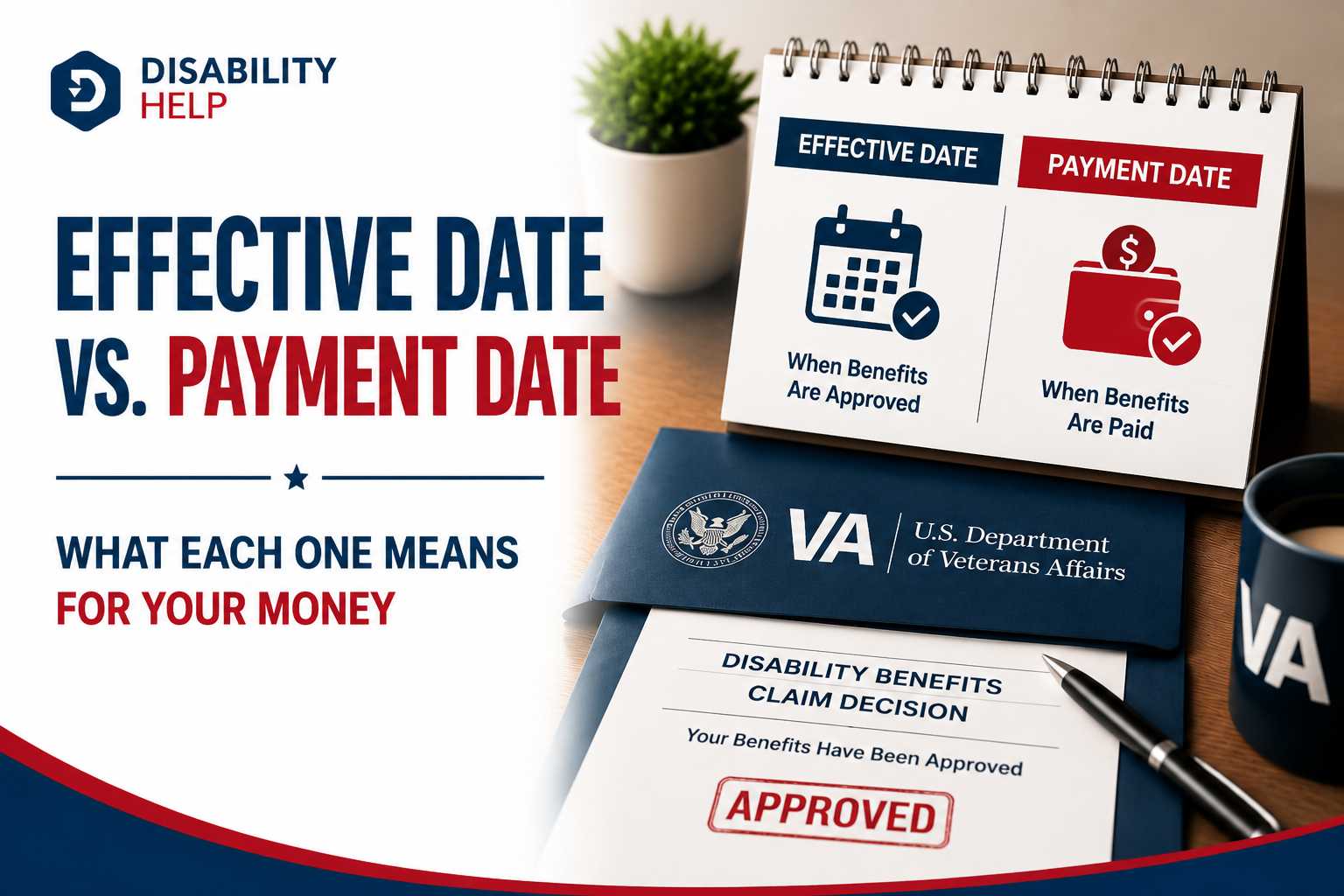
The difference between your VA disability effective date and payment date is simple but costly to confuse: the effective date is the day your benefits begin to accrue and sets your back pay, while the payment date is the fixed day each month the VA actually deposits your compensation. Getting the VA disability effective date vs. payment date distinction right matters because the effective date alone can decide whether you receive a few hundred dollars or several thousand in retroactive pay. It matters enough that a 2025 VA Office of Inspector General review found about 24% of first-year PACT Act-related claims reviewed in the OIG sample period carried an incorrect effective date.
This guide breaks down how each date is set, how the two connect, how back pay is figured from your effective date, and the steps that protect the date you are owed. You can also confirm your monthly amount on the 2026 VA disability pay chart.
Key Takeaways
- Two different dates: Your VA disability effective date sets when benefits start accruing, while your payment date is the day the VA deposits the money.
- Back pay hinges on the effective date: Every month earlier on your effective date adds another month of retroactive compensation to your lump sum.
- The VA pays in arrears: Compensation for one month arrives on the first business day of the following month, and the VA never pays for a partial month.
- The effective-date month is unpaid: Benefits start accruing on the first day of the month after your effective date, so that first partial month earns nothing.
- An Intent to File protects your date: VA Form 21-0966 locks your effective date for one year while you gather evidence for the full claim.
- Errors are common and fixable: A 2025 VA OIG review found about 24% of early PACT Act claims had the wrong effective date, and many are correctable on appeal.
- Payment dates shift for weekends: If the first of the month is a weekend or federal holiday, the VA pays on the last business day before it.
What Is the Difference Between a VA Effective Date and a Payment Date?
A VA disability effective date and a VA disability payment date answer two different questions. The effective date answers when your benefits start counting. The payment date answers when the money shows up. One controls how much you are owed. The other controls when each deposit arrives. Confusing the two is the single most common reason veterans misread their award letters.
Effective date: the official start date the VA assigns to your claim. It is the day your compensation begins to add up, and it anchors every dollar of back pay. The VA explains effective dates as the day you can start getting your disability benefits.
Payment date: the day the VA deposits your monthly compensation. VA typically pays on the first business day of the month (or the last business day before if the 1st falls on a weekend or holiday), and each payment covers the previous month.
Back pay (retroactive pay): the lump sum covering the gap between your effective date and the day your claim is approved. A claim that takes a year to decide can produce a year of back pay.
Paid in arrears: each payment covers the previous month. Your September compensation arrives on the first business day of October.
Intent to File (VA Form 21-0966): a formal notice that you plan to file. It can lock in an earlier effective date for up to one year while you prepare the full claim.
Here is the link in plain terms. Say your effective date is June 15, 2026. Your benefits do not start adding up until July 1, 2026, the first day of the month after your effective date. The VA then pays you for July on the first business day of August. You receive nothing for the partial month of June. The effective date set the clock; the payment date delivered the money.
How the VA Sets Your Effective Date
The general rule is straightforward: your effective date is the later of two dates, either the date the VA received your claim or the date your condition arose. This rule comes from federal law at 38 U.S.C. Section 5110 and the regulation at 38 C.F.R. Section 3.400. In most cases, the effective date cannot be earlier than the day you filed, even if your records show the condition existed for years. That single fact is why filing early, or filing an Intent to File, protects real money.
The most favorable exception is the one-year separation rule. If you file your claim within one year of leaving active duty, the VA can set your effective date as the day after you separated. The VA's own example shows a veteran who filed a hearing claim within a year of discharge and received an effective date of the day after separation, not the date the claim arrived. Filing more than a year after discharge removes that option, and the effective date becomes the date the VA received your claim.
For an increased rating claim, the rules add a useful wrinkle. The effective date can reach up to one year before you filed, but only if medical evidence shows your condition worsened during that lookback period and you filed within one year of the worsening. The table below summarizes how the VA sets your effective date across the most common claim situations.
| Claim Situation | How the VA Sets Your Effective Date | Legal Basis |
|---|---|---|
| Standard direct service connection | The later of the date the VA receives your claim or the date your condition began. | 38 U.S.C. 5110(a); 38 C.F.R. 3.400 |
| Claim filed within one year of separation | The day after you separated from active duty, the most favorable rule. | 38 C.F.R. 3.400(b)(2) |
| Increased rating claim | The earliest date evidence shows the worsening, up to one year before you filed, if filed within that year. | 38 U.S.C. 5110(b)(3) |
| Reopened claim | The later of the date the VA receives the reopen request or the date the condition arose. | 38 C.F.R. 3.400(q) |
| Liberalizing law change (such as the PACT Act) | The date the law changed, if you file within one year of that change. | 38 C.F.R. 3.114 |
| Dependency and IndemnityA legal principle requiring one party to compensate another for harm or loss, relevant in disability... Compensation (DIC) | The first day of the month the veteran died, if filed within one year of the death. | 38 U.S.C. 5110(d) |
The Intent to File sits underneath all of these rules as a date-protection tool. When you submit VA Form 21-0966, the VA records that date. You then have exactly one year to file the complete claim. If you do, the VA treats the claim as filed on the earlier Intent to File date. Miss the one-year window and the Intent to File expires, resetting your effective date to the day the full claim arrives. That reset can erase months of back pay.
VA Effective Date vs. Payment Date at a Glance
The fastest way to keep the two dates straight is to compare them side by side. The effective date is about how much you are owed. The payment date is about when it arrives. The comparison below lays out the practical differences a veteran feels in real life.
| Feature | Effective Date | Payment Date |
|---|---|---|
| What it is | The day your benefits begin to accrue | The day the VA deposits your money |
| What it controls | The size of your back pay | When each monthly deposit arrives |
| How it is set | Filing rules and claim type (38 C.F.R. 3.400) | A fixed monthly schedule (first business day) |
| Can it move earlier | Yes, with an Intent to File or the one-year separation rule | No, the schedule is fixed for every veteran |
| Which month it covers | Anchors the start of accrual | Pays for the previous month (arrears) |
| Why it matters most | Decides your lump-sum back pay | Decides your monthly budgeting and cash flow |
How VA Disability Payments Actually Work: Arrears, Partial Months, and the Weekend Rule
Three rules govern when your money arrives. First, the VA pays in arrears, so each deposit covers the month before. Second, the VA does not pay for partial months, so benefits start accruing on the first day of the month after your effective date. Third, the VA pays on the first business day of the month, and when the first falls on a weekend or federal holiday, payment moves to the last business day before it.
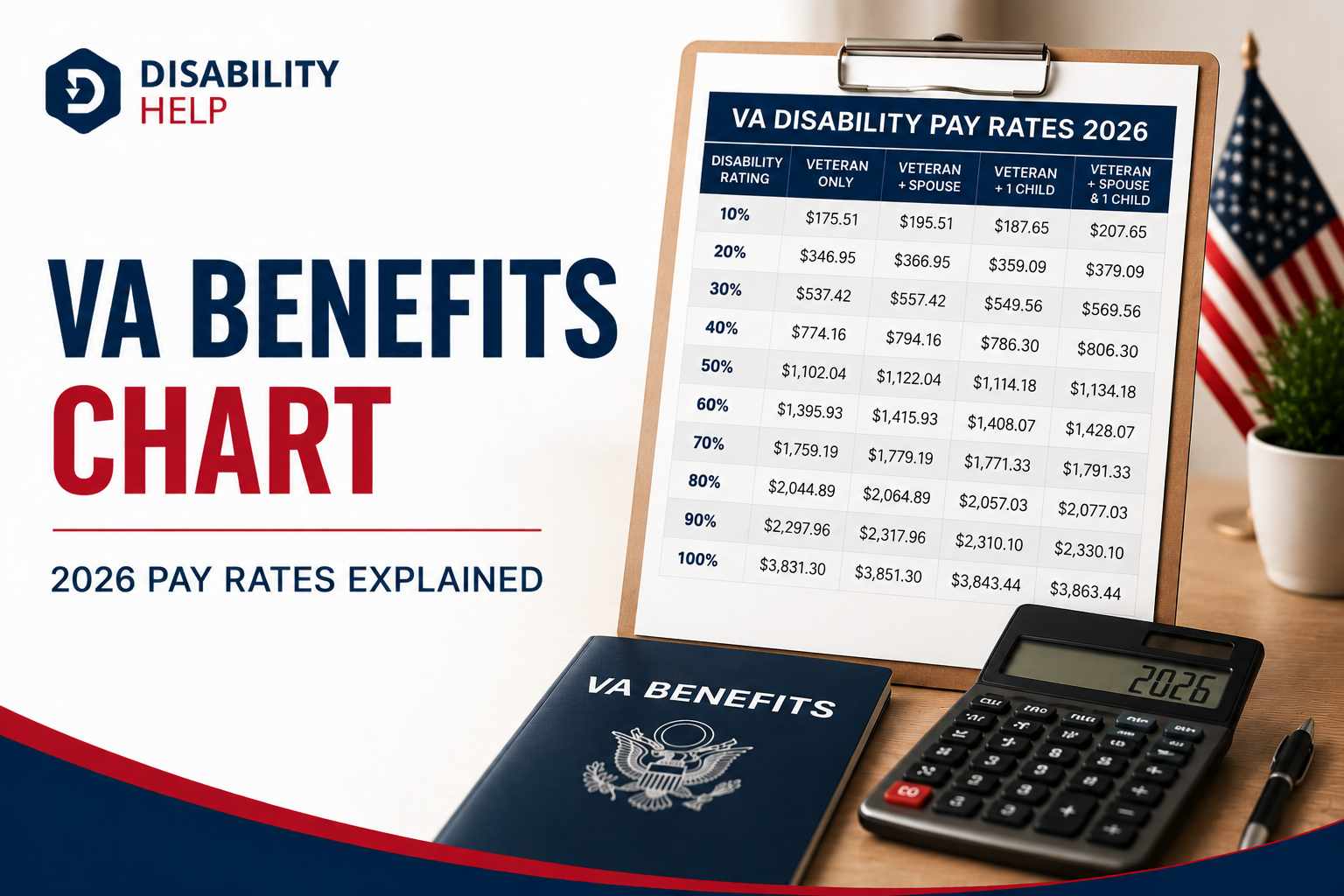
The 2026 schedule shows these rules in action. The 2.8% cost-of-living increase took effect with the December 2025 payment, which the VA deposited on December 31, 2025, because January 1 is a federal holiday. The VA's 2026 compensation rates range from $180.42 a month at 10% to $3,938.58 a month at 100% for a veteran with no dependents. The sample dates below show when the weekend rule shifts a payment earlier.
| Benefit Month | 2026 Payment Date | Why the Date Shifts |
|---|---|---|
| December 2025 | December 31, 2025 | January 1 is New Year's Day |
| January 2026 | January 30, 2026 | February 1, 2026 is a Sunday |
| June 2026 | July 1, 2026 | Regular first business day |
| July 2026 | July 31, 2026 | August 1, 2026 is a Saturday |
| November 2026 | December 1, 2026 | Regular first business day |
| December 2026 | December 31, 2026 | January 1, 2027 is a holiday |
Here is how the two dates connect in a single example. Suppose the VA assigns an effective date of April 15, 2026, and approves your claim in October 2026. Your benefits start adding up on May 1, 2026, the first day of the month after the effective date. April pays nothing because it is a partial month. Your first regular monthly payment covers May and arrives on the first business day of June. When the award is processed, the VA also sends a lump-sum back payment covering the accrued months.
How to Protect Your Effective Date and Maximize Back Pay
Your rating and your condition do not change your effective date. Filing behavior does. These six steps put the earliest defensible date on record and keep it there.
- File an Intent to File first. VA Form 21-0966 locks your effective date for one year while you gather evidence. You can file it online at VA.gov, by phone at 800-827-1000, or by mail.
- Submit your complete claim within 365 days. The Intent to File only holds if your full claim (VA Form 21-526EZ) reaches the VA within one year. Miss the deadline and the date resets.
- If you separated recently, file within one year of discharge. That can backdate your effective date to the day after separation, the most favorable rule available to any veteran.
- Keep proof of every filing date. For mailed forms, the effective date is the day the VA receives it, not the day you mailed it, so use certified mail with a return receipt.
- Read your decision letter for the stated effective date. Check it against the date you filed or submitted your Intent to File. This is where most money is won or lost.
- Act within the one-year appeal window if the date is wrong. A timely review keeps your original date in play and avoids starting the claim over with a later date.
How VA Disability Back Pay Is Calculated
Back pay is the monthly benefit for your rating multiplied by the number of months between when the accrual started and when the VA approved your claim. The VA uses historical rates for each month, so older months are paid at the rate that applied then, including each year's cost-of-living increase. The wait itself often makes this number large, because the VA's average decision time was about 78 days as of May 2026, and appeals can run far longer, as the VA describes in its guide to what happens after you file.
A simple example shows the math. Imagine a single veteran with no dependents is granted a 70% rating, with an effective date 14 months before approval. Using the 2026 rate of $1,808.45 a month for 70% with no dependents, 14 months of accrued benefits work out to roughly $25,318 in back pay, paid as one lump sum. For a rating increase, the VA instead pays the difference between the old and new monthly rates for each month owed. This figure is illustrative; your own total depends on the historical rates for the exact months involved.
Several factors move the final number up or down:
- Disability rating: higher ratings carry higher monthly amounts, so they produce larger back pay totals.
- Dependents: veterans rated 30% or higher receive added compensation for a spouse, children, or dependent parents, and changes during the back pay period adjust the total.
- Staged ratings: during a long appeal the VA may pay a lower rating for an early period and a higher rating later, which splits the calculation.
- Offsets: military retirement pay or severance pay can reduce compensation in some cases, which lowers the retroactive amount.
Your rating also shapes your long-term payments, which raises the stakes on getting the date right. If you reach the top of the scale, it is worth understanding whether a 100% VA rating is permanent, because permanence affects future reviews and the benefits attached to your award.
Common Effective Date Errors and How to Correct Them
Effective date errors are not rare, and they usually cost the veteran money. A 2025 VA Office of Inspector General review of first-year PACT Act claims estimated that about 24%, roughly 31,400 of 131,000 claims, had an incorrect effective date. The OIG found at least $6.8 million in improper payments in the first year alone and projected up to $20.4 million over the law's first three years. The watchdog tied the errors to thin guidance, unreliable date-calculation tools, and decisions issued before enough evidence was gathered.
When you read your decision letter, watch for these frequent mistakes:
- Ignoring the Intent to File: the VA uses the date your formal claim arrived instead of the earlier Intent to File date.
- Ignoring the one-year discharge rule: for a claim filed within a year of separation, the VA uses the claim date instead of the day after discharge.
- Breaking continuous pursuit: the VA assigns the date of a later supplemental claim, missing that you appealed within one year of the prior decision.
- Using the exam date: the VA wrongly uses your Compensation and Pension exam date rather than your claim date.
If the date is wrong, act inside the one-year window from your decision. The cleanest fix is a Higher-Level Review using VA Form 20-0996, where you identify the effective date error directly. If that one-year window has closed and the decision is final, the only remaining path is a Clear and Unmistakable Error (CUE) claim, which requires proving a clear, undeniable mistake in the original decision. CUE claims are hard to win and often need an accredited representative.
One trust note as you look for help. Accredited Veterans Service Organizations assist for free, and federal rules bar accredited agents and attorneys from charging a fee to file your initial claim. Any service that asks for an upfront fee on a free government process, or promises guaranteed approval, is a warning sign worth stepping back from.
Why Your Effective Date Matters More Than Your Monthly Payment
Your effective date decides how much you are owed, and your payment date decides when it arrives. The effective date is the one to guard, because moving it earlier, or simply keeping the date you already earned, can mean thousands of dollars in back pay. As of 2026, the tools that protect it are the same ones that have always worked: file an Intent to File, finish the full claim within a year, file within a year of discharge when you can, and read your decision letter closely for the stated date.
When you are ready to check what your monthly compensation should be, or to confirm the figures behind a back pay estimate, start with the current 2026 VA disability pay rates, then compare your decision letter against the rules above. The clearer you are on both dates, the harder it is for an error to cost you what you have earned.
Frequently Asked Questions
What is the difference between a VA effective date and a payment date?
The effective date is the day your benefits begin to accrue, and it sets how much back pay you are owed. The payment date is the day the VA deposits your monthly compensation, always on the first business day of the month for the month before. One controls the amount; the other controls the timing.
Does the VA pay you for the month of your effective date?
No. The VA does not pay for the partial month that contains your effective date. Benefits start accruing on the first day of the following month. If your effective date is April 15, accrual begins May 1, and your first payment for May arrives on the first business day of June.
How long after approval will you get your first VA payment and back pay?
After a favorable decision at 10% or higher, the VA typically issues the first payment, including any back pay, within about 15 to 30 days. It usually arrives as a single lump-sum direct deposit. Your regular monthly payments then follow the standard first-business-day schedule.
Can you fix a VA effective date that is wrong?
Yes, if you act in time. Within one year of your decision, request a Higher-Level Review with VA Form 20-0996 and point out the date error. After the one-year window closes and the decision is final, your only option is a Clear and Unmistakable Error claim, which is far harder to win and usually needs accredited help.
Is VA disability the same as SSDI?
No. VA disability compensation is paid by the Department of Veterans Affairs for service-connected conditions and is tax-free. Social Security Disability Insurance (SSDI)A U.S. government program that provides financial assistance to individuals who are unable to work d... is a separate program run by the Social Security Administration with its own rules and effective dates. Some veterans qualify for both, and each is decided on its own terms.