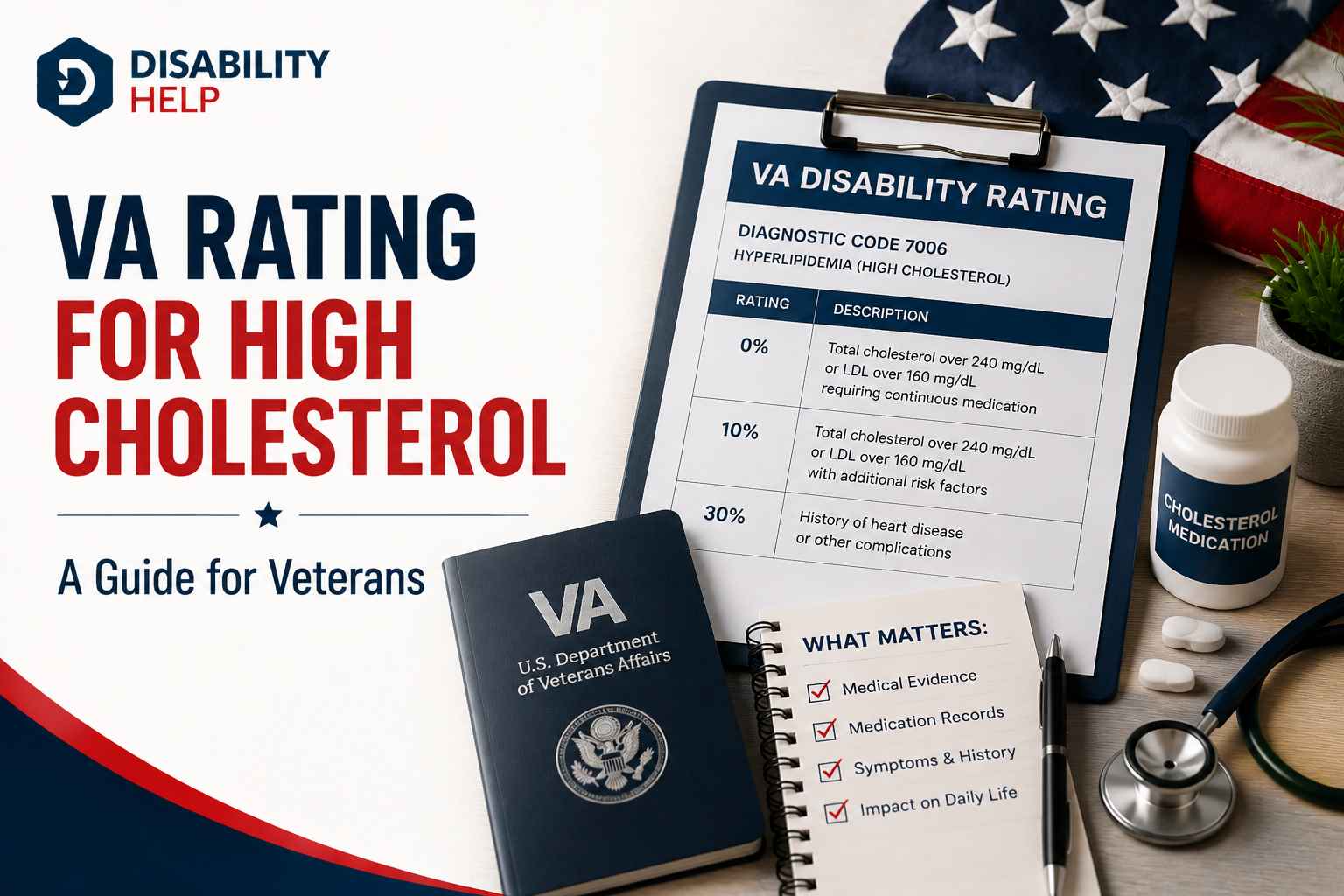
No. The VA does not assign a VA rating for high cholesterol as a standalone condition. The Department of Veterans Affairs treats high cholesterol, medically called hyperlipidemia, as a laboratory finding rather than a disability, so it carries a 0% rating on its own and pays no compensation by itself. That is not the end of the story, though. High cholesterol affects a large share of the population. The CDC reports that about 86 million U.S. adults have total cholesterol above 200 mg/dL, and nearly 25 million sit above 240 mg/dL. For veterans, that number matters because high cholesterol can open a side door to benefits through the conditions it causes or worsens.
This guide explains the VA's position, how secondary service connection works, and how to build a claim that actually pays.
Key Takeaways
- No standalone rating: The VA rates high cholesterol at 0% because it classifies hyperlipidemia as a lab finding, not a rateable disability or disease.
- Secondary connection pays: High cholesterol can support benefits when it causes or worsens a rateable condition like heart disease, hypertension, or stroke.
- The nexus letter is the key: A medical opinion linking your high cholesterol to a service-connected condition is the single most important piece of a secondary claim.
- In-service labs help: Elevated cholesterol readings recorded during service can prove an early onset and strengthen a later cardiovascular claim.
- Rateable results, not the lab number: Conditions such as coronary artery disease carry ratings of 10% to 100%, and hypertension ranges from 0% to 60%.
- Guidelines back the link: The 2025 VA/DoD lipid guideline confirms cholesterol's role in heart disease, giving you medical support for a nexus argument.
Why Doesn't the VA Rate High Cholesterol Directly?
The VA does not rate high cholesterol because federal rules treat it as a test result, not a disease. In plain terms, a lab number by itself does not reduce your ability to earn a living, and the VA only pays for conditions that impair earning capacity. High cholesterol usually causes no symptoms until it contributes to something more serious.
This position traces back to a 1996 Federal Register notice (61 Fed. Reg. 20,440) stating that diagnoses of hyperlipidemia, elevated triglycerides, and elevated cholesterol are laboratory results and are not, in and of themselves, disabilities. The Code of Federal Regulations at 38 CFR Part 4, which holds the VA's rating schedule, contains no diagnostic code for hyperlipidemia. Without a code, there is nothing for a rater to assign a percentage to.
The Board of Veterans' Appeals has repeated this ruling consistently. In a February 2025 decision, the Board wrote that hyperlipidemia and elevated cholesterol are laboratory findings and are not disabilities for which VA compensation benefits are payable. Veterans who file for high cholesterol as a direct condition are denied every time for this reason, which is why the smarter path runs through the conditions high cholesterol affects.
How High Cholesterol Can Still Lead to VA Benefits
High cholesterol reaches benefits through secondary service connection. Under 38 CFR 3.310, the VA will service-connect a condition that is proximately due to, the result of, or aggravated by an already service-connected disability. Cholesterol can sit on either side of that chain.
There are two directions that matter. In the first, a service-connected condition causes or worsens your high cholesterol. In the second, your high cholesterol causes or worsens a new condition that the VA can rate. Both can create a compensable claim, and the second direction is where most veterans find real value, because the resulting cardiovascular condition carries an actual rating.
The regulation covers aggravation as well as causation. If a service-connected disability makes a non-service-connected condition worse, the VA compensates you for that increase in severity, even if the second condition existed before. This aggravation pathway is written directly into 38 CFR 3.310(b), and it gives veterans more than one way to connect the dots.
Service-Connected Conditions That Can Raise Your Cholesterol
Several conditions the VA already rates are known to push lipid levels higher. If you carry a service connection for any of these, your high cholesterol may be secondary to it:
- Type 2 diabetesA chronic condition where the body cannot produce or properly use insulin, leading to high blood sug...: Metabolic changes from diabetes frequently raise blood lipid levels, and many veterans with diabetes develop hyperlipidemia as a result.
- PTSD: Chronic stress and several common psychiatric medications contribute to metabolic syndrome, which often includes elevated cholesterol.
- Sleep apneaA sleep disorder characterized by repeated interruptions in breathing during sleep, often treated wi...: Research links obstructive sleep apneaA sleep disorder where breathing repeatedly stops and starts during sleep due to airway obstruction.... to metabolic disorders, including disrupted lipid metabolism and higher cholesterol.
- Medication side effects: Drugs prescribed for service-connected conditions, such as hypertension or certain chronic illnesses, can raise cholesterol as a side effect.
Rateable Conditions That High Cholesterol Can Cause
High cholesterol is a documented risk factor for serious cardiovascular disease. When it causes or worsens one of the following, the VA can rate that result:
- Coronary artery disease: Plaque buildup from high cholesterol is a leading cause of CAD, and in-service cholesterol records can help link later CAD to service.
- Hypertension: Arterial plaque from high cholesterol, known as atherosclerosis, can worsen high blood pressure, which the VA rates on its own.
- Stroke and ischemic heart disease: Both often result from arterial blockage tied to cholesterol, and both are rateable cardiovascular events.
- Kidney disease: Lipid problems can contribute to the progression of chronic kidney disease, another condition with its own rating schedule.
Direct Claim vs. Secondary Claim: Which Path Works?
The difference between filing high cholesterol as a direct condition and filing the condition it caused is the difference between a guaranteed denial and a payable claim. The table below compares the two approaches so you can see why the secondary route is the one that works.
| Factor | Direct Claim for High Cholesterol | Secondary Claim Through a Related Condition |
|---|---|---|
| What you file | Hyperlipidemia as a standalone disability | The heart, blood pressure, or kidney condition tied to it |
| Likely outcome | Denied. No diagnostic code exists | Can be granted if the medical link is proven |
| Rating assigned | 0%, no compensation | 10% to 100%, depending on the condition and severity |
| Key evidence needed | None will overcome the lab-finding rule | A medical nexus letter plus treatment records |
| Governing rule | 38 CFR Part 4 (no listing) | 38 CFR 3.310 (secondary service connection) |
Reading the table one way: filing directly wastes months and ends in denial. Filing the rateable condition, with high cholesterol as the connecting evidence, is the approach that can actually put compensation in your pocket.
Five Steps to Strengthen a VA Claim Involving High Cholesterol
Because high cholesterol is not rateable on its own, you have to build the claim around its connection to a condition that is. Follow these five steps in order to give your claim the strongest possible foundation.
- Get the medical nexus letter. Ask a qualified provider, ideally a cardiologist or endocrinologist, to write an opinion that explicitly links your high cholesterol to a service-connected condition or to the rateable condition it caused. This letter is the backbone of a secondary claim.
- Gather your lab history. Pull cholesterol readings over time to show a pattern. A single number proves little, but a documented trend supports the argument that the condition progressed and affected your cardiovascular health.
- Find in-service evidence. Search your service treatment records for any elevated cholesterol readings. Even undiagnosed high cholesterol during service can serve as an early indicator that strengthens a later cardiovascular claim.
- Document treatment and medications. Keep records of statins, dietary changes, and provider notes. This history shows the condition was real, managed, and medically significant rather than incidental.
- File the rateable condition, not the lab result. Submit the claim for the heart, blood pressure, or kidney condition, and present your high cholesterol as the connecting evidence. Work with a Veterans Service Officer to file it correctly the first time.
Key Terms Every Veteran Should Understand
A few terms come up constantly in cholesterol-related VA claims. Knowing what each one means helps you read a decision letter and speak the same language as your provider and your Veterans Service Officer.
Hyperlipidemia: The medical name for high cholesterol, meaning elevated levels of lipids (fats), including cholesterol and triglycerides, in the blood. The VA treats it as a lab finding, not a disability.
Secondary service connection: Benefits granted when a service-connected disability causes or aggravates another condition. Under 38 CFR 3.310, that second condition is treated as part of the original service-connected disability.
Medical nexus: The evidence-based link between two conditions, or between a condition and a service. A nexus letter states, in a provider's professional opinion, that one condition is at least as likely as not connected to another.
Atherosclerosis: The buildup of cholesterol-based plaque inside artery walls. This process is how high cholesterol turns into rateable conditions such as coronary artery disease and stroke.
rateable condition: A disability listed in the VA's rating schedule with a diagnostic code and assigned percentages. Coronary artery disease and hypertension are rateable; hyperlipidemia is not.
How the VA Rates the Conditions Cholesterol Causes
When high cholesterol contributes to a rateable cardiovascular condition, that condition carries real percentages. Here is how the VA rates the two most common ones, so you can see what a successful secondary claim is worth.
| Condition | Diagnostic Code | Rating Range |
|---|---|---|
| Hypertension | DC 7101 (38 CFR 4.104) | 0%, 10%, 20%, 40%, or 60% |
| Ischemic heart disease | DC 7005 (38 CFR 4.104) | 10%, 30%, 60%, or 100% |
Hypertension rating levels depend on your blood pressure readings, as detailed by CCK Law's breakdown of DC 7101. A veteran who needs continuous medication but has controlled readings still receives a 0% rating, which establishes service connection and opens the door to further secondary claims.
What the 2025 VA/DoD Lipid Guideline Means for Your Claim
As of 2026, the VA has made no move to create a direct disability rating for high cholesterol. The lab-finding rule still stands. What has changed is the medical support available to link cholesterol to rateable conditions, and that shift works in your favor.
The 2025 VA/DoD Clinical Practice Guideline on Lipid Management for Cardiovascular Disease Risk Reduction reinforces the central role of lipids in atherosclerotic cardiovascular disease (ASCVD). ASCVD covers coronary artery disease, stroke, and peripheral artery disease, all of which trace back in part to cholesterol buildup in the arteries. That official recognition gives your provider a current, authoritative basis for a nexus opinion.
In our experience reviewing how these claims succeed, the strongest secondary claims pair three things: a clear service-connected primary condition, documented high cholesterol over time, and a nexus letter that cites current medical guidance. The 2025 guideline supplies that last piece. When a cardiologist writes that your high cholesterol contributed to your heart condition and points to established VA/DoD guidance, the rater has a harder time dismissing the connection.
One more practical note on Total Disability based on Individual Unemployability, or TDIU. According to Woods & Woods, veterans cannot receive TDIU for high cholesterol alone, because there is no rating for it. If the conditions it causes, such as heart disease or stroke, meet the TDIU thresholds, though, you may qualify for compensation at the 100% level even when your combined rating is lower.
Building a Claim That Actually Pays
High cholesterol will never carry its own VA rating, but it is far from useless in a claim. Treated as connecting evidence rather than a standalone condition, it can support secondary service connection for the serious cardiovascular problems it helps cause. The path runs through the conditions the VA rates, and it depends on solid medical evidence and a strong nexus.
As of 2026, the 2025 VA/DoD lipid guideline gives your providers a stronger footing than ever to make that connection. Your next step is to gather your records, request a nexus letter, and file the rateable condition, not the lab number.
Before filing, organize your service treatment records, current diagnosis, medication history, and relevant medical opinions. Then read our guide on how to prove VA disability to learn what evidence can strengthen your claim and help establish the required connection to military service. An accredited Veterans Service Officer can also help determine which theory of service connection best fits your case.
Frequently Asked Questions
Can I get any VA disability for high cholesterol?
Not directly. The VA rates high cholesterol at 0% because it is a lab finding, not a disability. You can receive compensation only when high cholesterol causes or worsens a rateable condition, such as coronary artery disease or hypertension, and you prove that link through secondary service connection.
What is a medical nexus letter, and why does it matter?
A medical nexus letter is a written opinion from a qualified provider that connects your high cholesterol to a service-connected condition or to the rateable condition it caused. It matters because secondary claims rise or fall on this link. Without a nexus, the VA has no basis to grant the connection.
Does high cholesterol during service help my claim?
Yes. Elevated cholesterol readings in your service treatment records serve as an early indicator of a developing cardiovascular issue. Even if no one diagnosed a disability at the time, that in-service evidence strengthens the argument that a later heart condition is connected to your service.
Which conditions are most commonly linked to high cholesterol in VA claims?
On the causing side, service-connected diabetes, PTSD, and sleep apnea can raise cholesterol. On the other hand, high cholesterol can contribute to coronary artery disease, hypertension, stroke, and kidney disease. Each of those results is rateable, which is what makes the secondary claim worth pursuing.
Do I need a lawyer to file a secondary cholesterol claim?
You do not need one to file. Many veterans start with a Veterans Service Officer, who assists at no cost. If your claim is denied or the medical link is complex, an accredited VA attorney or agent can help. This guide is educational and does not replace advice for your specific situation.