If you are in doubt, don’t hesitate to submit more documents that will support your Filing a VA claim for disability compensation means submitting VA Form 21-526EZ to the Department of Veterans Affairs, along with evidence that connects a current condition to your military service. You can file online at VA.gov, by mail, in person at a regional office, or through an accredited representative. As of September 30, 2025, about 6.3 million veterans received this tax-free monthly benefit. You earned it through your service, and this guide shows you how to claim it.
Below you will find who qualifies, what evidence strengthens your case, the full step-by-step filing process, how long a decision takes in 2026, how ratings turn into monthly pay, and what to do if the VA says no.
Key Takeaways
- Two-part eligibility: You qualify with a current service-connected condition and qualifying service on active duty, active duty for training, or inactive duty training.
- VA Form 21-526EZ starts it: File this application online at VA.gov, by mail, in person, or through an accredited VSO, claims agent, or attorney.
- Evidence drives the outcome: Medical records, your DD214, and a nexus letter linking your condition to service form the core proof the VA reviews.
- 2026 decisions are faster: The VA averaged 78.6 days to complete a disability claim at the end of May 2026, down from 141.5 days in January 2025.
- Ratings set your pay: A 100% rating pays $3,938.58 per month tax-free in 2026, and the VA combines ratings using VA math, not simple addition.
- A denial is not the end: You can file a Supplemental Claim, request a Higher-Level Review, or appeal to the Board of Veterans' Appeals.
- Accredited help costs little: VSOs assist free of charge, and accredited attorneys cannot charge upfront fees to prepare an initial disability claim.
Who Qualifies for VA Disability Compensation?
You qualify for VA disability compensation if you have a current illness or injury that affects your body or mind, you served on active duty, active duty for training, or inactive duty training, and your condition is linked to that service. The VA calls this link a service connection.
There are three common paths to a service connection, and the VA explains each on its eligibility page. An in-service claim covers a condition that started during your service. A pre-service claim covers a condition you had before joining that service that was made worse. A post-service claim covers a disability tied to your active duty that appeared only after you left the military.
Some conditions skip the hardest step. For presumptive conditions, the VA already assumes your service caused the condition, so you do not have to prove the link. The PACT Act, signed in 2022, is the largest expansion of VA health care and benefits in decades. It added burn-pit and other toxic-exposure conditions to the presumptive list, which means many veterans who were once denied can now file or refile with a much simpler evidence burden.
Your discharge status matters. An other-than-honorable, bad conduct, or dishonorable discharge can block eligibility. If that applies to you, you may still qualify by requesting a discharge upgrade or a VA Character of Discharge review before or during your claim.
What Are the Different Types of VA Disability Claims?
The VA recognizes several claim types, and picking the right one shapes your evidence and your effective date. The main categories are original, increased, new, secondary, special, and supplemental claims. The table below summarizes each, based on the VA guidance on when to file each claim type.
| Claim Type | What It Covers | Key Requirement |
|---|---|---|
| Original Claim | Your first claim for a disability. | Can be filed up to 180 days before discharge (BDD program). |
| Increased Claim | A service-connected disability that has worsened. | Up-to-date medical evidence showing greater severity. |
| New Claim | Added benefits tied to an existing disability. | Based on new evidence. |
| Secondary Claim | A new disability caused by an existing service-connected one. | A medical nexus linking the two conditions. |
| Special Claim | Needs such as vehicle equipment or recovery payments. | Tied to a specific service-connected disability. |
| Supplemental Claim | Reopening a denied claim with new evidence. | New and relevant evidence. |
You also decide who gathers the proof. With a Fully Developed Claim (FDC), you submit every supporting document up front and certify that nothing else is coming, which can lead to a faster decision. With a standard claim, the VA gathers records on your behalf, which usually takes longer. If the VA finds it needs more non-federal records on an FDC, it can move your claim to the standard track.
How Do You File a VA Disability Claim, Step by Step?
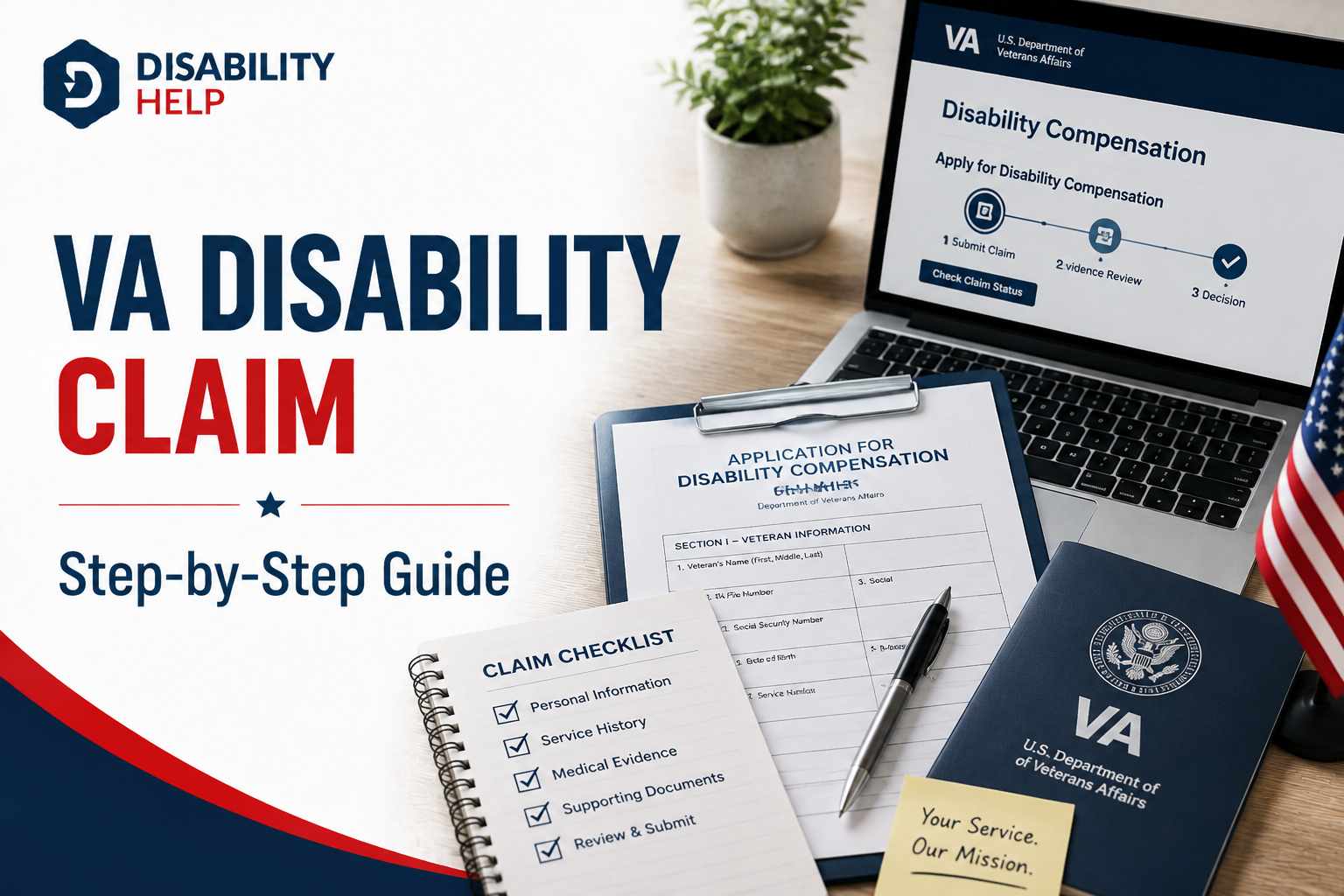
You file a VA disability claim in a clear sequence: confirm eligibility, protect your effective date, gather evidence, complete VA Form 21-526EZ, submit it, and attend any exam. Filing online at VA.gov sets your effective date automatically, so a separate Intent to File is not required for online applications.
- Confirm eligibility and list every condition. Write down each illness or injury you want to claim, along with the dates and how each one affects your daily life and work.
- File an Intent to File if you plan to mail a paper claim. VA Form 21-0966 reserves your effective date and gives you up to one year to gather evidence, so your back pay can start from the intended date.
- Gather your evidence. Collect VA and private medical records, your DD214, and service treatment records, and supporting statements from people who witnessed your condition.
- Complete VA Form 21-526EZ. This is the Application for Disability Compensation and Related Compensation Benefits. Fill it out fully, and sign every section that requires it.
- Submit through your chosen method. File online at VA.gov, mail the form to the Claims Intake Center, bring it to a regional office, fax it, or file through an accredited VSO, claims agent, or attorney.
- Attend your C&P exam if scheduled. The VA may set up a Compensation and Pension exam to confirm your diagnosis and rate its severity. Missing it can stall or sink your claim.
- Track your claim online. Use the claim status tool at VA.gov to watch your file move through each stage and respond quickly to any request for more evidence.
What Evidence Do You Need to Support Your Claim?
Strong evidence decides most claims. The VA needs proof that your condition exists today, proof of a qualifying service event or exposure, and proof of the link between them. Weak or missing evidence is the leading reason claims stall. Gather these core documents:
- VA medical and hospital records tied to your claimed conditions, or records showing a rated condition has worsened.
- Private medical records from non-VA providers who have treated your conditions.
- Supporting statements from family, friends, clergy, or fellow service members describing your condition and when it started.
- Discharge papers (DD214) and your service treatment records.
For harder cases, a nexus letter can carry the claim. A nexus letter is a statement from a doctor that explains the connection between your current condition and your military service. A strong one names the doctor's credentials, states your diagnosis, describes your symptoms and their impact, and gives a clear medical opinion on the link to an in-service event. Legal analysts at Hill & Ponton note that the letter should also confirm that the doctor reviewed your full file and use precise VA terminology.
How Long Does a VA Disability Claim Take in 2026?
A VA disability decision moves faster in 2026 than in recent years. The VA reported an average of 78.6 days to complete a disability claim at the end of May 2026, down from 141.5 days in January 2025, according to a VA press release. Your own timeline depends on your claim type and how complete your evidence is.
The same VA update shows the backlog of pending claims fell below 75,000 for the first time since 2020, while decision accuracy rose above 94%. The VA also processed more than two million disability claims in fiscal year 2026 as of June 1, 2026. Faster averages do not guarantee a fast personal result, though. A single, well-documented condition can close in under 90 days, while a claim with several conditions or a needed C&P exam can run past 150 days.
You control the biggest lever: evidence completeness. Filing a Fully Developed Claim with your records attached on day one keeps your file out of the slow evidence-gathering loop that a VA development letter triggers.
How VA Disability Ratings and VA Math Work
The VA assigns a rating from 0% to 100% in 10% steps, based on how severely your service-connected condition limits you. That percentage sets your monthly payment and unlocks other benefits. When you have more than one rated condition, the VA does not simply add the numbers, and this surprises many veterans.
The VA uses a whole-person method it calls VA math. It starts with your highest rating, then applies each additional rating to the part of you that remains, and rounds the final figure to the nearest 10%. Two conditions rated 50% and 30% combine to 65%, which rounds up to a 70% combined rating, not 80%.
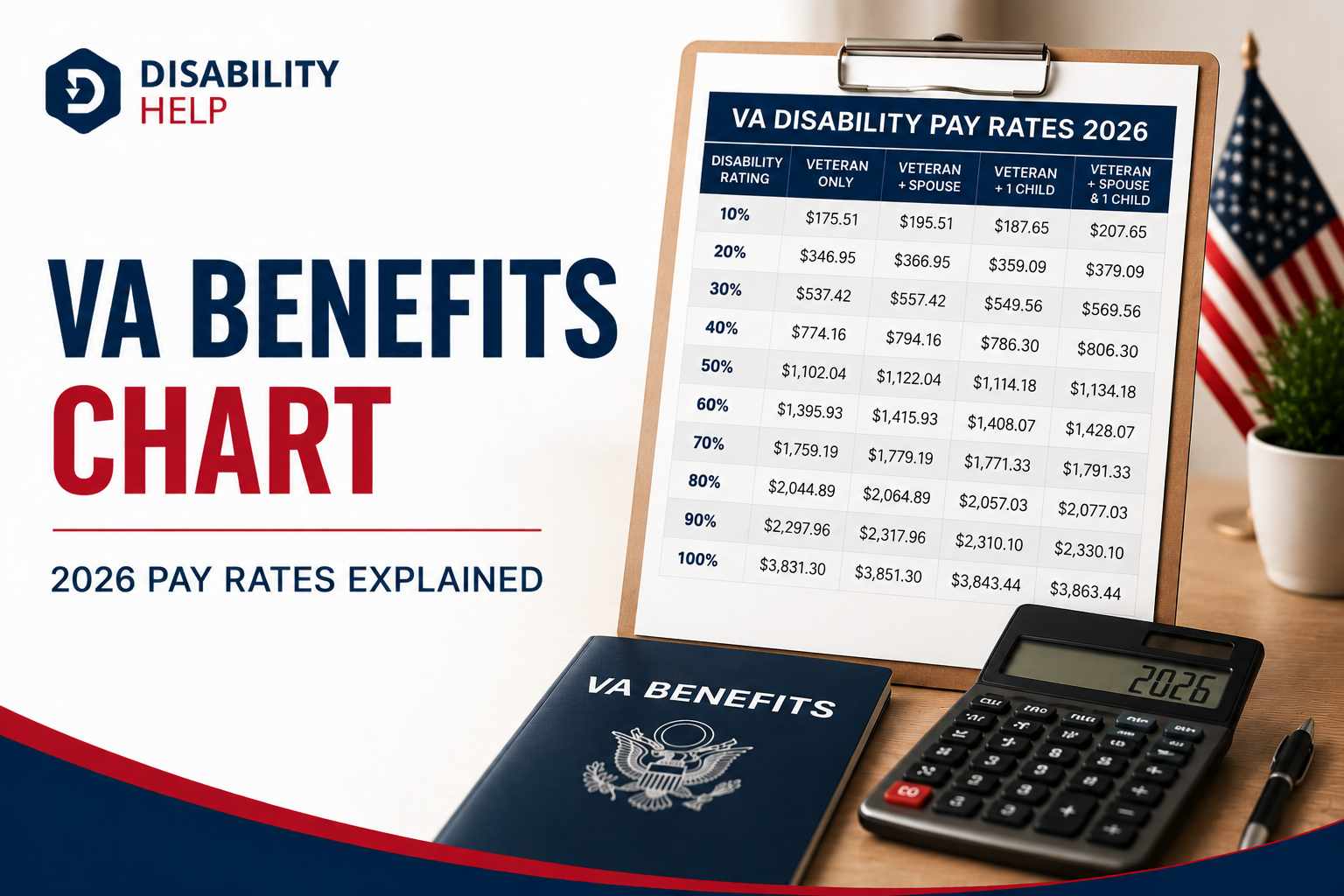
Your rating turns into real money. After a 2.8% cost-of-living adjustment effective December 1, 2025, a veteran with a 100% rating and no dependents receives $3,938.58 per month tax-free in 2026. Payments rise at 30% and above for veterans with dependents.
Key VA Claim Terms You Should Know
A few terms come up again and again in the claims process. Learn these before you file so nothing on your decision letter reads like code:
- Service connection: The link between your current condition and your military service. Every claim rises or falls on it.
- Nexus letter: A doctor's written medical opinion tying your diagnosis to an in-service event or exposure.
- C&P exam: The Compensation and Pension exam the VA uses to confirm your diagnosis and measure its severity.
- Effective date: The date your benefits start counting, which sets your back pay. An Intent to File can push it earlier.
- Presumptive condition: A condition the VA already assumes your service caused, so you skip proving the nexus.
- Combined rating: Your overall percentage after the VA applies VA math to all of your separate ratings.
Common Mistakes That Delay or Reduce VA Claims
Many veterans lose months or money to avoidable errors. Watch for these five, which appear in nearly every claim that gets sent back:
- Incomplete or inaccurate forms. Leaving off a condition, skipping dates, or missing a signature sends your file back to the start.
- Thin medical evidence. Relying only on military records or a single VA exam often falls short. Add private provider records too.
- Missed deadlines. Filing and appeal windows are strict, and missing one can cost retroactive benefits or restart the process.
- Vague condition descriptions. General symptom notes give the rater little to work with. Describe exactly how the condition affects your daily life and work.
- No clear service connection. Without a documented link to service, the VA denies the claim. A strong nexus letter often fixes this gap.
A Practical Look at How Evidence Changes a Claim
Consider an illustrative example that mirrors what we see across disability filings. A veteran files an original claim for a knee injury and submits only the application, expecting the VA to find the rest. The VA opens an evidence-gathering step, mails a development letter, waits on outside records, and the claim drifts past six months.
A second veteran with the same injury files a Fully Developed Claim. They attach service treatment records showing the original injury, a current private orthopedic evaluation, and a short nexus letter connecting the two. The rater has everything needed in one packet, and the decision arrives in roughly a third of the time. The difference is not luck. It is a complete evidence file submitted on day one. This example is illustrative and does not reflect a specific person or a guaranteed result, since every claim is decided on its own facts.
What If the VA Denies Your Claim? Your Appeal Options
A denial is a decision you can challenge, not a closed door. If you disagree with the VA, you have three decision review options under the modern appeals system. Choose based on whether you have new evidence and how much of a fresh look you want.
| Review Option | What It Is | New Evidence Allowed? |
|---|---|---|
| Supplemental Claim | You add new and relevant evidence the VA has not seen. | Yes, new and relevant evidence is required. |
| Higher-Level Review | A more senior reviewer takes a fresh look at the same file. | No new evidence is accepted. |
| Board of Veterans' Appeals | A Veterans Law Judge reviews your case. | Depends on the docket you choose. |
Pick the Supplemental Claim when you have found a missing record or a stronger nexus letter. Pick the Higher-Level Review when you believe the VA made a clear error on the evidence already in your file. The Board is the fullest review, and it takes the longest, often a year or more.
When to Get Help, and How to Avoid Claim Scams
You can file a VA claim on your own, but free, qualified help exists. Veterans Service Organizations have accredited representatives who prepare and file claims at no cost. Accredited claims agents and attorneys can also represent you, and by law, they cannot charge an upfront fee to prepare an initial disability claim. They may only charge a fee, usually a percentage of back pay, after they help win an appeal.
That fee rule is your fraud filter. Any company that demands a large upfront payment to file a basic VA claim, or that promises a specific rating, is a warning sign. Legitimate representatives are VA-accredited, and you can verify accreditation before you sign anything. Never pay a stranger to submit a form you can file yourself for free.
One more point worth knowing: VA disability compensation and Social Security Disability InsuranceA form of insurance that provides income to individuals who are unable to work due to a disability. are separate programs, and you can receive both at the same time. VA compensation is not means-tested and does not reduce an SSDI payment.
Build a Complete VA Claim, and Track What Happens Next
Filing a VA claim for disability compensation comes down to three things: proving a current condition, showing a service connection, and submitting a complete evidence file. Get those right, and you put your claim in the fastest lane the VA offers, where 2026 decisions now average under 80 days. A denial is only a checkpoint, since the Supplemental Claim, Higher-Level Review, and Board appeal all give you a real path forward.
Start by listing your conditions and gathering your records today, then file the way that fits your situation. For guidance that connects VA compensation with SSDI, workers' compensation, and the rest of your disability rightsThe legal and human rights afforded to individuals with disabilities, often the focus of advocacy an..., explore the resources at disabilityhelp.org and take the next step with a clear plan.
Once you submit your application, do not wait without knowing what is happening. Explore our guide on how to check your VA claim status to follow your claim’s progress, respond to evidence requests, and recognize when VA has issued its decision.
Frequently Asked Questions
How do I file a VA disability claim online?
Sign in at VA.gov, open the disability compensation application (VA Form 21-526EZ), and complete it in the online portal. Filing online sets your effective date the moment you start, so you do not need a separate Intent to File. You can save your progress and upload evidence before you submit.
What is the fastest way to get a VA disability decision?
File a Fully Developed Claim with all of your evidence attached on day one, including service treatment records, private medical records, and a nexus letter if service connection is unclear. Complete files skip the evidence-gathering delay that a VA development letter causes, which is the most common reason claims run long.
Can I get VA disability and SSDI at the same time?
Yes. VA disability compensation and Social Security Disability Insurance are separate federal programs with different rules, and receiving one does not reduce the other. Many veterans qualify for both. A VA rating does not guarantee SSDI approval, though, because the two programs measure disability differently.
How much does VA disability pay in 2026?
Payments depend on your combined rating and dependents. After the 2.8% cost-of-living adjustment that took effect December 1, 2025, a veteran rated 100% with no dependents receives $3,938.58 per month tax-free in 2026. Lower ratings pay less, and ratings of 30% and above add compensation for dependents.
Do I need a lawyer to file a VA disability claim?
No. You can file on your own or with a free VSO representative. An accredited attorney becomes most useful at the appeal stage, especially before the Board of Veterans' Appeals. Attorneys cannot charge upfront fees to prepare an initial claim, so early help through a VSO costs you nothing.
What is a nexus letter and do I need one?
A nexus letter is a doctor's written opinion linking your current condition to your military service. You do not need one for a presumptive condition, since the VA already assumes the link. For direct and secondary claims where the connection is not obvious, a clear nexus letter can be the difference between a grant and a denial.