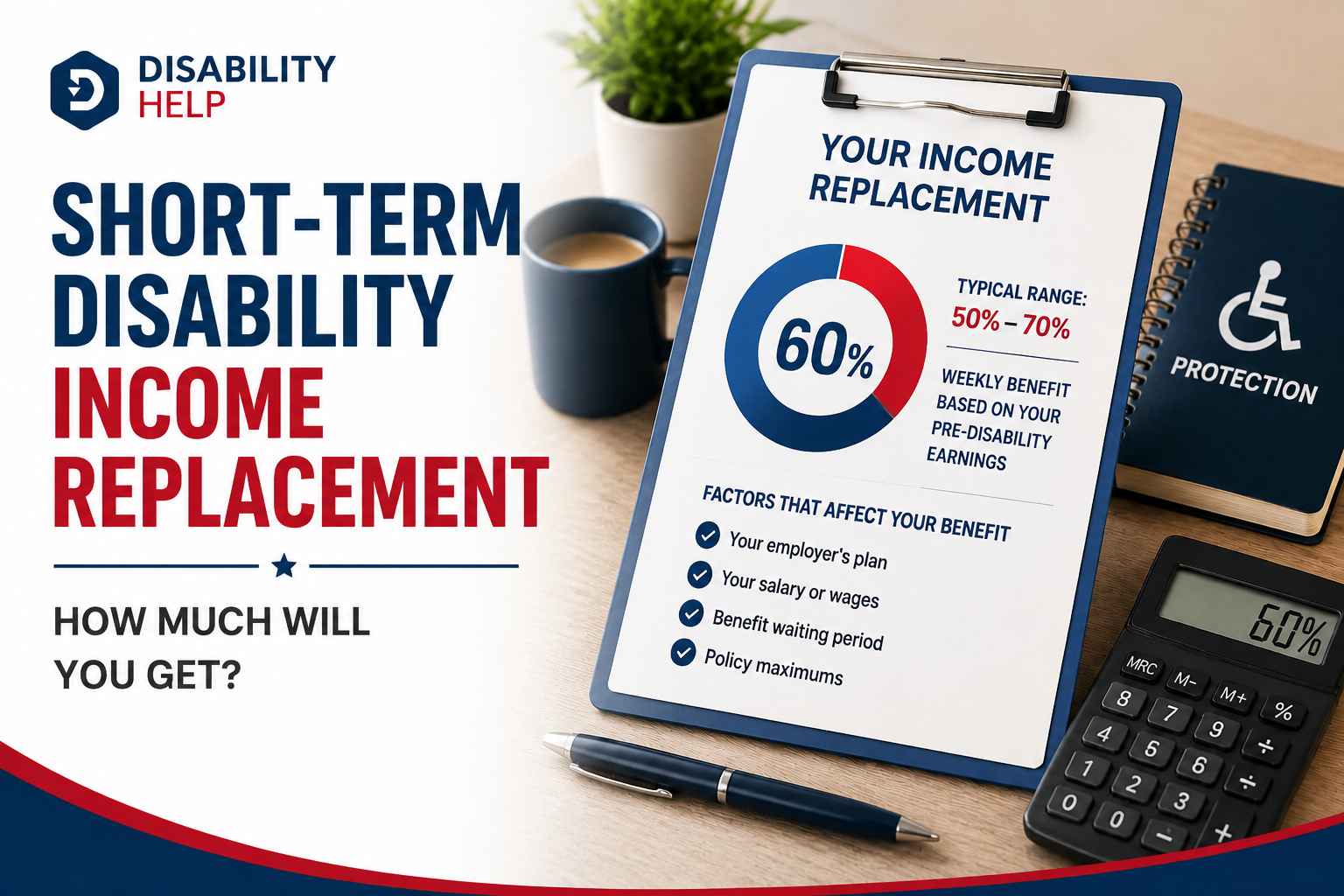
Most short-term disability insurance replaces 50% to 60% of your pre-disability gross income, with 60% being the industry standard for employer group plans. Your actual payout can land much lower once weekly benefit caps, taxes, and offsets from other income apply. According to the U.S. Bureau of Labor Statistics, the median salary replacement rate for short-term disability plans is 60%, a figure that has held steady for years.
This guide breaks down what determines your real number, including benefit caps, state programs, the tax rules tied to who pays your premium, and the offsets that quietly reduce your check.
Key Takeaways
- Standard replacement rate: Employer group short-term disability plans replace 50% to 60% of gross income, with 60% the most common benchmark across occupations.
- Caps cut high earners: A weekly maximum can drop a 60% policy to an effective 34% rate or lower for executives earning above the cap threshold.
- Base pay only: Group policies usually calculate benefits on base salary, excluding bonuses, commissions, and overtime that many workers depend on.
- Taxes depend on premiums: Employer-paid premiums make benefits taxable; premiums you pay with after-tax dollars make your benefits completely tax-free.
- State programs vary widely: California replaces up to 90% in 2026, while New York caps short-term disability at just $170 per week, unchanged since 1989.
- Offsets reduce payouts: Workers' compensation, state benefits, and SSDI all trigger offset provisions that lower what your private insurer pays you.
What Is the Typical Short-Term Disability Income Replacement Rate?
Short-term disability insuranceInsurance that provides income replacement for a limited time when an employee is unable to work due... replaces 50% to 60% of your gross income for most employer group plans, and 60% is the standard benchmark. Policies are built to replace a portion of your wages on purpose, not the full amount, so you keep a financial reason to return to work once you recover.
Some premium policies push the rate to 70% or even 80%, but those are uncommon in standard employer benefit packages. The Bureau of Labor Statistics reports that most employer-provided STD plans are fixed-duration policies, typically lasting to 13 to 26 weeks.
Benefit duration typically runs from 13 to 52 weeks, with 26 weeks (six months) being the most common. Before any benefit arrives, you must clear an elimination period, a waiting window that usually lasts 7 to 14 days for short-term policies. During that gap, most workers lean on accrued sick leave or paid time off to cover expenses.
A financial planning analysis from Mercer Advisors notes that short-term disability covers up to six months and replaces about 60% of income, which fits temporary events like surgery recovery, pregnancy, or a serious but recoverable illness.
Standard Short-Term Disability Policy Features
| Policy Feature | Typical Range | Most Common Standard |
|---|---|---|
| Income Replacement Rate | 40% to 80% | 60% of gross income |
| Benefit Duration | 13 to 52 weeks | 26 weeks (6 months) |
| Elimination (Waiting) Period | 7 to 30 days | 7 to 14 days |
Source: U.S. Bureau of Labor Statistics and major carrier policy data.
How Benefit Caps Reduce Payouts for High Earners
A maximum benefit cap can shrink a 60% replacement rate to 35% or less for high earners, because nearly every group policy limits the weekly or monthly dollar amount it will pay. The stated percentage tells only part of the story once your salary climbs above the cap threshold.
Among workers with maximum payout provisions, BLS data put the median maximum benefit at $584 per week. Modern policies frequently cap weekly benefits between $500 and $2,500, and individual policy caps can reach $5,000 to $6,500 per month. Two examples show how much the cap matters.
Two Scenarios: How the Same Policy Pays Differently
Scenario A: Standard Earner. An employee earns $60,000 a year, or $1,154 per week. The policy offers 60% replacement with a $1,000 weekly cap. The math is $1,154 multiplied by 60%, which equals $692.40 per week. Because $692.40 sits below the $1,000 cap, this worker receives the full 60% rate.
Scenario B: High Earner Hitting the Cap. An executive earns $150,000 a year, or $2,884 per week. The same policy offers 60% with a $1,000 weekly cap. The math is $2,884 multiplied by 60%, which equals $1,730.40 per week. Because that exceeds the $1,000 cap, the benefit drops to $1,000. The executive ends up with an effective replacement rate of just 34.6%, not 60%.
Group policies make this worse by basing calculations on base salary alone. They exclude commissions, bonuses, and overtime. For sales professionals and executives whose pay depends on performance bonuses, the share of real take-home pay replaced can be remarkably low. To close these gaps, many high earners buy supplemental individual disability policies that offer higher caps, stronger definitions of disability, and coverage for total compensation rather than just base salary. A disability insurance analysis from Savant Wealth Management explains why this gap hits high-income professionals hardest.
State-Mandated Disability Programs Compared (2026)
Five states plus Puerto Rico require temporary disability insuranceA form of insurance that provides income to individuals who are unable to work due to a disability., and their replacement rates range from 50% to 90% of wages. These state programs often calculate benefits differently from private group plans and, in several states, pay lower- and middle-income workers more generously.
As of 2026, the mandate states are California, New Jersey, Hawaii, New York, and Rhode Island, according to Paychex. The differences between them are dramatic, as the table below shows.
| State | Program | Replacement Rate | 2026 Max Weekly Benefit |
|---|---|---|---|
| California | State Disability Insurance (SDI) | 70% to 90% by income | $1,700–$1,800 per week |
| New Jersey | Temporary Disability Insurance (TDI) | 85% of average weekly wage | About $1,081 |
| Hawaii | Temporary Disability Insurance (TDI) | 58% of average weekly wage | $871 |
| New York | Disability BenefitsFinancial assistance provided to individuals who are unable to work due to a disability, such as Soc... Law (DBL) | 50% of salary | $170 |
| Rhode Island | Temporary Disability Insurance (TDI) | Varies by base period | Set annually by state |
California's SDI program stands out for its progressive structure. Under Senate Bill 951, lower-income workers can receive up to 90% wage replacement in 2026, scaling down to 70% for higher earners, up to a maximum of $1,700–$1,800 per week (adjusted annually). New Jersey also pays a strong 85% replacement rate for eligible workers.
New York sits at the opposite end. Its DBL benefit remains capped at $170 per week, a figure that has not changed since 1989, according to Nolo's legal guide. A pending bill, S172A, would raise it over several years, but as of 2026, the $170 cap still applies. New Jersey's maximum, by contrast, exceeds $1,000 per week, more than six times what New York pays.
How Taxes Change Your Real Take-Home Disability Pay
Whether your short-term disability benefits are taxable depends entirely on who paid the premiums. This single factor can swing your real income replacement by 10 to 15 percentage points, so it deserves close attention before you assume a 60% policy gives you 60%.
The IRS rules on disability proceeds set three outcomes based on premium payment.
Employer-paid premiums: If your employer pays 100% of the premiums, a common fringe benefit, the IRS treats your benefits as fully taxable income. You owe federal income tax, and possibly state income tax, on the payouts. A policy that promises 60% replacement may effectively yield closer to 45% or 50% after withholding.
Employee-paid premiums (post-tax): If you pay the premiums yourself with after-tax dollars, through a voluntary payroll deduction or an individual policy, your benefits are entirely tax-free. A 60% tax-free benefit often closely mirrors your normal take-home pay, since you no longer pay income tax, MedicareA U.S. federal health insurance program for people aged 65 and older, and for some younger people wi..., or Social Security tax on that portion.
Shared premiums: If you and your employer split the premium, the taxability is prorated. If your employer pays 60% and you pay 40% with after-tax dollars, then 60% of your benefit is taxable, and 40% is tax-free.
Key Short-Term Disability Terms You Need to Know
Before you read a policy, learn the terms that decide your payout. The following definitions cover the words that show up in every Summary Plan Description.
Elimination period: The waiting window between when your disability begins and when benefits start, usually 7 to 14 days for short-term policies. You receive no benefit during this period and typically cover it with sick leave or PTO.
Replacement rate: The percentage of your pre-disability gross income the policy pays, most often 60% for group plans. The stated rate applies only up to the policy's benefit cap.
Benefit cap: The maximum dollar amount the policy pays per week or month, regardless of your replacement percentage. Caps most affect high earners whose calculated benefit exceeds the limit.
Covered earnings: The portion of your pay on which the benefit is calculated. Group policies usually count base salary only and exclude bonuses, commissions, and overtime.
Offset: A provision that reduces your benefit by the amount you receive from other income sources, such as workers' compensation, state disability, or SSDI, so your total does not exceed your pre-disability wages.
Income Sources That Trigger a Benefit Offset
Offset provisions prevent you from collecting more than 100% of your pre-disability income across all sources. If you qualify for other income replacement, your private disability insurer reduces its payout by that amount. A United Policyholders explainer on disability offsets details how these clauses work. Four common sources trigger a reduction.
- Workers' compensation. If your disability is work-related, workers' comp acts as the primary payer. Your short-term disability benefit drops by the workers' comp amount you receive.
- State disability benefits. If you live in a state with a mandated program like California or New Jersey, your private group policy subtracts the state benefit from its payout.
- Social Security Disability Insurance (SSDI)A U.S. government program that provides financial assistance to individuals who are unable to work d.... SSDI has a strict definition of disability and a five-month waiting period, but if you qualify and start receiving federal benefits, your private insurer offsets those amounts.
- Part-time earnings. If your policy includes a partial or residual disability provision, you may work part-time while recovering. Your benefit then reduces based on those earnings, so your total income stays at or below your pre-disability wage.
Workers navigating a job-related injury often face workers' comp and disability claims at the same time.
Why the Advertised Percentage Rarely Matches Reality
In practice, the percentage printed in your benefits summary is a starting point, not a promise. Three factors stack on top of each other to lower it: the benefit cap, the exclusion of bonus and commission pay, and taxes on employer-funded premiums. A worker who reads 60% on the brochure can end up replacing closer to 40% of real take-home pay once all three apply.
Financial advisors point to the gap between federal benefits and professional income as the reason supplemental coverage matters. Mercer Advisors reports the average 2026 monthly SSDI benefit is $1,630, or about $19,560 a year, with a five-month waiting period. That figure rarely replaces professional income, which is why short-term disability and supplemental individual policies fill the early gap before any long-term benefit begins. The lesson for any reader: read the cap and the covered-earnings definition before you trust the headline percentage.
Knowing Your Real Replacement Rate Before You Need It
Figuring out how much short-term disability insurance replaces means looking past the advertised percentage. While 60% is the group-plan standard, your true benefit depends on the weekly cap, the exclusion of bonuses and commissions, the tax structure tied to your premiums, and offsets from other income. As of 2026, state programs widen the range further, from $170 a week in New York to $1,765 a week in California.
To find your real number, review your employer's Summary Plan Description or your individual policy, and check the definition of covered earnings, the maximum benefit cap, the elimination period, and the premium tax structure.
If your situation also involves a workplace injury, an SSDI claim, or a long-term disability question, explore our guide on the importance of disability rights in the legal system to understand how each piece fits together before you file.
Frequently Asked Questions
How much of my paycheck does short-term disability replace?
Most employer group short-term disability plans replace 50% to 60% of your gross income, with 60% the standard. Your real payout can fall below that once weekly benefit caps, taxes on employer-paid premiums, and offsets from other income apply.
Is short-term disability income taxable?
It depends on who paid the premiums. If your employer paid them, your benefits are fully taxable. If you paid with after-tax dollars, your benefits are tax-free. If you split the cost, the benefit is taxed in proportion to the employer's share.
Why is my short-term disability benefit lower than 60% of my pay?
Three factors lower it. A weekly or monthly benefit cap limits high earners, group policies exclude bonuses and commissions, and benefits from employer-paid premiums are taxed. Together, these can drop a 60% policy to an effective 40% or less.
How long does short-term disability pay benefits?
Benefit duration typically runs 13 to 52 weeks, and 26 weeks (six months) is the most common across occupations. Benefits begin after an elimination period of 7 to 14 days, which you usually cover with sick leave or PTO.
Which states require short-term disability insurance?
As of 2026, California, New Jersey, Hawaii, New York, and Rhode Island require temporary disability insurance, and Puerto Rico runs a similar program. Replacement rates range from 50% in New York to as much as 90% in California for lower-income workers.
Does workers' comp reduce my short-term disability benefit?
Yes. If your disability is work-related, workers' compensation is the primary payer, and your private short-term disability insurer offsets its payout by the amount of workers' comp you receive, so your combined income does not exceed your pre-disability wages.