If you receive SSDI or SSI and rent feels impossible, you are not imagining the gap. The maximum federal SSI payment in 2026 is $994 per month for an individual, and the average federally administered SSI check that the Social Security Administration paid in January 2026 was $737. Meanwhile, the National Low Income Housing Coalition's 2026 Gap report found there are only 35 affordable and available rental homes for every 100 extremely low-income renter households. Social Security disability housing assistance exists to close that gap through several federal programs, but the rules, waiting lists, and benefit interactions trip up most first-time applicants.
This guide walks you through which programs you can apply for, how housing assistance affects your SSI check, and exactly what to do first.
Key Takeaways
- Primary federal programs: The Section 8 Housing Choice Voucher, Section 811, Section 202, public housing, and USDA Section 521 all serve disabled renters with rent generally capped at 30% of adjusted income.
- 2026 SSI rate: The federal benefit rate is $994 per month for an individual and $1,491 for a couple, with most recipients receiving less due to countable income.
- ISM reduction: If you live in someone else's home and don't pay your fair share of housing costs, SSI can reduce your check by up to $351.33 per month under the in-kind support and maintenance rule.
- ABLE accounts protect benefits: Up to $100,000 in an ABLE account is excluded from SSI's $2,000 resource limit, and recent rules let people whose disability began before age 46 qualify.
- Apply to multiple lists: Most Section 8 waiting lists are years long, and many are closed, so apply to every public housing agencyThe capacity of individuals with disabilities to act independently and make their own choices. you can reach and ask about disability set-asides.
- Fair Housing Act protects you: Landlords must allow reasonable accommodationsModifications or adjustments in healthcare settings to support patients with disabilities. and modifications, and federally funded providers must pay for needed structural changes.
- Update your contact info: The single most common reason applicants get removed from waiting lists is missing a routine update letter from the housing authority.
How SSDI and SSI Recipients Qualify for Housing Assistance
Most federal housing programs use the U.S. Department of Housing and Urban Development's income tiers, not the Social Security Administration's disability rules. To qualify, your household income must fall below a percentage of your area's median income (AMI) set by HUD each year. People with disabilities, including SSDI and SSI recipients, almost always fall well under these thresholds.
By law, public housing agencies must give 75% of new Housing Choice Vouchers to households earning at or below 30% of AMI, the extremely low-income tier. SSI recipients living on the $994 federal benefit rate fall into this group in every state. SSDI recipients with average benefit amounts also generally qualify.
Disability status itself matters too. Many public housing agencies have separate set-aside vouchers for non-elderly people with disabilities (called NED vouchers) and project-based units reserved for disabled tenants. These set-asides often move faster than the general voucher waiting list because demand is lower, even though supply is also limited.
How In-Kind Support and Maintenance Affects Your SSI Check
In-Kind Support and Maintenance (ISM) is the Social Security Administration's term for housing help you receive from someone else. If a family member lets you live rent-free, pays your utilities, or covers your mortgage, the SSA treats that as income and can reduce your SSI payment by up to $351.33 per month in 2026, equal to one-third of the federal benefit rate plus $20.
What counts as ISM: rent, mortgage payments, property taxes, heating fuel, gas, electricity, water, and sewer. As of September 30, 2024, the SSA eliminated food from ISM calculations, so groceries paid by someone else no longer reduce your check.
There is one major workaround. Money you pay for housing out of an ABLE account does not count as ISM. If a family member contributes to your ABLE account and you use those funds to pay rent or utilities yourself, your SSI check stays whole. This is a meaningful planning point that most SSI recipients are never told about.
Which Federal Housing Programs Help People with Disabilities?
Five federal programs make up the core of Social Security disability housing assistance. Each has different rules, different application paths, and different waiting list realities. The table below summarizes the structure of each.
| Program | Who It Serves | How It Works | Tenant Rent Share |
|---|---|---|---|
| Section 8 Housing Choice Voucher | Low-income families, elderly, people with disabilities | Tenant-based voucher; you find your own rental in the private market | About 30% of adjusted monthly income |
| Section 811 Supportive Housing | Very low-income adults with disabilities | Project-based; specific units developed for disabled tenants with supportive services | About 30% of adjusted monthly income |
| Section 202 Supportive Housing | Very low-income adults aged 62 and older | Project-based senior housing with supportive services | About 30% of adjusted monthly income |
| Public Housing | Low-income families, elderly, and disabled tenants | Government-owned and operated developments | About 30% of adjusted monthly income |
| USDA Section 521 | Low-income rural residents, including disabled tenants | Project-based rental assistance in USDA-financed rural properties | About 30% of adjusted monthly income |
A Few Program-Specific Notes Worth Knowing:
Section 8 vouchers are portable. Once you receive a voucher, you can use it with any landlord willing to participate in the program, in most cases, anywhere in the country. The downside is that waiting lists are long and often closed. The Housing Choice Voucher program is HUD's largest disability housing resource, but the San Diego Housing Commission, for example, closed its Section 8 list in February 2026 and does not expect to pull new families for several years.
Section 811 is purpose-built for disabled adults. HUD published a $158 million Section 811 Project Rental Assistance funding opportunity in May 2026 to expand units for extremely low-income adults with disabilities. Units are often paired with voluntary supportive services that help residents live independently in the community.
Section 202 only serves seniors 62 and older. If you are under 62, this program is not an option. No new Section 202 capital advances have been funded since 2012, but existing properties continue to operate, and many include accessible units.
USDA Section 521 matters if you live rurally. Many disabled renters in small towns and unincorporated areas overlook this program because it does not appear on HUD's main site. Apply directly through USDA Rural Development.
How to Apply for Disability Housing Assistance: A Step-by-Step Process
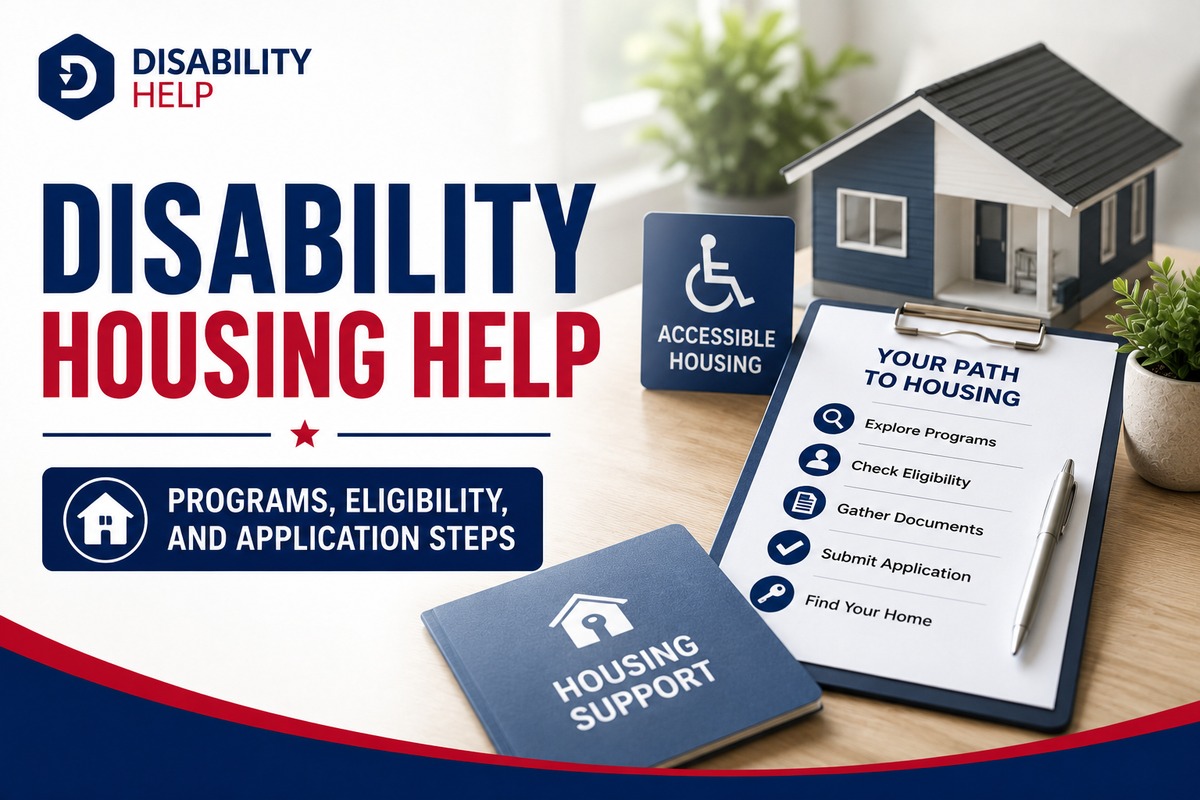
The application process varies by program, but the general sequence applies across most federal options. Start here.
- Locate your local public housing agency. HUD maintains a PHA contact directory on HUD.gov. Most metropolitan areas have multiple PHAs, and you do not have to live in a PHA's jurisdiction to apply to its waiting list, though you may need to live there for the first 12 months after receiving help.
- Check which waiting lists are open. Many PHAs cycle their lists open and closed depending on funding. Apply to every open list within commuting distance. Section 811, public housing, and project-based developments often have separate lists from the Section 8 voucher list.
- Gather documentation before you apply. You will need proof of income (SSDI or SSI award letter), Social Security cards for everyone in the household, proof of citizenship or eligible immigration status, and disability verification if you are applying for a disability set-aside.
- Ask about disability-specific set-asides. When you apply, ask the PHA directly whether they have NED vouchers, project-based set-asides for disabled tenants, or shorter waiting lists for households where at least one member has a disability.
- Apply for MedicaidA U.S. government program that provides health coverage to eligible low-income individuals, includin... in parallel. Most states confer Medicaid eligibility to SSI recipients automatically or after a separate application. Medicaid Home and Community-Based Services (HCBS) waivers can pay for home modifications and personal care services even when they do not cover rent itself.
- Maintain your contact information. When a PHA tries to contact you and cannot, you are removed from the list. Update your address and phone number every time they change.
- Request reasonable accommodations during the application process itself. If the application is hard to complete due to your disability, the PHA must accommodate you under the Fair Housing Act. This can mean help with paperwork, an alternative interview format, or extended time.
Common Application Mistakes That Disqualify Disability Applicants
The single most common reason an applicant loses their place is administrative, not financial. Avoid these mistakes.
- Submitting an incomplete application. Missing income documentation, an unsigned form, or a blank household composition page is enough to bounce your application out of the queue.
- Stating income inaccurately. Be precise about every income source, including SSDI, SSI, child support, and part-time wages. Inaccuracy during verification is treated as fraud, not a typo.
- Ignoring update letters. PHAs purge their lists every 12 to 24 months by mailing update requests. If you do not respond, you are removed. Set a calendar reminder to check your mailing address with every PHA you have applied to.
- Applying to only one waiting list. Demand far outstrips supply. Apply to as many lists as you reasonably can. Section 8, Section 811, public housing, and project-based vouchers all use different lists.
- Failing to disclose a disability during application. If you qualify for a disability set-aside or preference, the PHA needs to know. You do not have to disclose your specific diagnosis, only that you have a qualifying disability under the Fair Housing Act.
- Not requesting a reasonable accommodationModifications or adjustments to a job or environment that enable a person with a disability to perfo... when you need one. If you cannot complete the application alone, ask in writing. The PHA must respond.
Key Terms Every Disability Housing Applicant Should Know
A few terms come up across every disability housing program. Definitions follow.
Public Housing Agency (PHA): The local agency that administers HUD-funded housing programs in your area, including Section 8 vouchers and public housing developments.
Area Median Income (AMI): The median household income for your metropolitan or rural area, published annually by HUD. Most disability housing programs use percentages of AMI (30%, 50%, 80%) to define income eligibility tiers.
Extremely Low-Income (ELI): A household earning at or below 30% of AMI, or the federal poverty line, whichever is higher. Almost all SSI recipients fall into this tier, as do most SSDI recipients.
In-Kind Support and Maintenance (ISM): Free or below-market housing help that the SSA counts against your SSI check. The maximum reduction in 2026 is $351.33 per month.
Reasonable AccommodationAdjustments or modifications provided to individuals with disabilities to ensure equal access and pa...: A change in a rule, policy, or practice that lets a person with a disability use and enjoy housing on equal terms with others. The Fair Housing Act requires landlords to grant reasonable accommodations.
Reasonable Modification: A structural change to a unit or common area to make it accessible. Tenants typically pay for modifications in private housing; federally funded providers pay under Section 504A provision of the Rehabilitation Act of 1973 that prohibits discrimination based on disability in p... of the RehabilitationThe process of helping individuals with disabilities achieve and maintain their optimal physical, se... Act.
ABLE Account: A tax-advantaged savings account for people whose disability began before age 46 (as of 2026). Up to $100,000 in an ABLE account is excluded from the SSI resource limit, and funds can be used to pay for rent, mortgage, and utilities.
Your Fair Housing Rights as a Disabled Tenant or Applicant
The Fair Housing Act (FHA)A U.S. law that prohibits discrimination in housing based on disability, race, color, religion, sex,..., Section 504 of the Rehabilitation Act, and the Americans with Disabilities Act (ADA)A U.S. law that prohibits discrimination against individuals with disabilities in all areas of publi... all protect disabled renters and applicants. You have specific legal rights you can exercise without hiring an attorney to do it.
You can request a reasonable accommodation in writing at any time. Examples include moving your rent due date to align with your SSI deposit, mailing in your rent instead of dropping it off, keeping an assistance animal in a no-pets building, or being assigned a parking space close to your unit if you have a mobility disability. The landlord must respond and engage in what HUD calls the interactive process.
You can request a reasonable modification. This is a physical change to your unit, such as a ramp, grab barsBars installed in bathrooms or other areas to provide support and prevent falls for those with mobil..., widened doorways, or a roll-in shower. In private housing, you pay for the modification unless the landlord receives federal funding (Section 8 properties, public housing, Section 811 developments), in which case the provider pays under Section 504 of the Rehabilitation Act.
You do not have to disclose your diagnosis. You only have to state that you have a qualifying disability under the Fair Housing Act and that the accommodation is necessary to use and enjoy your housing. A short letter from a healthcare provider verifying the disability-related need is typically enough.
You can file a complaint with HUD if your request is denied. HUD's Office of Fair Housing and Equal Opportunity accepts complaints by phone, online, and in writing. Many state fair housing organizations also offer free legal assistance for housing discrimination cases.
How ABLE Accounts and Medicaid Waivers Add Housing Support
Beyond rental subsidies, two other tools can stretch your housing budget while protecting your benefits.
ABLE accounts became significantly more useful in 2026. As of January 1, 2026, the ABLE age threshold expanded to include people whose disability began before age 46 (up from 26), the annual contribution limit rose to $20,000, and up to $100,000 in the account is excluded from SSI's $2,000 resource limit. Critically, ABLE funds spent on housing do not trigger an ISM reduction the way payments from a special needs trustA legal arrangement that allows individuals with disabilities to receive income without affecting th... do. If a family member wants to help you pay rent without cutting your SSI check, contributing to your ABLE account is the cleanest path.
Medicaid Home and Community-Based ServicesPrograms that provide support to individuals with disabilities in their own communities, rather than... (HCBS) waivers rarely cover rent itself, but they can pay for home modifications, assistive technology, personal care, and support services that make staying in your home possible. Many state waiverA legal provision that allows states to forego certain requirements of federal law, often used in th... programs use an income threshold of 300% of SSI, which is approximately $2,982 per month in 2026. Centers for Independent Living can help you identify and apply for waivers in your state.
Expert Insight: Why the Shortage Affects Disability Recipients First
The shortage of affordable housing falls hardest on the people Social Security was designed to support. In the National Low Income Housing Coalition's 2026 Gap report, NLIHC President and CEO Renee M. Willis stated that “only one in four households who qualify for housing assistance receive it.” Among the 11 million extremely low-income renter households in the United States, NLIHC found that 74% are severely cost-burdened, spending more than half their income on rent and utilities.
For an SSI recipient receiving the average federally administered benefit of $737 per month, a severe cost burden often means choosing between rent and food, medication, or transportation. The federal programs covered above exist precisely because the private rental market cannot serve households living on disability benefitsFinancial assistance provided to individuals who are unable to work due to a disability, such as Soc... without subsidy.
Putting Disability Housing Assistance to Work for You
Social Security disability housing assistance is real, federally funded, and survivable. The hard part is not eligibility, because most SSDI and SSI recipients qualify on income alone. The hard part is the supply problem and the administrative discipline the application process demands: applying to multiple waiting lists, keeping your contact information current, requesting accommodations in writing when you need them, and understanding how ISM, ABLE accounts, and Medicaid waivers interact with your benefits.
As of 2026, every state has a documented shortage of affordable units for extremely low-income renters, and federal programs are oversubscribed. That makes early application, disability-specific set-aside requests, and the use of ABLE accounts to pay for housing without losing SSI more important than ever.
For step-by-step guides on SSDI and SSI applications, appeals, and benefits navigation, explore the process for applying for SSDI on Gov-Relations.
Frequently Asked Questions
Can I get Section 8 housing if I receive SSDI?
Yes. SSDI counts as income for HUD purposes, and most SSDI recipients fall well within Section 8's income limits. Apply directly with your local public housing agency. People with disabilities often receive priority placement on Section 8 waiting lists, and many PHAs have set-aside vouchers specifically for non-elderly people with disabilities.
Will accepting housing assistance reduce my SSI check?
No. Federal housing subsidies like Section 8 are not counted as income for SSI purposes. Your SSI check stays the same when you receive a voucher or move into project-based assisted housing. The ISM rule only triggers when someone (a family member, a friend, a special needsA term used to describe individuals who require additional support due to physical, learning, or emo... trust) personally pays your housing costs outside of a federal program or ABLE account.
How long is the typical Section 8 waiting list for disabled applicants?
It varies dramatically by location. In some rural areas the wait is months. In high-demand markets like San Diego, Los Angeles, and New York City, waits can run 5 to 10 years or more. Many PHAs have closed their lists entirely. Apply to multiple PHAs and ask about disability-specific set-asides, which often move faster.
Can a caregiver apply for housing assistance on behalf of a disabled family member?
Yes. If you are a caregiver acting under power of attorneyA legal document that gives one person the authority to act on behalf of another, often used when an..., guardianshipA legal relationship where a guardian is appointed to make decisions for an individual who is deemed..., or as an authorized representative, you can complete the housing application on behalf of the person with the disability. The PHA may ask for documentation of your authority. The Fair Housing Act also lets you request reasonable accommodations during the application process if your family member cannot participate fully due to their disability.
What happens to my housing assistance if I start working again?
Your rent share will recalculate based on your new income, but you typically do not lose the voucher or unit unless your earnings push you above the program's income ceiling. Many disabled tenants worry about losing housing if they return to work; HUD's earned income disregard rules and Social Security's Ticket to Work programA U.S. Social Security Administration program that provides free employment services to help individ... both offer protections that let you test work without immediately losing assistance.
- "Social Security Beneficiary Statistics." Social Security Administration, [Publication Date Not Provided], https://www.ssa.gov/oact/STATS/OASDIbenies.html. Accessed [01 Nov. 2023].
- "Section 811 Supportive Housing for Persons with Disabilities." Benefits.gov, U.S. Department of Housing and Urban Development, Accessed [01 Nov. 2023]. https://www.benefits.gov/benefit/5892.
- "National Housing Trust Fund." National Low Income Housing Coalition, National Low Income Housing Coalition, 9 Sept. 2023, https://nlihc.org/explore-issues/projects-campaigns/national-housing-trust-fund.