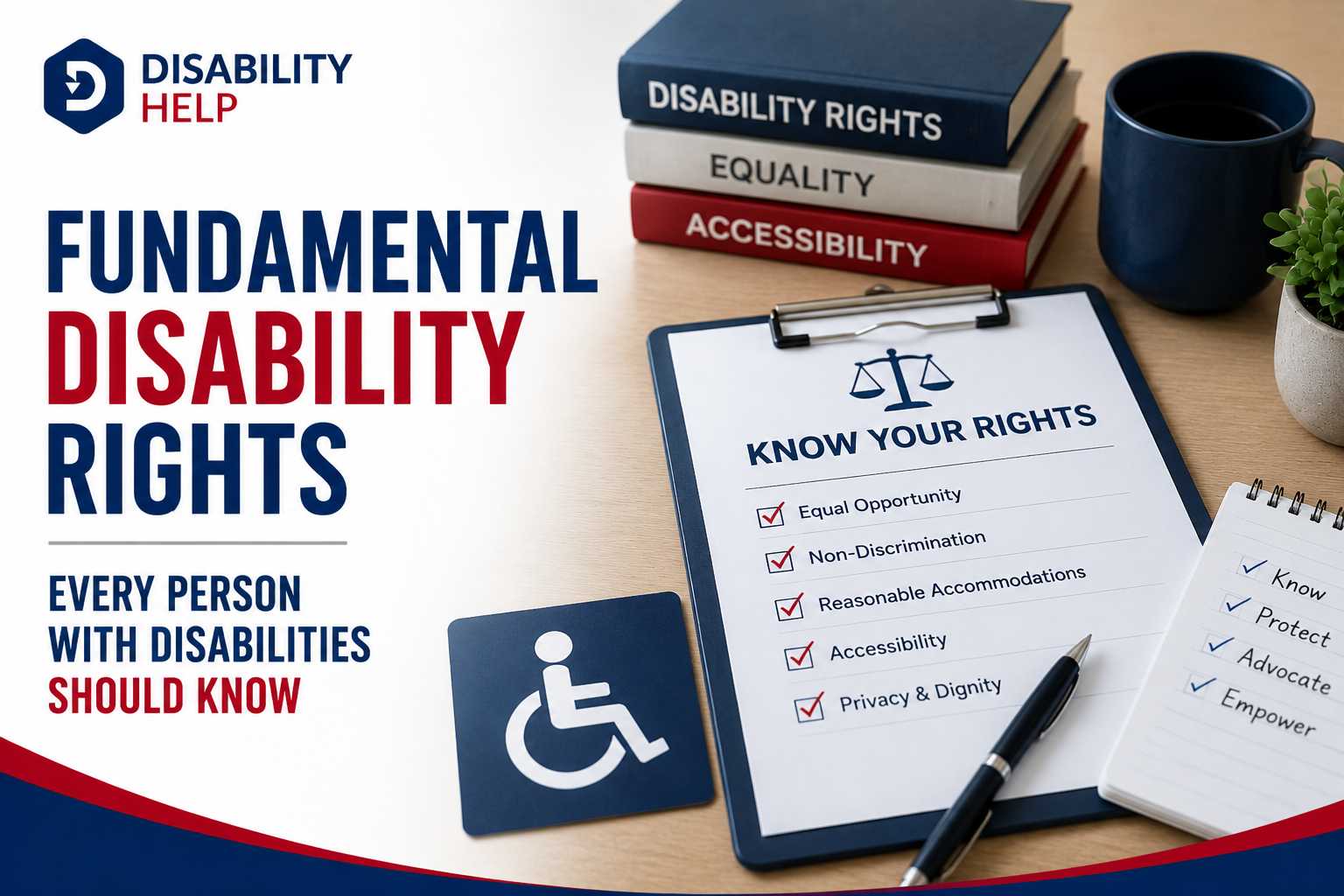
The four foundational rights for people with disabilities are the right to equality and non-discrimination, the right to independent living and community inclusionThe practice of ensuring that individuals with disabilities are fully integrated and involved in all..., the right to inclusive educationEducational practices that integrate students with disabilities into general education classrooms, s..., and the right to work and employment. Each one is protected under the United Nations Convention on the Rights of Persons with Disabilities (CRPD)An international treaty that promotes and protects the rights of people with disabilities. and reflected in U.S. law through the ADA, Section 504A provision of the Rehabilitation Act of 1973 that prohibits discrimination based on disability in p... of the RehabilitationThe process of helping individuals with disabilities achieve and maintain their optimal physical, se... Act, IDEA, and related civil-rights protections. These rights matter because disability is common: about 1 in 6 people worldwide, roughly 1.3 billion people, live with a significant disability, according to the World Health Organization.
This guide explains what each right means, the laws behind it, the data that shows where the gaps remain, and the practical steps you can take to protect yours.
Key Takeaways
- Four core rights: Equality, independent living, inclusive education, and employment form the four fundamental rights for people with disabilities under the CRPD.
- A human rightsThe basic rights and freedoms that all people are entitled to, including those with disabilities, of... model: The CRPD treats disabled people as rights holders with agencyThe capacity of individuals with disabilities to act independently and make their own choices., replacing older medical and charity models that framed them as objects of pity.
- Near-universal law: As of 2026, more than 180 countries have ratified the CRPD, and the ADA anchors these rights in United States federal law.
- Equality means accommodationAdjustments or modifications provided to individuals with disabilities to ensure equal access and pa...: Non-discrimination requires reasonable accommodationModifications or adjustments to a job or environment that enable a person with a disability to perfo... in work, school, and services unless it imposes a disproportionate or undue burden.
- Wide gaps persist: In 2025, the U.S. unemployment rate for people with a disability hit 8.3 percent, about double the rate for people without one.
- Rights are enforceable: Court rulings like Olmstead v. L.C. turned these principles into legal duties you can act on when they are violated.
Where These Rights Come From: The CRPD and the ADA
The four fundamental rights rest on two pillars: an international treaty and a national civil rightsThe rights of individuals to receive equal treatment under the law, including protection against dis... law. The United Nations Convention on the Rights of Persons with Disabilities was adopted in December 2006 and entered into force in May 2008. It marked a shift in how the world defines disability.
Older thinking used a medical or charity model that treated disabled people as patients to be cured or recipients of pity. The CRPD replaced that with a human rights model that recognizes people with disabilities as active rights holders who make their own choices. As of 2026, more than 180 countries have ratified the treaty: the UN Office of the High Commissioner for Human Rights reports that 185 of the 193 UN member states are now States Parties. The United States signed the treaty but has not ratified it, so domestic protection comes mainly from the ADA of 1990 and its 2008 amendments.
The treaty's general principles, set out in Article 3, give the four rights their shared foundation. The CRPD is built on respect for inherent dignity and individual autonomy, including the freedom to make one's own choices. It commits states to non-discrimination, full participation in society, accessibilityThe design of products, devices, services, or environments to be usable by people with disabilities...., and equality of opportunity. The ADA carries the same goals into enforceable U.S. law, barring disability discriminationUnfair treatment of individuals based on their disability in areas such as employment, education, an... in employment, public services, transportation, and public accommodationsModifications or adjustments in healthcare settings to support patients with disabilities..
How the Four Fundamental Rights Compare at a Glance
Each right answers a different question about daily life, draws on a different CRPD article, and connects to a different part of U.S. law. The table below compares the four side by side so you can see where your situation fits.
| Fundamental Right | CRPD Article | What It Protects | Primary U.S. Legal Anchor |
|---|---|---|---|
| Equality and non-discrimination | Article 5 | Equal protection of the law and the right to reasonable accommodation | ADA; Section 504 of the Rehabilitation Act |
| Independent living and community inclusionThe practice of creating environments in which any individual or group can be and feel welcomed, res... | Article 19 | The right to live in the community rather than an institution | ADA integration mandate (Olmstead v. L.C.) |
| Inclusive education | Article 24 | Free, inclusive education at every level | IDEA; Section 504 |
| Work and employment | Article 27 | Equal accessThe principle that all individuals, including those with disabilities, should have equal opportunity... to open, inclusive, and accessible work | ADA Title I |
Sources: UN CRPD Article 5, Article 19, Article 24, and Article 27.
Right 1: Equality and Non-Discrimination
The right to equality and non-discrimination means you are entitled to equal protection and equal benefit of the law without discrimination based on disability. Article 5 of the CRPD requires states to prohibit disability discrimination and to guarantee equal, effective legal protection. In the United States, the ADA and Section 504 of the Rehabilitation Act carry that duty into enforceable rules.
This right rests on three core ideas:
- Equality before the law: People with disabilities are entitled to the same legal protection and benefit as everyone else.
- Reasonable accommodation: Employers, schools, and service providers must make appropriate adjustments unless doing so creates a disproportionate or undue burden.
- Positive action: Temporary measures used to speed up real equality do not count as discrimination.
Legal protection has not erased discrimination. According to UNICEF, children with disabilities are 41 percent more likely to report feeling discriminated against than peers without disabilities, and 51 percent more likely to feel unhappy because of stigmaThe negative attitudes and discrimination faced by individuals with disabilities due to societal ste... and exclusion. The barriers extend to health care: research summarized by AudioEye finds that 25 percent of U.S. adults with disabilities face health care barriers tied to cost. Discrimination also compounds for women, girls, and people who belong to ethnic minorities, who often face it on more than one front at once.
Right 2: Independent Living and Community Inclusion
The right to independent living means you can choose where, how, and with whom you live, with equal options to everyone else, instead of being placed in an institution. Article 19 of the CRPD protects this right. For decades, disabled people were segregated in large residential facilities, and this right exists to reverse that history.
Three principles define what community inclusion requires:
- Choice of residence: You cannot be forced into a particular living arrangement and must have a real say in where you live.
- Access to support services: States must provide community supports, including personal assistance, so people are not isolated or pushed into segregationThe separation of individuals with disabilities from mainstream society, often through institutional....
- Mainstream accessibility: General community services and facilities must be open and responsive to disabled people on an equal basis.
Progress is uneven. UNICEF reports that in parts of Eastern Europe, a child with a disability is 17 times more likely to be institutionalized than a child without one.
Mobility gaps reinforce isolation: The U.S. Bureau of Transportation Statistics reported that in 2022, 40.2 percent of people ages 18 to 64 with travel-limiting disabilities stayed home on the surveyed travel day. In the United States, this right gained real teeth through the Supreme Court's 1999 ruling in Olmstead v. L.C., which held that needlessly segregating disabled people in institutions is a form of discrimination under the ADA.
Right 3: Inclusive Education
The right to inclusive education means children with disabilities cannot be excluded from free, quality education and must learn alongside their peers with the support they need. Article 24 of the CRPD requires an inclusive education system at every level, aimed at developing each child's potential, dignity, and talents.
There is a sharp difference between integration and inclusion. Integration places disabled students in standard classrooms without changing the curriculum or teaching methods. Inclusion, the standard the CRPD sets, changes content, teaching, and environments so every student can take part. True inclusion also means teaching Braille, sign language, and other communication modes, plus employing qualified teachers and providing reasonable accommodations.
The data shows education is where exclusion bites hardest. UNICEF finds that children with disabilities are 49 percent more likely to have never attended school, 42 percent less likely to gain foundational reading and numeracy skills, and 24 percent less likely to receive early childhood stimulation. The Right to Education Initiative reports that exclusion is most severe in low-income countries, where the majority of children with disabilities are out of school entirely. Two early U.S. court cases, PARC v. Pennsylvania (1971) and Mills v. Board of Education (1972), established that public schools cannot shut out children with disabilities, even when budgets are tight.
Right 4: Work and Employment
The right to work means you can earn a living in a job you freely choose, in a workplace that is open, inclusive, and accessible. Article 27 of the CRPD protects against discrimination in hiring, pay, advancement, and working conditions, and it requires reasonable accommodation on the job. In the United States, Title I of the ADA enforces these protections for most employers with 15 or more workers.
This right covers four practical protections:
- No discrimination: Protection across recruitment, hiring, pay, promotion, and working conditions.
- Fair conditions: Equal pay for work of equal value, safe conditions, and protection from harassment.
- Workplace accommodationModifications or adjustments made to a job or work environment to enable individuals with disabiliti...: Adjusted schedules, assistive technology, or modified duties, as outlined by the U.S. Department of Labor.
- A path to open work: Support for vocational training, supported employmentEmployment in a competitive work environment with support services provided to individuals with disa..., and self-employment in integrated settings.
The employment gapA period during which an individual is not employed, often experienced by people with disabilities d... remains one of the widest measures of inequality. The U.S. Bureau of Labor Statistics reported that in 2025 the unemployment rate for people with a disability rose to 8.3 percent, about double the rate for people without a disability, and roughly 75 percent of people with a disability were not in the labor force. The pay gap is just as stark: an analysis from the Center for American Progress found workers with disabilities earn a median of about 66 cents for every dollar earned by workers without disabilities, a gap widened by Section 14(c) of the Fair Labor Standards Act, which still lets some employers pay subminimum wages.
Older UN disability-employment materials have reported very high unemployment rates among people with disabilities in many countries, but current comparable global employment data remains limited.
United States Employment Gaps by Disability Status
| Labor Indicator | With Disability | Without Disability | Year |
|---|---|---|---|
| Unemployment rate | 7.2% | 3.5% | 2023 |
| Unemployment rate | 8.3% | ≈4% (half the rate) | 2025 |
| Not in the labor force | ≈75% | ≈32% | 2025 |
| Part-time work rate | 29.0% | 16.0% | 2023 |
Source: U.S. Bureau of Labor Statistics and the U.S. Department of Labor.
7 Barriers That Still Block These Rights
Laws set the standard, but daily life is shaped by real obstacles. The Centers for Disease Control and Prevention groups these obstacles into seven environmental barriersPhysical, social, or attitudinal barriers in the environment that hinder the participation of indivi... that keep people from enjoying rights they hold on paper.
- Attitudinal barriers: Stereotypes, stigma, and prejudice that frame disability as a personal tragedy rather than a shared social responsibility.
- Communication barriers: Information that excludes people with sensory or cognitive impairments, such as missing captions, no Braille, or text that screen readers cannot use.
- Physical barriers: Steps, narrow doorways, curbs, and medical equipment that cannot accommodate a wheelchair.
- Policy barriers: Failures to enforce existing law, denials of reasonable accommodation, or exclusion from public services.
- Programmatic barriers: Service delivery problems like inflexible scheduling, untrained providers, and appointments too short to meet a person's needs.
- Social barriers: Systemic factors, including lower education attainment and higher poverty rates among disabled adults.
- Transportation barriers: Inaccessible transit that blocks independent travel to work, school, and health care.
Landmark Court Cases That Turned Rights Into Duties
These four rights became enforceable through court decisions that defined what they require in practice. The cases below, summarized by the law firm Nelson Mullins, established precedents that still shape how U.S. courts read disability rightsThe legal and human rights afforded to individuals with disabilities, often the focus of advocacy an... today.
| Case | Year | Right Addressed | Precedent Established |
|---|---|---|---|
| PARC v. Pennsylvania | 1971 | Inclusive education | Excluding children with intellectual disabilities from public school is unconstitutional. |
| Mills v. Board of Education | 1972 | Inclusive education | Schools cannot deny education to disabled children because of budget shortfalls. |
| O'Connor v. Donaldson | 1975 | Independent living | States cannot confine non-dangerous people with mental illness who can live safely in the community. |
| City of Cleburne v. CLC | 1985 | Equality | Zoning rules that block group homes out of prejudice are unconstitutional. |
| Olmstead v. L.C. | 1999 | Independent living | Unjustified institutional segregation is discrimination under the ADA, creating the integration mandate. |
| PGA Tour v. Martin | 2001 | Equality | Public accommodations must provide reasonable accommodations, even in professional sports. |
Key Terms You Need to Know
A few terms appear across all four rights. Understanding them helps you read your own documents and conversations with confidence.
- Reasonable accommodation: A change to a job, school, or service that lets a disabled person take part equally, as long as it does not impose an undue burden.
- Integration mandate: The rule from Olmstead v. L.C. that public services must be offered in the most integrated setting appropriate to a person's needs.
- Interactive process: The back-and-forth between an employee and employer to find a workable accommodation, required under the ADA.
- Inclusion vs. integration: Integration places a person in a mainstream setting; inclusion changes that setting so the person can fully participate.
Why the Human Rights Model Changes Everything
The most important shift in disability rights is not any single law. It is the idea that disability is created by the gap between a person and the barriers around them, not by the person alone. The CRPD builds every protection on respect for inherent dignity and individual autonomy, the freedom to make your own choices.
In our experience helping readers, the people who fare best are the ones who learn early that these are rights, not favors. A worker who knows that an accommodation requestA formal request made by an employee with a disability for reasonable adjustments to their work envi... triggers a legally required interactive process approaches that meeting very differently than one who believes they are asking for a personal favor. The shift from “asking for help” to “exercising a right” often changes the outcome.
Consider a common situation. Someone develops a condition that limits how long they can stand, then assumes they must simply quit a job they can no longer perform the old way. Under the right to work, the first step is not resignation. It is a written accommodation request, which obligates the employer to discuss adjustments such as a stool, a modified schedule, or reassigned duties. Knowing the right exists turns a dead end into a process.
Know Your Rights Before You Need to Defend Them
The four fundamental rights for people with disabilities; equality, independent living, education, and work are not abstract ideals. They are legal commitments backed by treaty, statute, and court precedent. As of 2026, the framework is strong, even as the data on employment, education, and discrimination show how much work remains.
The most useful thing you can do is treat each one as a right you hold, not a favor you request. Learn which law applies to your situation, document what you need, and ask for it in writing. If your situation is complex or a right has been denied, talk with a qualified disability attorney or advocate who can tell you whether your claim is worth pursuing. Knowing these rights exist is the first step toward using them.
To keep learning how disability law protects access, accommodations, and equal opportunity, read Disability Help’s guide on what is considered a reasonable accommodation under the ADA.
Frequently Asked Questions
What are the four fundamental rights for people with disabilities?
The four fundamental rights are equality and non-discrimination, independent living and community inclusion, inclusive education, and work and employment. They come from the UN CRPD and are reinforced in the United States by the ADA. Together, they cover legal protection, where you live, how you learn, and how you earn.
Are these rights the same as the rights in the ADA?
They overlap closely. The CRPD frames the rights internationally, while the ADA enforces most of them inside the United States. The ADA bars disability discrimination in employment, public services, transportation, and public accommodations. The U.S. signed the CRPD but has not ratified it, so domestic claims usually rely on the ADA and related laws.
What counts as a reasonable accommodation?
A reasonable accommodation is any change that lets a person with a disability participate equally without causing an undue burden. Examples include flexible schedules, assistive technology, modified duties, accessible formats, and physical changes to a space. The employer or provider must engage in an interactive process to find one that works.
Can these rights be enforced in court?
Yes. Decisions like Olmstead v. L.C. and PARC v. Pennsylvania turned broad principles into enforceable duties. If a right is violated, you can file a complaint with the relevant federal agency, such as the EEOC for workplace discriminationUnfair treatment of employees based on disability, including hiring, promotion, job assignment, term..., and pursue legal action. Many disability attorneys evaluate these cases at no upfront cost.
Why do gaps remain if the rights are legally protected?
Enforcement is uneven and barriers are persistent. The CDC identifies attitudinal, physical, communication, policy, and other obstacles that keep people from enjoying rights they technically hold. The 2025 employment gap, with disabled workers facing roughly double the unemployment rate, shows how far legal protection and lived reality can still diverge.