
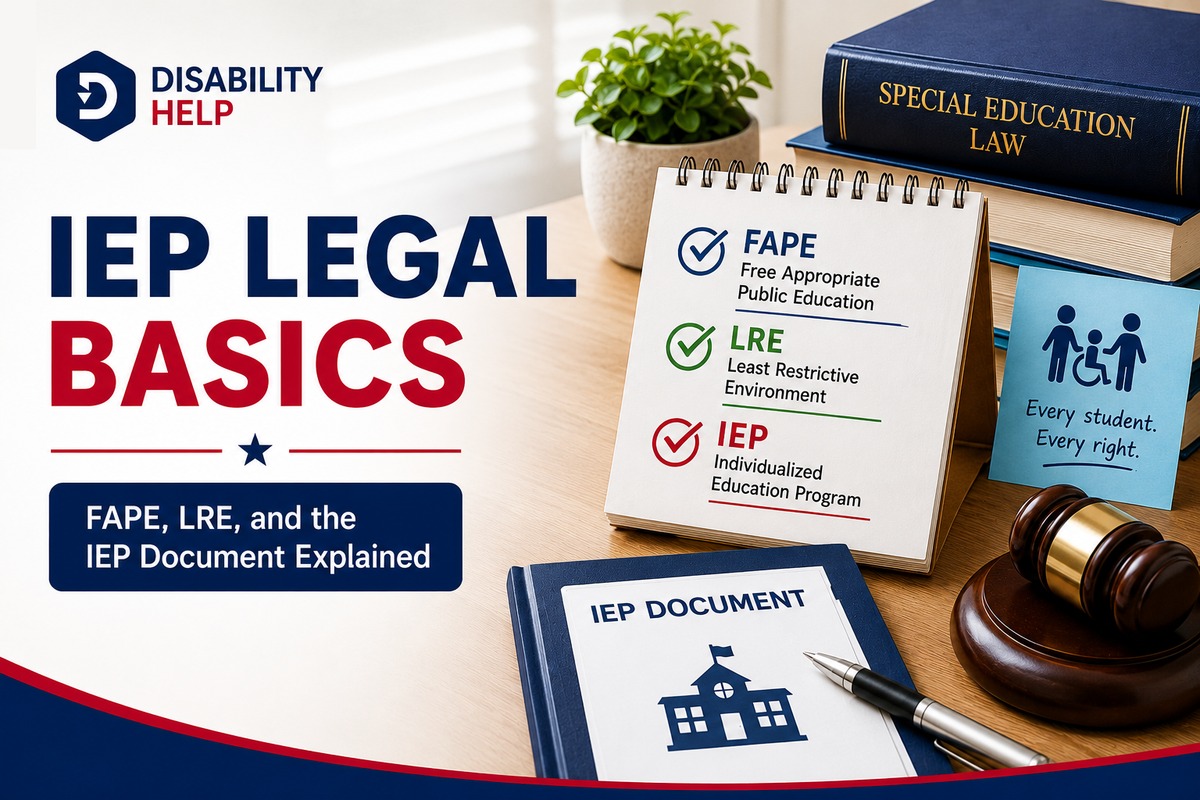
The three legal concepts of an IEP are Free Appropriate Public Education (FAPE), Least Restrictive Environment (LRE), and the Individualized Education Program (IEP) document itself. These three pillars come from the Individuals with Disabilities Education Act (IDEA), the federal law that protects the educational rights of roughly 7.9 million children with disabilities under Part B in the 2023 to 2024 school year, according to a Congressional Research Service report.
If you are a parent or guardian preparing for your child’s first IEP meeting, fighting a placement decision, or simply trying to understand what your school district legally owes your child, knowing how these three concepts work together gives you a real foundation to stand on. This guide breaks each one down to simplify them for parents.
Key Takeaways
- Three pillars define IDEA: The three legal concepts of an IEP are Free Appropriate Public Education, Least Restrictive Environment, and the written IEP itself.
- FAPE means free and appropriate: Every eligible student aged 3 to 21 is entitled to special educationCustomized educational programs designed to meet the needs of students with disabilities. and related services at no cost to the family.
- LRE favors inclusionThe practice of creating environments in which any individual or group can be and feel welcomed, res...: Federal law requires schools to educate children with disabilities alongside nondisabled peers to the maximum extent appropriate.
- The IEP is the blueprint: It is a legally binding document with measurable annual goals, services, accommodationsModifications or adjustments in healthcare settings to support patients with disabilities., and progress measurement.
- Endrew F. raised the bar: The 2017 Supreme Court ruling requires IEPs to enable progress appropriate in light of the child’s circumstances, not just a trivial benefit.
- Parents have due processThe legal requirement that the state must respect all legal rights owed to a person, including fair ... rights: You can file a state complaint, request mediation, or pursue a due process hearing if you disagree with school decisions.
- Nearly 8 million students rely on it: As of the 2023 to 2024 school year, about 7.9 million children received services under IDEA Part B.
What Are the Three Legal Concepts of an IEP?
The three legal concepts of an IEP are Free Appropriate Public Education (FAPE), Least Restrictive Environment (LRE), and the Individualized Education Program (IEP)A plan developed for U.S. students with disabilities to ensure they receive tailored educational ser... itself. Together, they form the legal scaffolding that every public school in the United States must follow when serving a child with a qualifying disability under IDEA.
These three concepts work as a single system. FAPE is the substantive right that your child is entitled to receive. LRE is the placement standard, where and with whom your child should be educated. The IEP is the written instrument that documents how the school will deliver FAPE in the LRE for your specific child. If any one of the three breaks down, the whole legal protection breaks down with it.
IDEA was first passed in 1975 as the Education for All Handicapped Children Act and reauthorized several times since, most recently as the Individuals with Disabilities Education Improvement Act of 2004. As of the 2022 to 2023 school year, 15 percent of all public school students, roughly 7.5 million children aged 3 to 21, received services under IDEA, according to the National Center for Education Statistics. That number climbed again to about 7.9 million in the 2023 to 2024 school year.
FAPE: What Free Appropriate Public Education Actually Guarantees
FAPE is the right of every eligible child with a disability to receive special education and related services at no cost to the family. Under federal regulation 34 CFR § 300.17, FAPE must be provided at public expense, must meet state educational agencyThe capacity of individuals with disabilities to act independently and make their own choices. standards, must include an appropriate preschool, elementary, or secondary education, and must be delivered in conformity with an IEP.
The obligation extends to all eligible children residing in the state from age 3 through age 21, including students who have been suspended or expelled. Free means free to the parent. The cost is borne by the school district and the state. Appropriateness is where most disputes happen, because the law does not define a single quality standard. Two Supreme Court decisions have shaped what counts as appropriate.
In Board of Education v. Rowley (1982), the Supreme Court held that an IEP must be reasonably calculated to enable the child to receive educational benefits. That standard was the law for 35 years. Then, in Endrew F. v. Douglas County School District (2017), a unanimous Court rejected a “merely more than de minimis” interpretation of Rowley and elevated the standard. Chief Justice John Roberts wrote that schools must offer an IEP reasonably calculated to enable a child to make progress appropriate in light of the child’s circumstances. In short, every child should have the chance to meet challenging objectives, not just trivial ones.
If your child’s IEP is not producing meaningful progress, the Endrew F. standard gives you a stronger legal basis to push back than the older Rowley standard did.
LRE: How the Least Restrictive Environment Rule Shapes Placement
The Least Restrictive Environment rule requires that students with disabilities be educated with nondisabled peers to the maximum extent appropriate. Under 34 CFR § 300.114, removal from the regular classroom is permitted only when the nature or severity of the disability is such that education in regular classes with supplementary aids and services cannot be achieved satisfactorily.
In practice, that means inclusion is the default and segregationThe separation of individuals with disabilities from mainstream society, often through institutional... is the exception that must be justified. In fall 2023, about 68 percent of school-aged children served under IDEA Part B spent 80 percent or more of their time in a regular classroom, according to the Congressional Research Service. Only about 4.7 percent received services in other environments such as separate schools, residential facilities, or hospital and home settings.
Courts evaluate LRE disputes using a two-part test rooted in Oberti v. Board of Education (1993). First, can education in the regular classroom be achieved satisfactorily with supplementary aids and services? Second, if removal is necessary, is the child being mainstreamed to the maximum extent appropriate for activities like lunch, recess, arts, and electives? If the school cannot show genuine attempts at the first part, the placement likely violates LRE.
LRE Placement Continuum
| Placement Setting | Description |
|---|---|
| General Education Classroom | Full-time placement in a regular classroom with accommodations, supplementary aids, and related services delivered there. |
| Partial Inclusion (Push-In or Pull-Out) | Most of the day in general education, with targeted time in a resource room or pull-out service block. |
| Self-Contained Special Education Classroom | Most or all of the school day in a smaller classroom designed specifically for students with disabilities. |
| Separate Day School | A specialized school outside the home district focused entirely on students with disabilities. |
| Residential, Hospital, or Home Instruction | The most restrictive placement, used only when medical, behavioral, or safety needs cannot be met elsewhere. |
The continuum is not a ranking of quality. It is a hierarchy of restriction. The legal preference is always for the least restrictive setting that still allows the child to make meaningful progress, which ties LRE directly back to the FAPE standard.
The IEP: The Document That Makes FAPE and LRE Real
The IEP is a written, legally binding document developed by a team that includes the child’s parents, at least one general education teacher (if the child participates in general education), at least one special education teacher, a school district representative with authority to commit resources, someone who can interpret evaluation results, and the child when appropriate. Federal regulation 34 CFR § 300.320 lists what every IEP must contain.
If FAPE is what the law promises and LRE is where the promise is delivered, the IEP is how the promise is operationalized for one specific child. It must be reviewed at least annually and must be revised when the child’s needs change.
Required Components of Every IEP
- Present Levels of Academic and Functional Performance: A clear statement describing what your child can currently do, how the disability affects involvement in the general curriculum, and where the gaps are.
- Measurable Annual Goals: Academic and functional goals the team expects the child to meet within the year, written in measurable terms.
- Progress Measurement and Reporting: A description of how progress toward each annual goal will be tracked and how often reports will be sent to you (typically aligned with general education report card periods).
- Special Education and Related Services: Specific services, frequency, location, and duration, plus any supplementary aids, program modifications, or supports for school staff.
- LRE Explanation: A written statement explaining the extent, if any, to which the child will not participate with nondisabled peers in the regular class and in school activities.
- Assessment Accommodations: Individual accommodations needed for state and district-wide testing, or a statement explaining why the child will take an alternate assessment.
- Service Dates and Logistics: Projected start date for services and the anticipated frequency, location, and duration.
- Transition ServicesServices that help individuals with disabilities move from one life stage to another, such as from s... (Age 16 or Younger): Postsecondary goals related to training, education, employment, and independent living, plus the transition services needed to reach them.
If any of these components is missing or vague, the IEP is procedurally weak, and you have a basis to raise the issue at the next meeting or through a formal dispute process.
Key Court Cases That Shaped FAPE, LRE, and IEP Rights
Three Supreme Court and federal appellate decisions have done the heavy lifting in defining what the three legal concepts of an IEP actually require in practice.
Board of Education v. Rowley (1982) was the Supreme Court’s first IDEA case. The Court rejected the argument that schools must maximize a child’s potential and instead required that an IEP be reasonably calculated to enable educational benefit. For a child in a regular classroom, that meant a program designed to enable the child to achieve passing marks and advance from grade to grade.
Oberti v. Board of Education (1993), a Third Circuit case, established the two-part LRE test described above. It set the principle that schools cannot remove a child from the regular classroom without first showing that inclusion with supplementary aids and services cannot work, and that any removal must be balanced by maximum mainstreamingThe practice of placing students with disabilities in regular education classrooms, with appropriate... in nonacademic settings.
Endrew F. v. Douglas County School District (2017) raised the FAPE standard from Rowley’s “some benefit” to a requirement that an IEP enable progress appropriate in light of the child’s circumstances. The unanimous Court emphasized that every child should have the chance to meet challenging objectives. Endrew F. is the current standard and is cited in special education due process decisions across the country.
You should know these case names. If you ever attend a due process hearing or file a state complaint, your attorney or advocate will rely on this case law.
Parental Rights and Dispute Resolution Under IDEA
IDEA gives you procedural rights that exist independent of whether you and the school agree on the IEP. The school must give you prior written notice before changing your child’s program. You have the right to review your child’s educational records. You have the right to request an Independent Educational Evaluation (IEE) at public expense if you disagree with the school’s evaluation. You have the right to invite anyone with relevant knowledge about your child to the IEP meeting.
When disputes happen, three formal options are available under IDEA:
- State Complaint: You file a written complaint with your state education department alleging an IDEA violation. The state must investigate and issue findings, typically within 60 calendar days.
- Mediation: A voluntary, confidential process in which a neutral mediator helps you and the district try to reach a written agreement. It is free, often available within 30 days, and does not waive any other rights.
- Due Process Hearing: A formal legal proceeding before an impartial hearing officer. Either you or the district can file a due process complaint within two years of the alleged violation. The hearing is followed by a written decision that is binding unless appealed to state review or federal court.
Most parents who reach a serious disagreement try mediation before due process because it is faster, less expensive, and less adversarial. Due process is effective but stressful, and legal representationThe way people with disabilities are depicted in media, culture, and politics, often influencing pub... typically requires at least 10 to 20 attorney hours of preparation, according to special education legal aid resources.
Expert Insight: Why the IEP Is the Heart of the System
The IEP gets called a lot of things: a plan, a contract, a roadmap. Legally, it is something more specific. Katy Neas, CEO of The Arc of the United StatesAn organization that promotes and protects the human rights of people with intellectual and developm... and a former Deputy Assistant Secretary in the Office of Special Education and Rehabilitative Services at the U.S. Department of Education, describes the IEP as the blueprint for how schools uphold every child’s right to a quality education.
That framing matters because it explains why procedural details (the meetings, the consent forms, the prior written notice, the goal language) are not bureaucratic busywork. They are the mechanism by which abstract rights become enforceable, day-by-day actions in your child’s school. As Neas has put it, students are general education students first, and the way they access learning looks different for each child.
In our experience working with families, the parents who get the best outcomes from the IEP process are the ones who treat the document the way the law treats it: a binding plan that the school must implement, not a wish list. When you read your child’s IEP, ask whether each goal is measurable, whether each service has a defined frequency and duration, and whether the LRE explanation matches what is actually happening in the building.
What This Means for Your Child
The three legal concepts of an IEP exist because Congress decided in 1975 that children with disabilities had a federal right to learn in their public schools, and the Supreme Court has spent the decades since defining what that right actually means in practice. As of the 2023 to 2024 school year, nearly 8 million American children rely on those decisions every day, a number that continues to climb in 2026.
For you as a parent, the practical value of understanding FAPE, LRE, and the IEP document is leverage. You walk into the IEP meeting knowing the standard the school must meet, where your child should be placed, and what the document in front of you must contain. You also know that if the school falls short on any of the three, you have real tools to push back, not just polite disagreement.
If your child is being evaluated for the first time, see our walkthrough of how to qualify for the Individuals with Disabilities Education Act. If you are dealing with a denial, a placement dispute, or a stalled evaluation, consider speaking with a special education advocate or attorney who can review your child’s records and advise on the specific path forward in your state.
Frequently Asked Questions
What are the three legal concepts of an IEP?
The three legal concepts of an IEP are Free Appropriate Public Education (FAPE), Least Restrictive Environment (LRE), and the Individualized Education Program (IEP) itself. FAPE is what every eligible child with a disability is entitled to receive. LRE is the placement standard requiring inclusion to the maximum extent appropriate. The IEP is the written document that operationalizes both rights for one specific child.
Is an IEP a legally binding document?
Yes. An IEP is a legally binding document under IDEA. Once finalized and signed, the public school district must provide every service, accommodationAdjustments or modifications provided to individuals with disabilities to ensure equal access and pa..., and goal-related instruction listed in the IEP at the frequency and duration specified. If the school fails to implement the IEP as written, parents can file a state complaint, request mediation, or pursue a due process hearing.
What is the difference between an IEP and a 504 Plan?
An IEP is for students who need specially designed instruction under IDEA. A 504 Plan provides accommodations under Section 504A provision of the Rehabilitation Act of 1973 that prohibits discrimination based on disability in p... of the Rehabilitation Act of 1973A U.S. law that prohibits discrimination based on disability in federal programs and services, inclu... for students whose disabilities require access support but not specialized instruction. A student with dyslexiaA learning disorder characterized by difficulty reading due to problems identifying speech sounds an... who needs targeted reading instruction usually needs an IEP. A student with diabetesA chronic condition where the body cannot produce or properly use insulin, leading to high blood sug... who needs scheduled snacks and bathroom access typically needs a 504 Plan.
How often must an IEP be reviewed?
Federal law requires that the IEP team meet to review the IEP at least once every 12 months. The team must revise the IEP whenever there is a lack of expected progress, new evaluation results, information from the parents, or anticipated needs. Parents can request an IEP meeting at any time, and the school must convene the team within a reasonable timeframe.
What can I do if I disagree with my child’s IEP?
You have three formal dispute resolution options under IDEA: file a state complaint with your state education department, request voluntary mediation, or file a due process complaint. You generally have two years from the date you knew or should have known of the alleged violation to file. Most disputes are resolved through mediation or settlement before reaching a formal due process hearing.
Do I have to accept the IEP the school offers?
No. You must give written consent before the school can begin providing special education servicesEducational programs and services designed to meet the needs of students with disabilities. for the first time, and you can withhold consent or sign with disagreement. If you agree with parts of the IEP and not others, document your disagreements in writing and request another meeting. The school cannot move forward on initial placement without your consent, though it can use due process procedures to challenge your refusal.