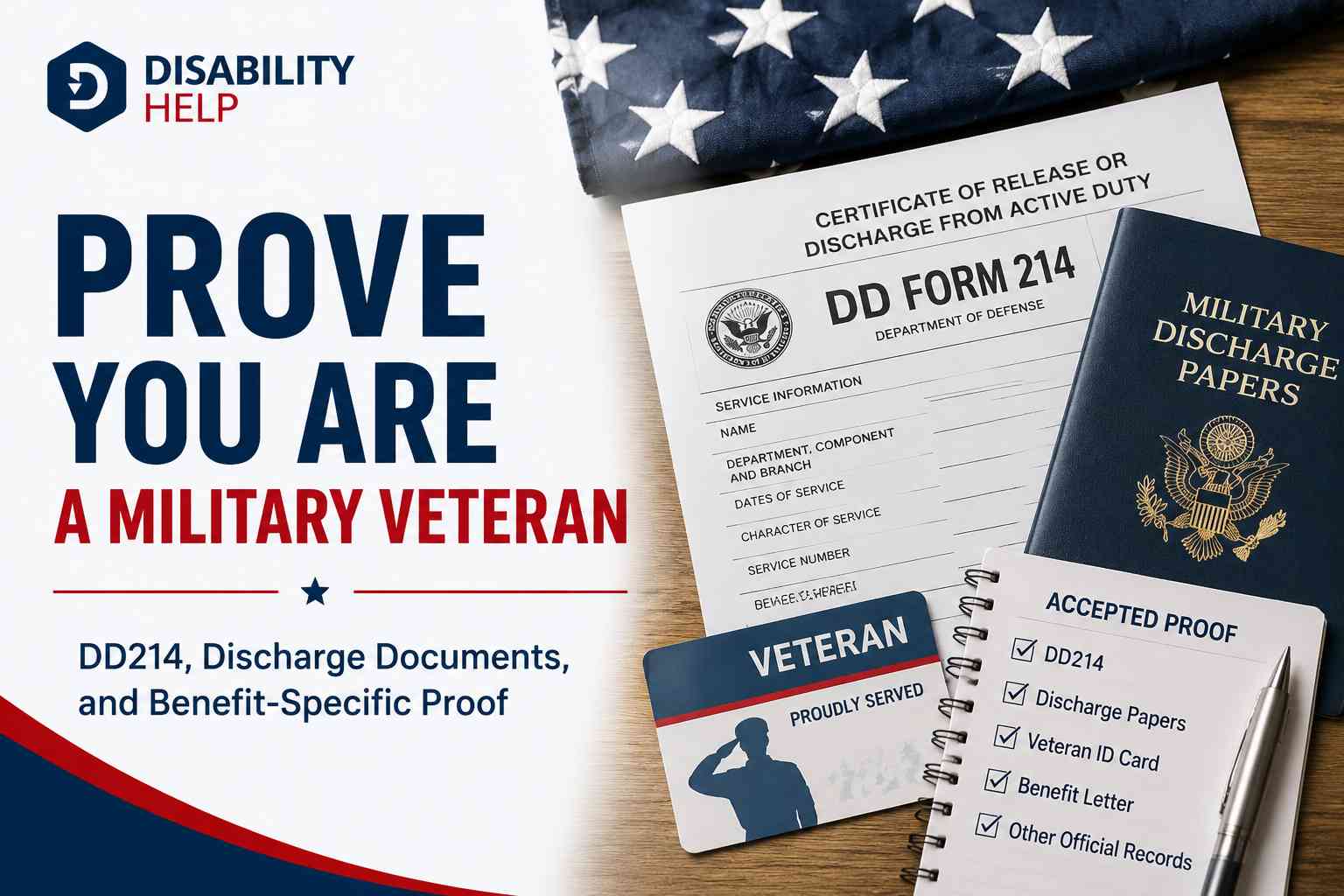
To prove you are a military veteran, you need an official discharge document, usually the DD Form 214 (Certificate of Release or Discharge from Active Duty), that shows qualifying active service and a discharge under conditions other than dishonorable. The proof you actually need depends on the benefit or purpose you are pursuing. As of 2026, an estimated 17.3 million veterans live in the United States, yet only about 6.3 million received VA disability compensation in fiscal year 2025, and some never apply because they cannot locate a single document.
This guide breaks down the federal definition of a veteran, the documents that prove service, how to request them for free, and the exact evidence each benefit requires. If your service left you with a lasting condition, proving veteran status is also the first step toward VA disability and Social Security benefits.
Key Takeaways
- The DD214 is primary proof: To prove you are a military veteran, the DD Form 214 is the most important document, listing your service dates, rank, and character of discharge.
- Discharge character decides status: Federal veteran status requires a discharge under conditions other than dishonorable, which includes honorable and most general discharges.
- milConnect is the fastest route: Veterans separated since the mid-1990s to mid-2000s can often download a DD214 within minutes through the DoD milConnect portal.
- Every records request is free: The VA, National Archives, and Department of Defense never charge for service records, so any company charging a fee is unnecessary.
- Veteran status is not benefit eligibility: Meeting the legal definition of a veteran does not guarantee any specific benefit, because each program sets its own separate rules.
- Lost records can be rebuilt: Even files destroyed in the 1973 National Archives fire can often be reconstructed from pay, medical, and state records.
What Legally Counts as a Military Veteran?
Federal law defines a veteran as a person who served in the active military, naval, air, or space service and was released under conditions other than dishonorable. Congress set this definition in Title 38 of the U.S. Code. On its own, it sets no minimum service length, war era, or disability requirement. Specific benefit statutes add those extra rules later.
Your discharge characterization carries real legal weight because it decides both your veteran status and your access to benefits. The Armed Forces issue separation papers with one of several characterizations:
- Honorable discharge: The highest characterization, given for faithful and meritorious service. It confers full veteran status and eligibility for most federal benefits.
- General discharge (under honorable conditions): Given for satisfactory service with some minor issues. It qualifies for most federal benefits, though certain programs add restrictions.
- Other than honorable, bad conduct, or dishonorable: These characterizations remove veteran status under Title 38 and block most federal benefits, unless a separate review restores access.
- Uncharacterized or unknown: When the record is unclear, an agencyThe capacity of individuals with disabilities to act independently and make their own choices. may require verification or a Character of Discharge review before it decides.
One point surprises many readers: you do not need a fully honorable discharge to be a veteran. A discharge under conditions other than dishonorable, which includes a general discharge, meets the legal test. Even an other-than-honorable discharge does not always end the story, because the VA can run a Character of Discharge review that weighs your service separately from the paper label.
The DD214: Your Primary Proof of Service
The DD Form 214 is the single most important document for proving military service. The Department of Defense issues it the moment you separate from active duty, and it records the facts that nearly every benefit office wants to see. A DD214 typically lists:
- Full name and service number
- Dates of active duty
- Character of discharge
- Military occupational specialty
- Rank at separation
- Decorations, medals, and awards
- Reason and narrative reason for separation
The DD214 comes in several copies. The Member 4 copy is the one to keep and submit, because it shows the character of service and the narrative reason for separation. Some employers accept the shorter Member 1 copy, but federal hiring offices and most benefit programs prefer Member 4, as the Office of Personnel Management notes for several special hiring authorities.
How Do You Get a Copy of Your DD214?
You can request a free copy of your DD214 through three main channels: the DoD milConnect portal, the National Archives eVetRecs system, or a mailed Standard Form 180. Which one fits you depends on when you separated and how fast you need the document. The VA also requests it for you when you file a benefit claim, as explained on its military service records page.
Which method should you use?
| Method | Best for | Sign-in needed | Typical speed |
|---|---|---|---|
| milConnect (DPRIS) | Recently separated veterans with digitized records | Premium DS Logon | Minutes if on file |
| eVetRecs (National Archives) | Most veterans and older records | ID.me or Login.gov | Two to four weeks |
| Standard Form 180 (mail or fax) | No internet access or pre-digital records | None (wet signature) | Several weeks to months |
| VA benefit application | Veterans already applying for VA benefits | VA.gov account | VA requests it for you |
To request records through eVetRecs, follow these steps:
- Create or verify an ID.me or Login.gov account with identity verification.
- Sign in to eVetRecs on the National Archives website.
- Enter your service details: branch, discharge date, full name, and service number if you have it.
- Select the records you need, such as the DD214, medical records, or performance reports.
- Submit the request, and flag it as an emergency if you have a funeral, surgery, or loan closing deadline.
milConnect is often the quickest option, because recently separated veterans can download a digitized DD214 in about ten minutes. Records are usually available for immediate download if you were:
- Air Force: discharged after October 1, 2004
- Army: discharged after October 1, 2002
- Marine Corps: discharged after January 1, 1999
- Navy: discharged after January 1, 1995
Every legitimate method is free. The VA, the National Archives, and the Department of Defense do not charge veterans or eligible next of kin for service records. Treat any company that asks for a fee to "retrieve your DD214" as unnecessary, because you can get the same document at no cost.
What If You Don't Have a DD214? Discharge-Document Equivalents
Not every veteran has a DD214. Service that predates the form, records lost in the 1973 fire, and certain Guard or Reserve duty can all be documented with alternative papers. The VA publishes a full list of documents that prove honorable active service, and the most common substitutes include:
- DD Form 13: Statement of Service
- DD Forms 256 or 257: Honorable or general discharge certificates showing active-duty dates
- DD Form 303: Certificate in lieu of a lost or destroyed discharge
- DD Form 1300: Report of Casualty
- NGB Form 22: Report of Separation and Record of Service for the National Guard
- NA Form 13038: Certification of Military Service
- State separation records: Older state-issued discharge or separation documents
Acceptance is purpose-specific. A document on the VA discharge documents list does not automatically satisfy every program. For example, an NGB Form 22 may require proof of prior active federal service other than training, or at least 20 years of total service, for some VA purposes.
On July 12, 1973, a fire at the National Personnel Records Center in St. Louis destroyed roughly 16 to 18 million military personnel files, mostly Army and Air Force records for people discharged between 1912 and 1964. No microfilm backups existed. Even so, a lost file rarely ends a claim. The National Archives reconstructs service from pay vouchers, Selective Service records, military medical files, and state records, so ask for a reconstruction and note the fire on your request if your record was affected.
What Proof Does Each Veteran Benefit Require?
Proof of veteran status is not one-size-fits-all. A home loan office, a federal hiring manager, and a cemetery scheduling office each want a different combination of documents. The table below maps the most common purposes to the proof each one expects.
| Purpose or benefit | Primary proof required | Key note |
|---|---|---|
| VA disability compensation | DD214 (VA can request it for you) | Character of Discharge review may still open access |
| Federal employment (veterans preference) | DD214 Member 4; SF-15 for 10-point | Title 5 rules differ from Title 38 benefit rules |
| VA home loan (Certificate of Eligibility) | DD214 or status-specific documents | The COE is program-specific, not generic proof |
| VA burial and memorial benefits | DD214 plus death certificate | Filed by family, executor, or funeral home |
| Education (GI Bill) | VA Certificate of Eligibility letter | The decision letter, not the DD214, is the proof |
| Veteran ID Card (VIC) | DD214, DD256, or NGB22 plus photo ID | Designed for discounts, not full benefit eligibility |
| Veteran-owned business (federal contracts) | SBA VetCert certification | Showing a DD214 to a contracting officer is not enough |
Federal hiring adds a wrinkle. Veterans' preference runs under Title 5 of the U.S. Code, not Title 38, so the rules overlap but are not identical. You may be a veteran for VA purposes yet not qualify for employment preference, or the reverse. For a 10-point preference based on a service-connected disability or a Purple Heart, you file an SF-15 with supporting documents.
For federal contracts, showing a DD214 to a contracting officer is not enough. Veteran-owned and service-disabled-veteran-owned firms must certify through SBA VetCert, which verifies ownership and, for service-disabled status, a VA disability rating for at least one owner.
Veteran Status vs. Benefit Eligibility: The Disability Connection
Proving you are a veteran and qualifying for a specific benefit are two separate steps. You can clear the first and still fall short of the second, because benefits such as pensions, home loans, and disability compensation each add their own service-length, era, or medical rules on top of the base definition.
The gap is easy to see with a simple example. A person discharged after only 30 days of service may still be a veteran under Title 38, but that short service does not meet the 90-day wartime threshold some pension benefits require. The label and the payout are governed by different rules.
This distinction matters most for disabled veterans. A DD214 proves your service, but a VA disability claim also needs medical evidence linking a current condition to that service.
Veteran status also opens a door that many people miss. A veteran rated 100 percent by the VA can receive VA disability compensation and Social Security Disability InsuranceA form of insurance that provides income to individuals who are unable to work due to a disability. at the same time, with no reduction to either payment, and a total VA rating can even strengthen an SSDI case.
Special Situations That Change How You Prove Service
Some service histories need extra documents or an added step. Four situations come up most often:
- Records lost in the 1973 fire: Note the fire on your request, provide your unit, dates, and any fellow service members, and allow extra time while the National Archives rebuilds the file.
- Never-activated Guard or Reserve service: Provide the NGB Form 22 for each service period, the NGB Form 23 retirement points statement, and proof of the character of service.
- Multiple service periods: Submit every discharge document, and note any honorable period, even if a later period ended less favorably, since the VA can evaluate periods separately.
If your discharge was issued under circumstances now recognized as unjust, such as PTSD, traumatic brain injury, military sexual trauma, or service under the Don’t Ask, Don’t Tell policy, you can apply for a discharge upgrade or correction. An approved upgrade produces a DD215 correction or an updated DD214, which can then unlock benefits tied to the character of service.
A Real-World Look at Proving Service
Two illustrative scenarios show how the same goal takes different paths. A veteran who left the Army in 2008 needs a DD214 for a home loan closing in ten days. Because the Army digitized records after October 2002, he signs in to milConnect, requests his personnel file, and downloads the Member 4 copy the same afternoon.
A second veteran served in 1961, and her file burned in the 1973 fire, so she has no quick download. She submits an SF-180, marks the request as affected by the fire, and includes her unit and approximate dates so the National Archives can rebuild her record from pay and medical sources. Same objective, two very different routes, both free.
In practice, the fastest way to avoid a records emergency is to store a digital copy of your DD214 the moment you separate, and to register it with your county recorder, where that is allowed. Accredited Veterans Service Organizations help with records requests and benefit claims at no charge, which is worth remembering in a field where paid "record retrieval" services add cost without adding value.
Prove Your Veteran Status, Then Check the Benefits You May Qualify For
Proving you are a military veteran comes down to two things: securing an official discharge document and matching it to the specific requirement of the benefit you want. The DD214 handles most situations, alternative forms cover the rest, and every legitimate request is free. As of 2026, with roughly 17 million veterans in the country and millions of benefits left unclaimed, the document you can produce often decides the benefit you receive.
Request your DD214 today, store a digital copy, and if your service left you with a lasting condition, read our guide on how a 100 percent VA rating and Social Security work together to see what your veteran status can unlock next.
Frequently Asked Questions
Is a DD214 the only way to prove you are a military veteran?
No. The DD214 is the primary proof, but the VA also accepts alternatives such as the NGB Form 22, DD Forms 256 or 257, a DD Form 303 in lieu of a lost discharge, or an NA Form 13038 Certification of Military Service when a DD214 is unavailable.
How much does it cost to get a copy of my DD214?
Nothing, if you are a veteran or the eligible next of kin. Requests through milConnect, eVetRecs, and Standard Form 180 are free. Only archival records released 62 years after separation carry a small copying fee for the general public.
Can I prove veteran status if I only served in the National Guard or Reserve?
Yes, though your documents differ. Members activated to federal active duty usually receive a DD214. Those never activated should provide the NGB Form 22 for each service period, the NGB Form 23 retirement points statement, and proof of the character of service.
Does an other-than-honorable discharge mean I can never get VA benefits?
Not always. An other-than-honorable discharge blocks many benefits by default, but the VA can run a Character of Discharge review that weighs your service on its own terms. That review does not change your DD214, yet it can restore access to certain benefits.
Can family members request a deceased veteran's records?
Yes. Eligible next of kin, including an unmarried surviving spouse, child, parent, or sibling, can request records, but must include proof of death such as a death certificate, funeral home letter, or published obituary.
Can I receive VA disability and Social Security at the same time?
Yes. VA disability compensation and Social Security Disability Insurance are separate programs, and you can receive both at once with no offset. A 100 percent VA rating can even support an SSDI claim, though SSDI applies its own medical and work-history rules.