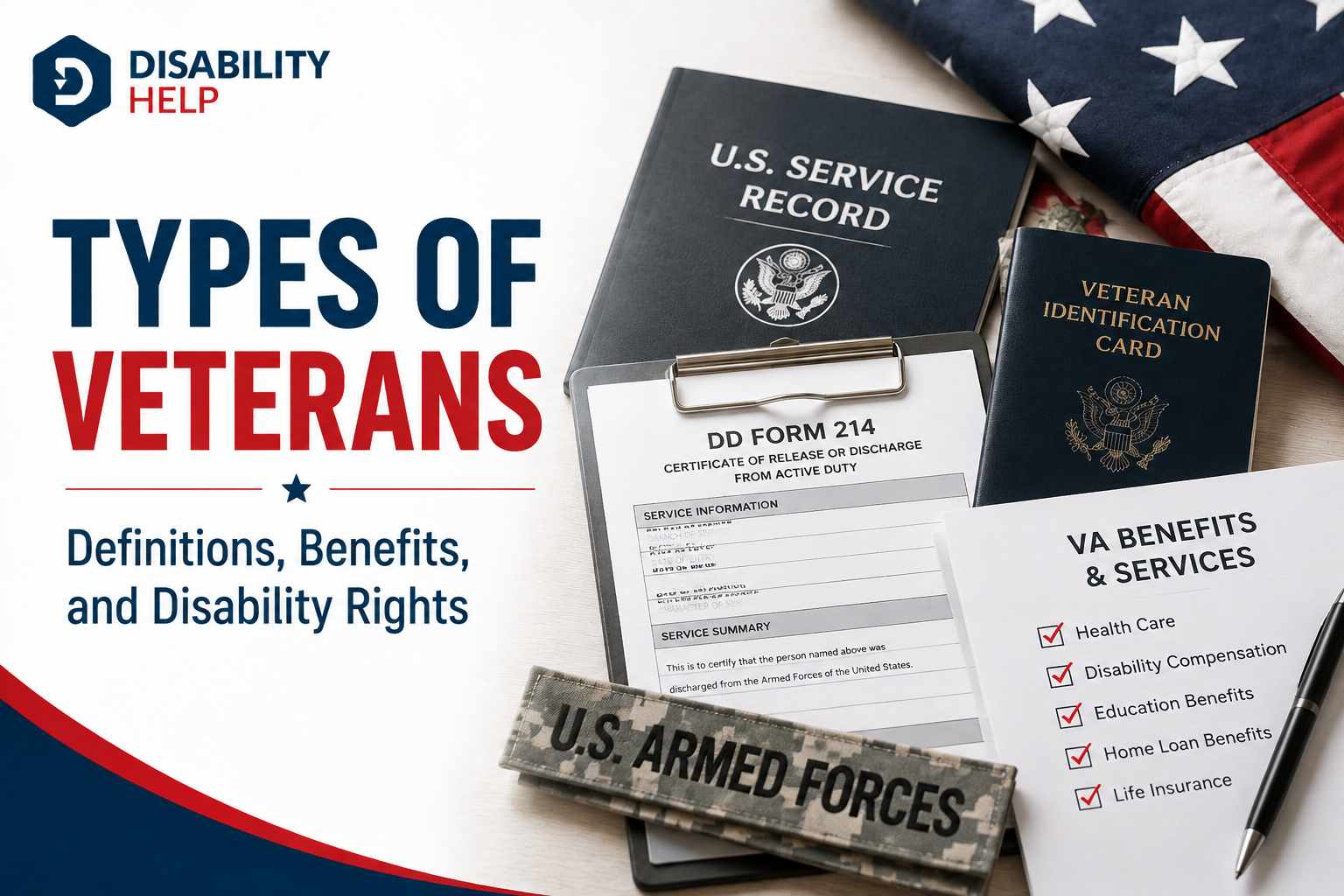
The four types of veterans are war veterans, combat veterans, retired veterans, and protected veterans. Each label describes a different service experience, and each one shapes the benefits, employment protections, and disability options you can claim. The categories overlap in real life, so one person can be a war veteran, a combat veteran, and a protected veteran at the same time. As of fiscal year 2025, about 17.6 million veterans live in the United States, and roughly 1 in 3 of them receive VA disability compensation. Knowing which type or types apply to you is the first step to claiming what your service earned.
This guide defines each of the four types, shows the benefits tied to each, and explains how VA disability compensation and Social Security Disability Insurance (SSDI) work together for veterans who can no longer work.
Key Takeaways
- Four recognized categories: The four types of veterans are war, combat, retired, and protected, and one person often fits more than one at the same time.
- War is not combat: A war veteran served during a wartime period, while a combat veteran actually engaged the enemy or served under hostile fire.
- Protected is a job-law term: VEVRAA shields disabled, recently separated, campaign badge, and service medal veterans from hiring discrimination by federal contractors.
- Disability drives benefits: About 6.3 million veterans received VA disability compensation as of September 2025, and nearly 1.85 million carry a 100% rating.
- Two checks at once: Veterans can collect VA disability compensation and SSDI at the same time, because the two programs do not reduce each other.
- A 100% rating speeds SSDI: A 100% permanent and total VA rating lets the Social Security Administration expedite your SSDI claim.
What Counts as a Veteran Under Federal Law?
A veteran is a person who served in the active military, naval, air, or space service and was discharged under conditions other than dishonorable. That baseline definition comes from Title 38 of the U.S. Code, and it applies before any of the four types are assigned. The four types then describe how and when you served, and which protections and benefits follow.
Three terms decide almost everything that comes next. Active duty means full-time federal military service, which is why Guard and Reserve members generally meet the core definition only after activation to federal active duty. Discharge status refers to the character of your separation, and a discharge under conditions other than dishonorable is the gate to most federal benefits. Service-connected means a condition was caused or made worse by your military service, which is the standard the VA uses to decide disability compensation.
These terms matter because two veterans with identical injuries can end up with very different benefits, based on when they served, how they were discharged, and whether a condition is tied to service.
The Four Types of Veterans at a Glance
Here is how the four types compare. Find the category or categories that match your service, then read the full section below for the benefits attached to each.
| Type | Who this describes | Why it matters | Example benefit |
|---|---|---|---|
| War veteran | Served during a recognized wartime period, with or without combat | Wartime service dates affect certain benefit eligibility | VA pension eligibility |
| Combat veteran | Engaged the enemy or served in a combat zone under hostile fire | Direct exposure raises health risks and unlocks combat markers | Enhanced VA health care period |
| Retired veteran | Completed 20+ years or was medically retired | Career-length or medical retirement earns lifetime pay | Military retirement pay |
| Protected veteran | Fits a VEVRAA category (disabled, recently separated, and more) | Guards against hiring discrimination by federal contractors | Employment protections |
War Veteran: Service During a Wartime Period
A war veteran served on active duty during an officially recognized wartime period, whether or not they saw combat. The recognized periods include World War II, the Korean conflict, the Vietnam era, and the Gulf War period, which remains open under current law. Service dates inside these windows can affect eligibility for benefits such as the VA pension.
Wartime service is common. About 78% of veterans served during a wartime period, while 22% served during peacetime, according to Pew Research Center. That means most veterans carry the war veteran label, even those who never deployed to a combat zone.
The war veteran category is often confused with the combat veteran category, but they are not the same. A war veteran qualifies based on the calendar and the service period. A combat veteran qualifies based on what actually happened during that service.
Combat Veteran: Direct Engagement or a Combat Zone
A combat veteran served in a combat zone or an area of hostility, or directly engaged the enemy under hostile fire. This is a narrower group than war veterans. You can deploy to a war zone, spend your entire tour inside a base, and never fire a shot, which still makes you a war veteran but not a combat veteran.
The VA recognizes combat service through markers such as imminent danger or hostile fire pay, combat-zone tax benefits, and certain campaign medals. Combat veterans also receive a period of enhanced eligibility for VA health care after separation.
Combat exposure carries a documented health cost. About 7 out of every 100 veterans, or 7%, will have PTSD at some point in their life, a rate higher than the civilian population, according to the U.S. Department of Veterans Affairs. PTSD and physical injuries from combat are among the most common conditions behind both VA disability compensation and SSDI claims, which is where the benefits question turns urgent for many combat veterans.
Retired Veteran: A Full Career or Medical Retirement
A retired veteran completed a full military career, usually 20 or more years of service, or was medically retired because of a service-connected condition. Retired veterans receive military retirement pay for life and keep access to one of the widest benefit sets available, including health care and base privileges.
There are two paths into this category. The first is length-of-service retirement, earned by serving the required number of years. The second is medical retirement, granted when a service-connected condition ends a career early. The two paths lead to different pay calculations and different benefit details.
Retirement pay and VA disability compensation used to cancel each other out, dollar for dollar. Under concurrent receipt programs, many retirees can now keep both military retirement pay and VA disability compensation, which raises total monthly income for a retired veteran with a service-connected rating.
Protected Veteran: Employment Rights Under VEVRAA
A protected veteran is a legal category created by the Vietnam Era Veterans' Readjustment Assistance Act, known as VEVRAA. It protects certain veterans from employment discrimination by federal contractors and subcontractors, and it requires those employers to take affirmative actionPolicies that promote the employment of individuals from underrepresented groups, including people w... to recruit and hire covered veterans, according to the U.S. Department of Labor.
VEVRAA defines four protected categories. You qualify as a protected veteran if you fit even one of them:
- Disabled veteran: You are entitled to VA disability compensation, or you would be entitled but for receiving military retired pay, or you were discharged because of a service-connected disability. Because the standard is entitlement to compensation rather than a payment amount, some veterans with even a 0% VA rating meet this category.
- Recently separated veteran: You are within the three-year period that begins on the date of your discharge or release from active duty. A veteran discharged on January 1, 2024, for example, keeps this status until January 1, 2027.
- Active duty wartime or campaign badge veteran: You served on active duty during a war, or in a campaign or expedition for which a campaign badge was authorized.
- Armed Forces service medal veteran: You received an Armed Forces Service Medal for taking part in a U.S. military operation.
Protected status is about jobs, not health care or cash benefits. A common myth is that it only covers visible injuries. It also covers invisible wounds such as PTSD, and it covers recently separated veterans who have no disability at all.
How Disability Benefits Fit Every Type of Veteran
Disability cuts across all four types of veterans. Whatever your category, a service-connected condition can qualify you for VA disability compensation, and a condition that stops you from working can qualify you for SSDI. You can receive both at the same time, because the two programs do not reduce each other, according to the Social Security Administration.
The two programs judge disability differently. The VA asks whether a condition is connected to your service, then assigns a rating from 10% to 100% in 10-point steps, paying more as the rating rises. The SSA does not use a rating scale. It makes an all-or-nothing decision based on your work credits and whether your condition prevents substantial gainful activity for at least a year. A veteran can hold a partial VA rating and still be denied SSDI, or hold a 100% VA rating and still need to prove the separate SSDI standard.
One rating opens a fast lane. If you hold a 100% permanent and total rating from the VA, the SSA can expedite your SSDI claim. Tell the SSA you are a veteran rated 100% permanent and total, and include your VA rating letter.
| Feature | VA Disability Compensation | SSDI |
|---|---|---|
| Basis for the benefit | A service-connected condition | Inability to work plus enough work credits |
| Rating approach | Graduated, 10% to 100% | All-or-nothing disability finding |
| Maximum monthly benefit (2026) | About $4,085 for a single veteran at 100% | $4,152 |
| Average monthly benefit (2026) | Varies by rating and dependents | About $1,630 |
| Effect on the other program | No effect on SSDI | No effect on VA compensation |
Figures for 2026 as reported by Nolo.
Whether you can qualify for SSDI depends on your work history and the severity of your condition, not on your VA rating. If your income and resources are low, you may also look at whether you can receive both SSI and SSDI, though VA benefits count as income for the needs-based SSI program and can reduce that payment.
Veterans already lean on Social Security in large numbers. About 8.0 million veterans received Social Security benefits in 2025, roughly 13.5% of all adult beneficiaries, according to the Social Security Administration. For a veteran who can no longer work, SSDI can be the difference between a stable month and an impossible one.
A Real-World Example: When One Veteran Fits Three Types
Consider an illustrative example. A soldier deploys to Iraq during a recognized wartime period and comes under hostile fire on regular patrols. Years later, a service-connected back injury and PTSD led to a 70% VA rating, and the injury eventually ended their ability to work.
This one person fits three of the four types at once. They are a war veteran because of wartime deployment. They are a combat veteran because of the hostile-fire service. They are a protected veteran under VEVRAA because they are entitled to VA disability compensation. If the injury keeps them from holding a job and they have enough recent work credits, they may also qualify for SSDI on top of their VA compensation.
The example is illustrative rather than a real case, but it reflects the pattern that sends many veterans looking for answers. The labels are not just paperwork. Each one opens a different door, and most veterans qualify for more than one.
Claiming What Your Service Earned
The four types of veterans- war, combat, retired, and protected- are more than labels. Each one connects to a specific set of benefits, protections, and disability options, and most veterans fit more than one. As of 2026, with about 6.3 million veterans receiving VA disability compensation, the gap between what veterans have earned and what they actually claim often comes down to knowing which categories apply and what each one unlocks.
Take the next step: Learn how the two systems interact in our guide to best law firms for veteran disability claims, including the separate eligibility rules veterans must meet when applying.
Frequently Asked Questions
What are the four types of veterans?
The four types of veterans are war veterans, combat veterans, retired veterans, and protected veterans. War and combat describe service experience, retired describes career length or medical retirement, and protected is an employment-law category under VEVRAA. Many veterans fit more than one type at the same time.
What is the difference between a war veteran and a combat veteran?
A war veteran served during an officially recognized wartime period, whether or not they saw fighting. A combat veteran actually engaged the enemy or served in a combat zone under hostile fire. You can be a war veteran without being a combat veteran, but a combat veteran is almost always a war veteran too.
Does being a protected veteran mean I have a disability?
No. Protected veteran status covers four groups, and only one of them is disabled veterans. You can be a protected veteran as a recently separated veteran, a campaign badge veteran, or an Armed Forces service medal veteran with no disability at all. The status protects you from job discrimination by federal contractors.
Can a veteran receive VA disability and SSDI at the same time?
Yes. Veterans can collect VA disability compensation and SSDI at the same time, and the two programs do not reduce each other. You must apply for each separately, because the VA and the Social Security Administration use different rules and different definitions of disability.
Does a VA disability rating guarantee SSDI approval?
No. A VA rating does not guarantee SSDI approval, even a 100% rating. The SSA runs its own review based on your work credits and whether your condition prevents substantial gainful activity. A 100% permanent and total VA rating does, however, let the SSA expedite your SSDI claim.
How long does someone stay a recently separated veteran?
A recently separated veteran keeps that protected status for three years, starting on the date of discharge or release from active duty. A veteran discharged on January 1, 2024, stays a recently separated veteran until January 1, 2027, and can claim that protection when applying to federal contractors.