
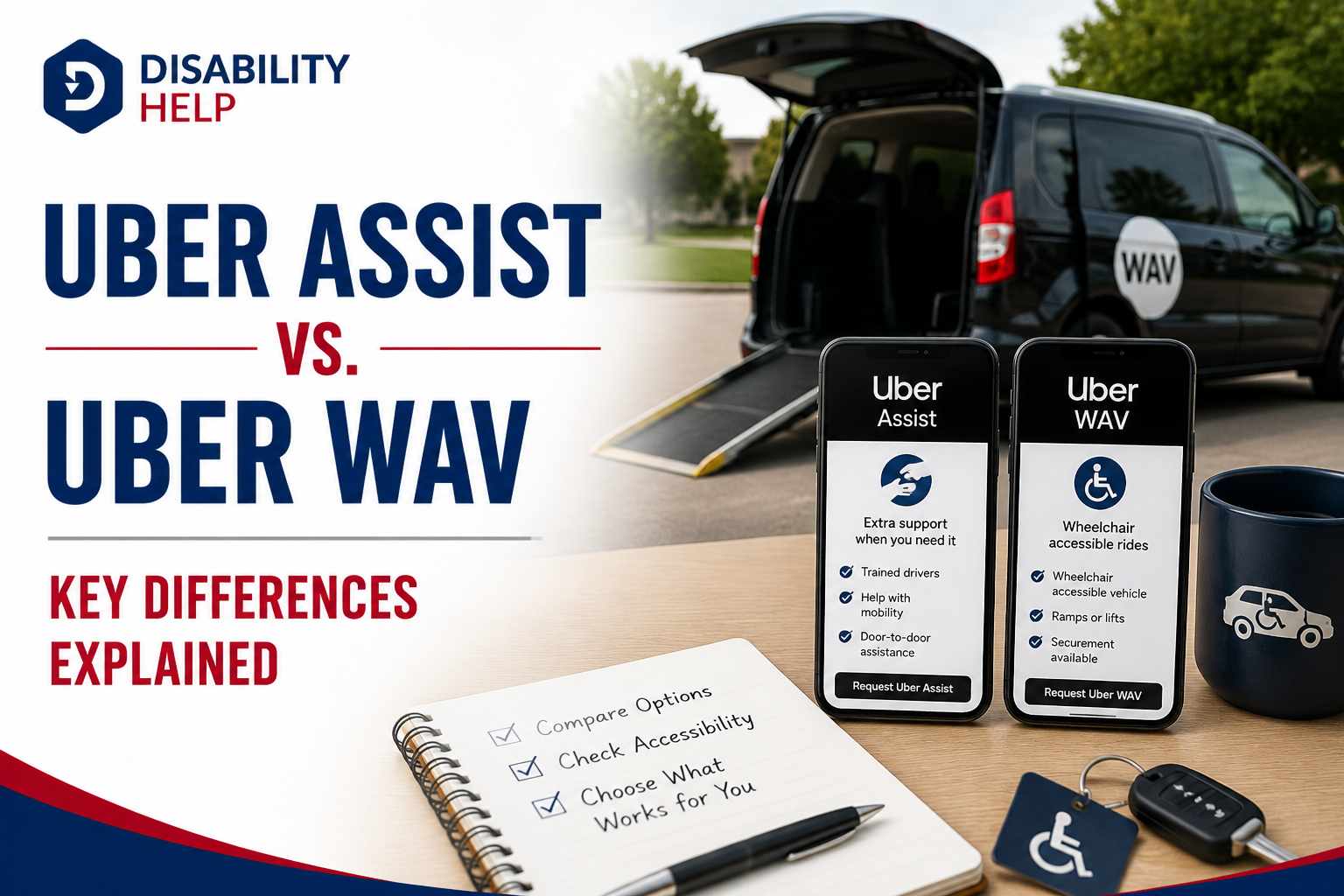
The difference between Uber Assist and Uber WAV is straightforward. Uber Assist sends a standard car with a driver trained to help you get to and from the vehicle. Uber WAV sends a van with a ramp or lift, so you can board while seated in a non-folding, motorized wheelchair. One service supports you on foot. The other removes the need to leave your wheelchair at all. That single distinction decides which ride you should request. Transportation remains a real barrier for many people: the U.S. Bureau of Transportation Statistics reports that 18.6 million Americans age 5 and older, about 6.1 percent, have a travel-limiting disability.
This guide explains how each service works, what drivers can and cannot do, what they cost, where they operate, and the legal rights that protect you as a rider.
Key Takeaways
- Difference between Uber Assist and Uber WAV: Assist provides a trained driver and a standard car; WAV provides a ramp-equipped van for riders who stay in their wheelchair.
- Who Uber Assist serves: Seniors, pregnant riders, people with visual or hearing impairments, and anyone using a folding wheelchair, walkerA mobility aid with a metal frame and sometimes wheels, used by individuals who need additional supp..., or caneA mobility aid used to assist with balance and walking..
- Who Uber WAV serves: Riders who stay seated in a non-folding motorized wheelchair or power scooter and need a ramp or lift to board.
- Same price as UberX: Both Uber Assist and Uber WAV can cost the same as a standard UberX fare, so your disability adds no surcharge to the ride.
- Availability gap: WAV runs in major U.S. metros while Assist has shrunk to a few U.S. cities, so check the app before you depend on either one.
- Your rights are federal: Under ADA Title III, drivers must accept service animals and folding mobility aidsDevices designed to help individuals move around more easily, such as canes, walkers, or wheelchairs..., and the DOJ sued Uber over alleged violations in September 2025.
What Is The Difference Between Uber Assist And Uber WAV?
The difference between Uber Assist and Uber WAV is the type of vehicle and the kind of help the driver provides. Uber Assist uses ordinary cars and trained drivers who guide you in and out. Uber WAV uses vans built with ramps or lifts so a wheelchair user can board without transferring to a seat.
Both services target riders with disabilities and mobility needs, but they solve different problems. Uber Assist answers the question, “I can move on my own, but I need a hand and a patient driver.” Uber WAV answers a different question, “I cannot leave my power wheelchair, so the vehicle has to fit the chair.” Choosing the wrong one leaves you stranded, so the device you use is the deciding factor.
Uber confirms this split in its own service descriptions. Assist vehicles can carry folding wheelchairs, walkers, and collapsible scooters but have no ramp or lift, while WAV vehicles are equipped with ramps or lifts for riders who use non-folding, motorized wheelchairs.
What is Uber Assist, And Who Is It For?
Uber Assist is a ride option that pairs you with a driver trained to give door-to-door help. The driver can walk you from the lobby or building entrance to the car, offer balance support, and help fold and store a mobility aid. The vehicle is a standard sedan, SUV, or minivan.
Uber Assist fits riders who can walk short distances but want extra help. That includes seniors, pregnant riders, people with visual or hearing impairments, and people recovering from a temporary injury. If you use a cane, a walker, or a wheelchair that folds and fits in a trunk, Assist is built for you.
There are firm limits on what an Assist driver may do. Drivers offer light physical support such as a steady arm, but they are not allowed to lift or carry you, and they do not act as medical caregivers. Their help also stops at the front door of a private home or a building lobby, not inside your residence. Knowing these limits in advance prevents a frustrating pickup.
Key terms: “Door-to-door assistance” means help between the building entrance and the car, not inside your home. A “folding mobility aid” is a wheelchair, walker, or scooter that collapses to fit in a standard trunk. An “Assist-certified driver” has completed third-party training in accessibilityThe design of products, devices, services, or environments to be usable by people with disabilities.... etiquette and basic physical assistance.
What is Uber WAV, And Who Is It For?
Uber WAV, short for Wheelchair Accessible Vehicle, is a ride option for people who use non-folding, motorized wheelchairs or power scooters. These vans are fitted with ramps or lifts, and the driver secures your wheelchair inside the vehicle so you ride while seated in your own device.
Uber WAV fits riders whose wheelchair cannot fold or be stored in a trunk. A power wheelchair can weigh 200 pounds or more, which makes transferring to a car seat impractical or unsafe. The ramp or lift lets you roll into the van, and the driver locks the chair in place with a four-point tie-down system before the trip starts.
WAV drivers complete a third-party certification course covering assistance and vehicle entry/exit. Common WAV models include the Toyota Sienna, Honda Odyssey, Dodge Grand Caravan, Ford Transit Connect, and Chrysler Town and Country.
One WAV holds a single wheelchair user at a time, plus companions up to the number of available seat belts. If two wheelchair users need a ride together, you request two separate WAV vehicles.
Uber Assist vs Uber WAV: A Side-By-Side Comparison
The table below compares Uber Assist and Uber WAV across the factors that decide which ride you need. Read it top to bottom, and the right choice usually becomes obvious based on your mobility device and where you live.
| Feature | Uber Assist | Uber WAV |
|---|---|---|
| Best for | Seniors, pregnant riders, people with visual or hearing impairments, and short-term injury recovery | Riders who stay seated in a non-folding, motorized wheelchair or power scooter |
| Vehicle type | Standard 4-door sedan, SUV, or minivan (no ramp or lift) | Retrofitted van with a commercial-grade ramp or hydraulic lift |
| Mobility devices | Folding wheelchairs, walkers, canes, collapsible scooters that fit in a trunk | Non-folding power wheelchairs and heavy mobility scooters |
| Driver help | Door-to-door support, balance and guidance, help folding and storing aids | Deploys the ramp or lift and secures the wheelchair with tie-down straps |
| Driver certification | Third-party training in accessibility etiquette and basic physical assistance | Third-party PASS certification in wheelchair securement and safety |
| Passenger capacity | Up to 4 riders, including companions | 1 wheelchair user plus companions, up to the available seat belts |
| Booking | On-demand request in the app | On-demand, with scheduled rides up to 30 days ahead in select markets |
| Cost | Same as UberX | Same as UberX for individual riders |
| Wait times | Comparable to UberX, depends on driver supply | Often longer because the specialized fleet is smaller |
How Do You Book Uber Assist or Uber WAV?
Booking either service follows the same path as a standard ride, with one extra step: you pick the accessible option before you confirm. Follow these steps to request Uber Assist or Uber WAV.
- Open the Uber app and enter your destination in the “Where to” box, the same way you would for any ride.
- Scroll through the ride options at the bottom of the screen and look for “Assist” or “WAV.” If neither appears, the service is not available at your location or time.
- Select Assist or WAV, confirm your pickup point, and request the ride. In select markets, you can schedule a WAV ride up to 30 days ahead instead of requesting on demand.
- Once a driver is assigned, use in-app messaging to share your needs, for example, “I am waiting by the sidewalk ramp” or “I will need help folding my wheelchair.”
- Before you board, check the license plate, the vehicle make and model, and the driver photo against the app to confirm you have the right car.
- If a driver refuses your folding wheelchair, walker, or service animalAn animal that is trained to perform tasks for the benefit of a person with a disability, protected ..., document what happened and report it in the app right away.
What do Uber Assist and Uber WAV Cost, And Where Can You Get Them?
For individual riders, both Uber Assist and Uber WAV are priced the same as a standard UberX fare. This pricing rule exists so a person with a disability is not charged more for the ride they need. You pay the UberX rate whether you take a regular car or a ramp-equipped van.
There are two pricing details to watch. Uber and some cities pay drivers extra to run costly WAV vans, including per-trip bonuses in select markets. Separately, WAV rides booked through business or healthcare portals such as Uber Health may carry a WAV Program Fee, which offsets fleet costs and is billed to the organization, not usually to you as the rider.
Availability is where the two services split sharply. Uber WAV is available only in select markets, and availability can change by city, time, and driver supply. Before relying on it for a medical appointment or other time-sensitive trip, open the app at your exact pickup location and confirm that WAV appears as an option. Uber Assist, by contrast, has been phased out across much of the United States and now runs in only a handful of cities such as Phoenix, San Diego, San Jose, and Las Vegas, while staying widely available in markets like Australia, Canada, New Zealand, and the United Kingdom.
A 2025 National Council on Disability report found that millions of people with mobility disabilities still lack reliable ground transportation, so checking the app for your exact location matters before you rely on either service.
Plan for longer waits with WAV. The accessible fleet is far smaller than the standard UberX fleet, so request your ride earlier than usual, especially for medical appointments and other time-sensitive trips.
What Are Your Legal Rights As A Rider With A Disability?
Your rights as a rider come from federal law, not from Uber’s goodwill. Under Title III of the Americans with Disabilities Act, private companies that transport the public cannot discriminate against people with disabilities. Courts have increasingly applied this standard to rideshare platforms, rejecting the argument that they are only technology companies.
Three protections matter most on a day-to-day basis. Drivers must transport riders with service animals, and denying a service animal can lead to permanent removal from the platform. Drivers cannot charge extra to store a folding wheelchair, walker, or other assistive device. And if your disability means you need more time to board, you can request a waiverA legal provision that allows states to forego certain requirements of federal law, often used in th... or refund of wait-time fees through the app.
These rights are under active enforcement in 2026. In September 2025, the U.S. Department of Justice sued Uber for alleged ADA violations in federal court in San Francisco, claiming drivers routinely refused riders who travel with service animals or use stowable wheelchairs and imposed improper fees. The DOJ is seeking changes to Uber’s policies, driver training, monetary damages for affected riders, and a civil penalty.
The case is moving forward. According to a Congressional Research Service analysis, the district court denied Uber’s motion to dismiss on March 5, 2026, which lets the lawsuit proceed. The same analysis notes an earlier settlement over wait-time fees that paid several million dollars to more than 65,000 Uber users, a reminder that these protections carry real financial weight when they are enforced.
What Disability Advocates And Federal Regulators Say
Federal regulators have framed rideshare access as a civil rightsThe rights of individuals to receive equal treatment under the law, including protection against dis... issue, not a customer-service problem. Announcing the 2025 lawsuit, Assistant Attorney General Harmeet K. Dhillon of the DOJ Civil Rights Division said that for too long, “blind riders have suffered repeated ride denials” when traveling with a service dog, and that the suit aims to end that pattern. Uber, for its part, has said riders who use guide dogs or assistive devices deserve a respectful experience and points to a zero-tolerance policy for confirmed service denials.
In practice, the gap between policy and pickup is what trips riders up. Consider a common case: a rider books a standard UberX, the driver sees a folding wheelchair, and cancels rather than load it. The rider waited, paid a wait-time fee, and missed an appointment. Two steps would have changed that outcome. Booking Assist, where it exists, pairs the rider with a driver trained for folding aids, and reporting the cancellation in the app creates the record that wait-time fee refunds and ADA complaints depend on. Documentation is the quiet tool that turns a written right into an actual remedy.
This site does not provide legal advice. If a driver denied you service, charged an improper fee, or refused a service animal, keep your trip records and consider speaking with a disability rightsThe legal and human rights afforded to individuals with disabilities, often the focus of advocacy an... attorney or filing a complaint with the U.S. Department of Justice.
Which Ride Should You Choose?
The choice between Uber Assist and Uber WAV comes down to one question: can you leave your wheelchair to sit in a car seat? If you can walk a short distance or use a folding aid, Uber Assist gives you a trained driver and door-to-door help. If you stay seated in a non-folding power wheelchair, Uber WAV is the only one of the two that fits, because the vehicle carries a ramp or lift.
As of 2026, availability is the practical catch. WAV runs in most large U.S. metros, while Assist has narrowed to a few U.S. cities, and the federal lawsuit against Uber signals that access for riders with disabilities is still contested. Before any important trip, open the app, confirm which option appears at your location, and request it early. Keep your trip records, because the federal rights that protect you only work when you can show what happened.
For more help planning accessible rides, read Disability Help’s guide on how to schedule a wheelchair-accessible Uber or Lyft.
Frequently Asked Questions
Is Uber Assist the same as Uber WAV?
No. Uber Assist sends a standard car with a driver trained to help you board and to store a folding mobility aid. Uber WAV sends a van with a ramp or lift for riders who stay seated in a non-folding, motorized wheelchair. Assist supports you on foot; WAV fits the wheelchair itself.
Does Uber WAV cost more than a regular Uber?
No. For individual riders, Uber WAV is priced the same as a standard UberX fare, so you are not charged extra for the accessible vehicle. The main difference you will notice is wait time, since the WAV fleet is smaller than the standard fleet and vans can take longer to arrive.
Can an Uber Assist driver lift me into the car?
No. Uber Assist drivers can offer balance support and a steady arm, and they can help fold and store a wheelchair or walker. They are not permitted to lift or carry passengers and do not act as medical caregivers. If you cannot transfer from your wheelchair, request Uber WAV instead.
Can I schedule an Uber WAV ride in advance?
In select markets, yes. Uber offers scheduled WAV rides up to 30 days ahead in some cities, which helps with medical appointments and other fixed times. Availability varies by location, so open the app and check whether the schedule option appears for WAV at your pickup point.
What can I do if a driver refuses my wheelchair or service animal?
Document the incident, including the date, driver, and what was said, then report it through the Uber app. Refusing a service animal violates federal law and Uber policy and can lead to driver deactivation. You can also file a complaint with the U.S. Department of Justice Civil Rights Division if the problem continues.