
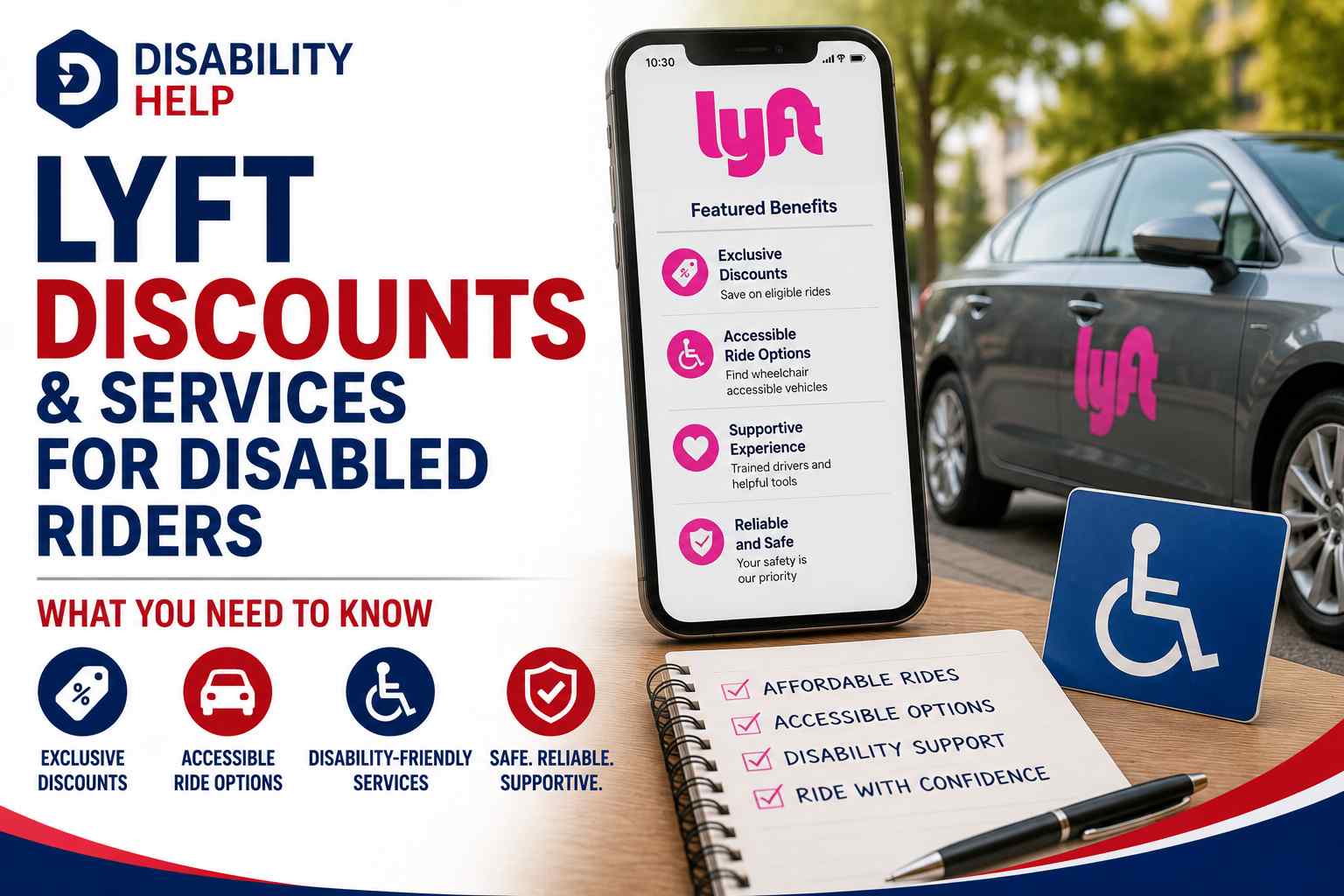
Lyft does not offer a flat discount based on disability status, but it does provide several special services for disabled passengers, including Wheelchair Accessible Vehicle (WAV) rides, Lyft Assisted, and Lyft Silver. Free and reduced-cost rides exist, but they come through government transit partnerships and nonprofit credit programs, not a discount code in the app. In 2022, an estimated 18.6 million Americans reported a travel-limiting disability, and a lack of reliable transportation is still one of the biggest barriers to work, healthcare, and daily errands.
This guide breaks down what Lyft actually offers, how each service is priced, where it works, which subsidy programs can lower your cost, and the rights you hold under the ADA.
Key Takeaways
- No flat disability discount: Lyft does not lower fares based on disability status. WAV rides and Lyft Silver cost the same as standard Lyft rides.
- WAV rides for power wheelchairs: Wheelchair Accessible Vehicle rides serve non-folding wheelchair and scooter users, but only in nine U.S. metro areas as of 2026.
- Lyft Assisted adds door-to-door help: Trained drivers help passengers board and stow light mobility devices, cutting healthcare no-shows by 20 percent.
- Subsidized rides come from partners: Programs such as Nevada's N4 Connect give qualifying disabled and senior riders up to $160 per month in Lyft credits.
- The ADA bans disability surcharges: Federal law prohibits charging a disabled passenger more for a ride or for stowing a wheelchair, walkerA mobility aid with a metal frame and sometimes wheels, used by individuals who need additional supp..., or caneA mobility aid used to assist with balance and walking..
- Service animals ride free, always: Drivers must accept service animals at no extra fee, with no exceptions for allergies, religion, or fear of animals.
What Special Services Does Lyft Offer Disabled Passengers?
Lyft offers three dedicated accessibilityThe design of products, devices, services, or environments to be usable by people with disabilities.... services: Lyft Wheelchair (WAV) for riders who cannot transfer out of a power wheelchair, Lyft Assisted for riders who need help boarding, and Lyft Silver for older adults. Each one targets a different level of physical need rather than a single, one-size program.
Lyft Wheelchair (WAV) pairs you with a driver whose vehicle has a ramp and securement system, so you can stay in a non-folding motorized wheelchair or scooter during the trip. According to Lyft's accessibility commitment, you turn this on through the "Wheelchair access" toggle in the app settings, after which a "Wheelchair" ride type appears alongside standard options.
Lyft Assisted, built with the Open Doors Organization, is for riders who need a hand getting in and out but do not need a ramp. The driver can meet you at your front door, help you into the car, and walk you to the entrance at drop-off. Lyft reports that the extra connection time produces a 20 percent reduction in no-shows compared with standard healthcare rides.
Lyft Silver is aimed at older adults, many of whom live with age-related disabilities. It uses a simplified app, gives caregivers real-time ride tracking, and offers live phone support from 8:00 a.m. to 9:00 p.m. ET so you can book by talking to a person instead of tapping through a screen.
Does Lyft Give a Discount for Disabled Riders?
No. Lyft does not apply an automatic price reduction for passengers with disabilities. WAV and Lyft Silver rides are priced the same as standard rides, which is deliberate: charging a disabled rider more would itself break federal law. Lower fares come from outside subsidy programs, not from Lyft's pricing.
This distinction matters because of a common scam pattern in the disability space. No legitimate service charges you a fee to "unlock" a government or nonprofit transportation benefit. Subsidized Lyft programs are administered by public transit authorities and registered nonprofits, and qualifying riders pay little or nothing. If a website or caller asks for an upfront payment to enroll you in free rides, treat it as fraud and verify the program directly with your local transit authority first.
It also matters legally. Lyft has long argued in court that it is a technology platform rather than a transportation company, a position it uses to push back on the broadest accessibility claims. A 2026 Congressional Research Service analysis notes that whether a rideshare company is treated as a public accommodationFacilities, both public and private, used by the public, which are required to be accessible to indi... or as specified public transportation, the core ADA duties are the same. The takeaway for you: the discount question and the rights question are separate, and your rights do not depend on a discount.
How Do Lyft's Accessibility Services Compare?
The four ride options below differ most in who they serve, how widely they are available, and what the driver is trained to do. Pricing is identical to standard Lyft for the in-app services. The biggest practical variable is geography, because WAV rides exist in only a handful of cities.
| Service | Who It Is For | Pricing | Availability | Key Feature |
|---|---|---|---|---|
| Lyft Wheelchair (WAV) | Motorized wheelchair and scooter users | Same as standard Lyft | 9 metro areas (Boston, Chicago, Dallas, LA, NYC, Philadelphia, Phoenix, Portland, San Francisco) | Ramp and securement system in the vehicle |
| Lyft Assisted | Riders needing boarding help or extra time | Varies by healthcare partner | National, through healthcare providers | Door-to-door help and stowing of light devices |
| Lyft Silver | Older adults and seniors | Same as standard Lyft | Select markets, broadly available | Live phone support and simplified app |
| Standard Lyft | Riders with foldable mobility devices | Standard rates | Nationwide | Driver must stow foldable wheelchair or walker by law |
Source: Lyft Help Center and the BraunAbility accessible rideshare guide.
How to Request an Accessible Ride and Lower the Cost
Getting an accessible Lyft ride, and paying less for it, follows a clear order: set up the app, check what is available where you live, then layer on any subsidy you qualify for. Work through these steps in sequence.
- Turn on accessibility settings. Open the Lyft app, go to settings, and enable "Wheelchair access" so the Wheelchair (WAV) ride type can appear when you book.
- Confirm local availability. Request a ride and look for the WAV option. If it does not appear, the service is not yet in your area, and Lyft will often list third-party accessible providers instead.
- Ask your transit authority about subsidies. Many cities run "Mobility on Demand" programs that cover part of your Lyft fare. Nevada's N4 Connect, for example, offers up to $160 per month in credits to disabled and senior riders.
- Apply for nonprofit ride credits. Lyft Up's Jobs Access program funds rides to job training, interviews, and the first three weeks of a new job, which directly helps unemployed riders with disabilities.
- Disclose a service animalAn animal that is trained to perform tasks for the benefit of a person with a disability, protected ... if you choose. You can pre-alert your driver in the app's Accessibility section. You are never required to do this, and you never pay extra for a service animal.
- Document any problem. If a driver denies your ride or charges an improper fee, screenshot the trip, note the time, and report it so the incident is on record.
Key Terms You Will See When Booking Accessible Rides
A few terms come up constantly in rideshare accessibility, and mixing them up can cost you the right ride. Here is what each one means in plain language.
WAV (Wheelchair Accessible Vehicle): A vehicle with a ramp or lift and tie-downs that let a rider stay seated in a non-folding power wheelchair or scooter during the trip.
Lyft Assisted: A ride type where the driver is trained to help you board, exit, and handle light mobility aidsDevices designed to help individuals move around more easily, such as canes, walkers, or wheelchairs... such as canes, walkers, and foldable wheelchairs.
Paratransit: Public, ADA-required shared transportation for people who cannot use fixed-route buses or trains. It usually needs advance booking, which is why on-demand rideshare partnerships are growing as a faster alternative.
Title III of the ADAThe section of the Americans with Disabilities Act that prohibits disability discrimination by publi...: The section of the Americans with Disabilities Act that bars private transportation providers from discriminating against riders with disabilities, including by charging higher fares.
Reasonable modification: A change to standard policy that a provider must make so a disabled rider can use the service, such as a driver stowing a wheelchair or letting a rider sit in the front seat when needed.
What Accessible Rideshare Looks Like in Real Life
Numbers explain the policy, but rider stories show the impact. Michael Martignetti, a wheelchair user in Boston, started relying on rideshare in 2017 for physical therapy, errands, and dinners after years of depending on a shared door-to-door bus service. Because the WAV driver pool is small, riders and drivers are often matched repeatedly: Martignetti has taken more than 440 trips with one driver, sometimes seeing him four times a week. That kind of consistency is hard to get from traditional paratransit.
The harder truth is that access is uneven. The U.S. Department of Justice sued Uber for $125 million in ADA violations, citing routine ride denials, surcharges tied to service animals and disability, and refusals to let riders with mobility disabilities sit up front. Lyft itself settled a 2020 case over drivers refusing riders with foldable wheelchairs and agreed to retrain drivers and add a complaint process. Knowing this record helps you recognize when a denial is not just bad luck but a rights violation.
None of this is legal advice. If you believe a driver discriminated against you, a disability rightsThe legal and human rights afforded to individuals with disabilities, often the focus of advocacy an... attorney can tell you whether your situation supports a complaint or a claim, and many offer a free first consultation.
Know Your Lyft Options Before You Book
Lyft does not hand out a disability discount, but it does run real accessibility services, WAV, Lyft Assisted, and Lyft Silver, and it cannot legally charge you more for using them. The cheaper rides come from transit and nonprofit subsidies, and your strongest protection comes from the ADA. As of 2026, with active federal enforcement and a $125 million Uber lawsuit moving forward, riders have more leverage than they did a few years ago. Know which service fits your needs, check what your city offers, and keep a record if something goes wrong.
To understand the legal foundation behind every accessible ride, read our explainer on how the ADA protects disabled people and what that protection includes.
Frequently Asked Questions
Does Lyft offer a disability discount?
No. Lyft does not reduce fares because of disability status, and WAV and Lyft Silver rides cost the same as standard rides. Lower or free fares come from city transit subsidies and nonprofit credit programs, not from a Lyft discount code.
How do I request a wheelchair accessible Lyft?
Open the app settings and turn on "Wheelchair access." A "Wheelchair" ride type will then appear when you book, if WAV is available in your city. WAV currently runs in nine U.S. metro areas, so it may not appear in suburban or rural locations.
Can a Lyft driver refuse my service animal or wheelchair?
No. Federal law and Lyft policy require drivers to accept service animals and to stow foldable wheelchairs, walkers, and canes at no extra cost. There are no exceptions for allergies, religion, or fear of animals, and a driver cannot cancel simply because you use an assistive device.
Are there free or subsidized Lyft rides for disabled people?
Yes. Government transit authorities and nonprofits fund reduced or free rides for qualifying riders. Examples include Nevada's N4 Connect, which gives up to $160 per month in credits, and Lyft Up's Jobs Access program for job seekers. Verify any program through your local transit authority before paying anything.
What should I do if a Lyft driver discriminates against me?
Document the trip with screenshots and the date, then report it through the app's Ride History, or call Lyft's service animal line at 1-844-554-1297. You can also file an ADA complaint with the U.S. Department of Justice. For serious or repeated discrimination, consider speaking with a disability rights attorney.