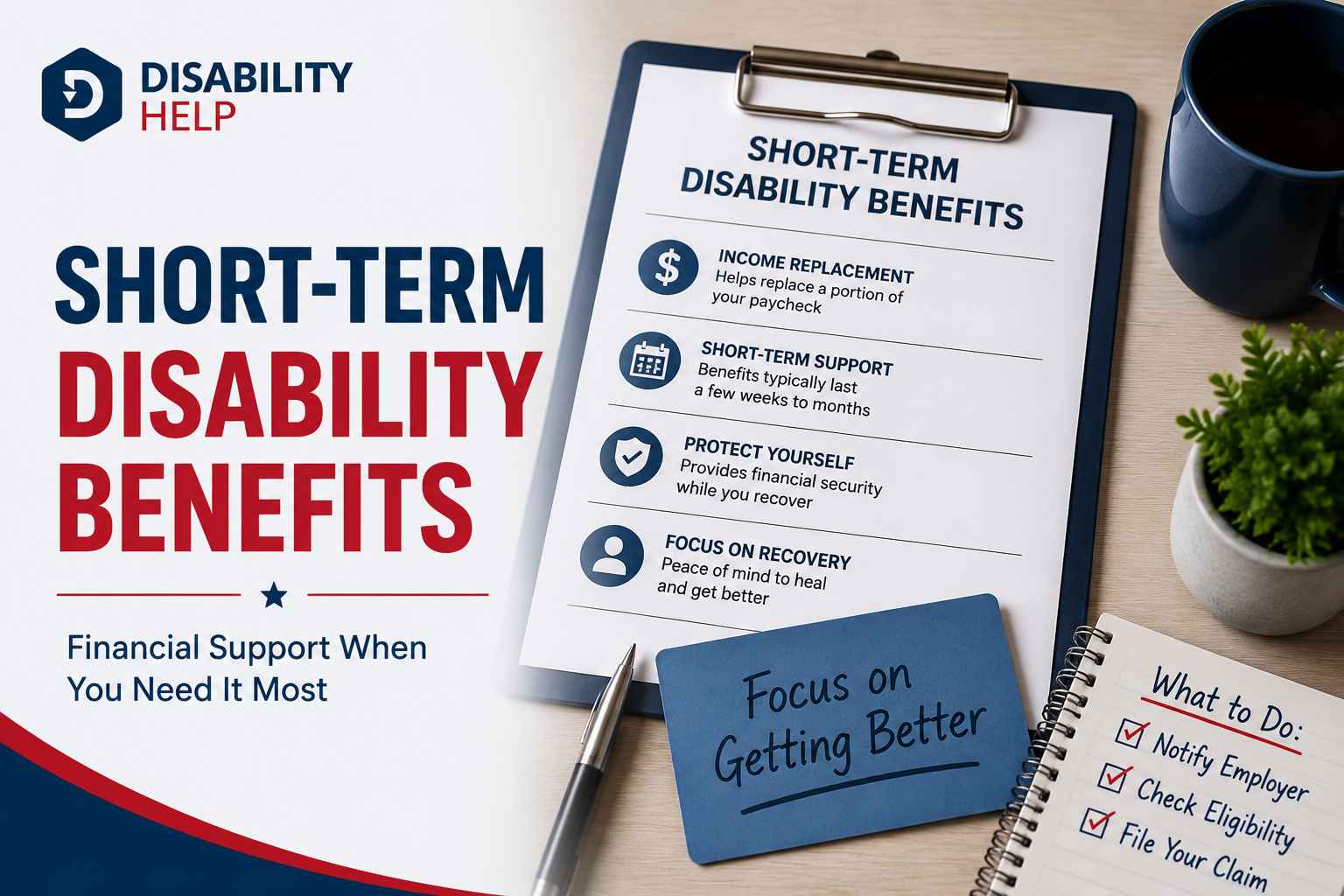
Yes, you can receive short-term disability benefits while on maternity leave, and in most cases, the two are built to work together. Short-term disability (STD) replaces part of your income while you recover from childbirth, and the Family and Medical Leave Act (FMLA)A U.S. law that provides eligible employees with unpaid, job-protected leave for family and medical ... protects your job during the same weeks. The two run at the same time, not back to back.
Access is not universal, though. In March 2025, 68% of private industry workers at companies with 500 or more employees had short-term disability coverage, while far fewer workers at small firms did.
This guide explains how short-term disability and maternity leave fit together, what your state offers in 2026, and how to claim the pay you are owed.
Key Takeaways
- STD and FMLA stack: Short-term disability pays part of your wages while FMLA protects your job, and the two run at the same time during maternity leave.
- Pay is partial, not full: Most short-term disability plans replace 60% of your salary, with a median coverage period of 26 weeks, according to the U.S. Bureau of Labor Statistics.
- Standard recovery windows: Short-term disability usually covers 6 weeks after a vaginal birth and 8 weeks after a Cesarean section, and longer if complications occur.
- Five states mandate coverage: California, Hawaii, New Jersey, New York, and Rhode Island run state disability programs that pay for pregnancy and childbirth.
- Timing decides individual policies: If you buy an individual short-term disability policy after conceiving, insurers usually treat the pregnancy as a pre-existing condition and exclude it.
- Federal law protects you: The Pregnancy Discrimination Act requires any employer that offers short-term disability to cover pregnancy the same as any other temporary medical condition.
Can You Get Short-Term Disability and FMLA at the Same Time?
Yes. Short-term disability and FMLA cover different needs and run concurrently. Short-term disability replaces a portion of your income while you cannot work. FMLA gives you up to 12 weeks of unpaid, job-protected leave. You do not receive 12 weeks of FMLA after your short-term disability ends. Both clocks run together.
To qualify for FMLA, you must work for a covered employer with at least 50 employees within a 75-mile radius, have worked there for at least 12 months, and have logged at least 1,250 hours in the year before your leave. The U.S. Department of Labor lays out these rules on its FMLA page. FMLA also requires your employer to keep your health insuranceA system for paying for medical services, often covering preventive, diagnostic, and treatment costs... active while you are out.
The pairing helps your budget. Without short-term disability, FMLA leave is entirely unpaid, which creates real financial strain for many families. With both in place, you get income replacement and job protection over the same stretch of time.
One caution: short-term disability pays you, but it does not protect your job on its own. Job protection comes from FMLA and, in some states, a separate state leave law. If you are not FMLA-eligible, confirm what other protection applies before you file.
How Much Does Short-Term Disability Pay During Maternity Leave?
Short-term disability replaces 40% to 70% of your salary during maternity leave, depending on the plan. The median replacement rate is 60%, and the median coverage period is 26 weeks, according to the U.S. Bureau of Labor Statistics. Ninety-three percent of employer plans pay for a fixed duration rather than open-ended.
For maternity, the payment window follows your recovery. Most plans pay 6 weeks after an uncomplicated vaginal delivery and 8 weeks after a Cesarean section. If you develop complications, your doctor can certify a longer period, and the benefit extends with it. Payment is tied to medical recovery, so the benefit ends once your provider clears you to return to work.
Most plans include an elimination period, a short waiting period before benefits begin. For employer and group plans, this is usually 1 to 2 weeks. Read your plan document for the exact number, because the waiting period reduces how many paid weeks you actually receive.
How Do Maternity Leave Benefits Compare Across Programs?
The programs that support maternity leave do different jobs. Some pay you, some protect your job, and a few do both. The table below compares the main options using current 2026 figures so you can see where your situation fits.
| Benefit Aspect | Federal FMLA | California SDI | New York (DBL + PFL) | Private STD (Group) | Private STD (Individual) |
|---|---|---|---|---|---|
| Job protection | Yes, 12 weeks | No (CFRA is separate) | No (NY leave law is separate) | No | No |
| Income replacement | No, unpaid | Yes, 70–90% of wages | Disability 50%; PFL 67% | Yes, 50–70% | Yes, 40–70% |
| Pre-delivery coverage | Counts in 12 weeks | Up to 4 weeks | Up to 4 weeks | Varies by plan | Often excluded if pre-existing |
| Post-vaginal birth | In 12 weeks | 6 weeks | 6 weeks | 6 weeks | 6 weeks |
| Post-C-section | In 12 weeks | 8 weeks | 8 weeks | 8 weeks | 8 weeks |
| Max weekly benefit | None (unpaid) | $1,765 (2026) | PFL $1,228.53 (2026) | Set by plan | Set by policy |
| Waiting period | None | 7 days | 7 days (disability) | 1–2 weeks | 1–2 weeks (12 mo. if pre-existing) |
| Health insurance continues | Required | Not guaranteed | Not guaranteed | Varies | Not guaranteed |
Figures reflect 2026 state benefit levels. State maximums adjust each year, so verify your current amount with the official program before you file.
How to Claim Short-Term Disability for Maternity Leave: 7 Steps
Filing goes smoothly when you prepare early and keep your paperwork organized. Follow these steps to claim short-term disability for your maternity leave.
- Confirm your coverage. Check whether your income replacement comes from an employer plan, a private policy, or a state disability program. Each has its own rules and forms.
- Read your plan document. Find your replacement rate, elimination period, benefit duration, and any pregnancy-specific terms. Note the claim deadline.
- Notify HR and request FMLA in writing. Tell your employer your expected leave dates and ask to have FMLA run with your short-term disability so your job is protected.
- Get medical certification. Ask your healthcare provider to complete the disability certification with your due date, delivery type, and expected time off work.
- File your claim on time. Submit as soon as your leave begins. New York, for example, requires disability claims within 30 days of becoming disabled, and missing a deadline can cost you benefits.
- Coordinate other benefits. If you also have state disability, Paid Family Leave, or accrued paid time off, map out the order so you avoid gaps and do not lose weeks of pay.
- Plan for the weeks beyond recovery. Short-term disability usually ends at 6 to 8 weeks. If you want a longer leave for bonding, line up state Paid Family Leave, unpaid FMLA, or saved paid leave to cover it.
Key Terms to Know Before You File
A few terms come up repeatedly in maternity leave paperwork. Knowing them helps you read your plan and file correctly.
- Short-term disability (STD): Insurance that replaces part of your income when a temporary medical condition, including childbirth recovery, keeps you from working.
- FMLA: The Family and Medical Leave Act, a federal law giving eligible employees up to 12 weeks of unpaid, job-protected leave.
- Elimination period: The waiting time between when your disability begins and when benefit payments start, often 1 to 2 weeks.
- Pre-existing condition exclusion: A policy clause that denies coverage for a condition, such as a pregnancy, that began before the policy took effect.
- Paid Family Leave (PFL): A state benefit that pays you to bond with a new child, usually after your disability recovery period ends.
- Concurrent leave: Two benefits running over the same days, such as short-term disability and FMLA during maternity leave.
- Wage replacement rate: The percentage of your normal pay the benefit provides, commonly 50% to 70% for employer plans.
What Do the Five State Disability Programs Offer in 2026?
Five states run mandatory disability programs that pay for pregnancy and childbirth: California, Hawaii, New Jersey, New York, and Rhode Island. These programs are funded through payroll deductions and provide more complete maternity coverage than most other states, where paid income during leave depends entirely on an employer or private plan.
California State Disability Insurance (SDI)
California offers one of the strongest maternity programs in the country. In 2026, SDI pays 70% to 90% of your wages, up to a maximum of $1,765 per week, after full phase-in of Senate Bill 951. Lower and middle-income workers receive the higher 90% rate. You can claim up to 4 weeks before your due date, 6 weeks after a vaginal birth, and 8 weeks after a Cesarean section.
To qualify, you must have earned at least $300 in wages subject to SDI during your base period, be unable to do your regular work, and have your disability certified by a licensed provider. There is a 7-day waiting period. After SDI ends, most parents move to California Paid Family Leave, which adds up to 8 weeks of bonding pay at the same 70% to 90% rate.
New York Disability Benefits and Paid Family Leave
New York splits maternity support into two benefits. Statutory disability benefitsFinancial assistance provided to individuals who are unable to work due to a disability, such as Soc... pay 50% of your average weekly wage, capped at a low $170 per week, a limit that has not kept pace with wages. The real money comes from New York Paid Family Leave. In 2026, PFL pays 67% of your average weekly wage up to $1,228.53 per week for up to 12 weeks, according to the New York State Paid Family Leave 2026 update.
Disability benefits and PFL cannot run at the same time in New York, but you can use them one after the other. The state caps combined disability and PFL at 26 weeks in any 52-week period. Disability claims must be filed within 30 days of becoming disabled, so file early to protect your pay.
New Jersey, Hawaii, and Rhode Island
New Jersey Temporary Disability InsuranceA form of insurance that provides income to individuals who are unable to work due to a disability. provides 10 to 12 weeks of cash benefits for pregnancy and recovery, with pay calculated as a share of prior wages. Hawaii requires employers to provide temporary disability coverage and pays pregnancy leave at the same rate as any other disability, with coverage lasting between 26 and 52 weeks. Rhode Island offers Temporary Disability Insurance and Temporary Caregiver Insurance for workers who have paid into the state fund, including for maternity-related conditions.
Private Short-Term Disability and the Pre-Existing Condition Trap
Timing decides whether an individual short-term disability policy will cover your pregnancy. If you buy an individual policy after you conceive, insurers usually classify the pregnancy as a pre-existing condition. That can exclude your maternity claim or delay benefits until 12 months after the policy takes effect. To be covered, you generally need to enroll before becoming pregnant.
Group plans offered through an employer work differently. They rarely require medical underwriting and rarely apply pre-existing condition exclusions, so employees with employer STD usually get more favorable terms than those buying individual policies. If your employer offers a group plan, that is almost always the better route for maternity coverage.
Federal employees face a specific gap: the federal government does not include short-term disability in its standard benefits package. Federal and postal workers get FMLA leave, but it is unpaid unless they use accrued annual or sick leave. Some buy private guaranteed-issue coverage that pays up to $5,000 per month for as long as one year, with a 14-day elimination period. The same timing rule applies, so a policy bought after conception typically will not cover that pregnancy.
Your Legal Protections as a Pregnant Worker
Federal law gives you rights that exist no matter what an employer or insurer tells you. Three laws matter most for maternity leave and short-term disability.
The Pregnancy Discrimination Act (PDA) amends Title VII of the Civil RightsThe rights of individuals to receive equal treatment under the law, including protection against dis... Act and requires employers that offer short-term disability to treat pregnancy and childbirth the same as any other temporary medical condition. An employer cannot exclude pregnancy from coverage or force you onto unpaid leave when other temporarily disabled employees receive paid benefits. The U.S. Equal Employment Opportunity Commission enforces this protection.
The Pregnant Workers Fairness Act (PWFA), effective since June 2023, requires employers with 15 or more workers to provide reasonable accommodationsModifications or adjustments in healthcare settings to support patients with disabilities. for pregnancy, childbirth, and related conditions, unless doing so causes undue hardshipA legal concept that refers to significant difficulty or expense imposed on an employer or service p.... The law remains in effect in 2026. The EEOC explains covered accommodations on its PWFA guidance page. Accommodations can let you keep working in a modified role, while short-term disability steps in if you become unable to work.
The Americans with Disabilities Act (ADA)A U.S. law that prohibits discrimination against individuals with disabilities in all areas of publi... does not treat pregnancy itself as a disability. It can still apply when a related condition, such as gestational diabetesA chronic condition where the body cannot produce or properly use insulin, leading to high blood sug..., preeclampsia, or severe hyperemesis gravidarum, substantially limits a major life activity. In those cases, you may be entitled to reasonable accommodations and, sometimes, leave beyond what FMLA provides.
Real-World Examples: How the Pieces Fit Together
The examples below are illustrative scenarios, not real cases. They show how the same rules produce different outcomes based on where you live and what coverage you have.
Employer STD plus FMLA
Sarah works for a 100-person company, has been there 18 months, and has employer short-term disability. Her plan pays 60% of her salary for 6 weeks after a vaginal delivery, and FMLA protects her job for 12 weeks. Short-term disability and FMLA run together, so she has 6 weeks of partial pay followed by 6 weeks of unpaid, job-protected leave. She can fill those unpaid weeks with accrued paid time off if she has it.
California resident using SDI and PFL
Maria lives in California and pays into SDI. She receives up to 4 weeks before delivery and 6 to 8 weeks of recovery pay at 70% to 90% of her wages, then transitions to Paid Family Leave for up to 8 more weeks of bonding pay at the same rate. Combined, she gets roughly 10 to 14 weeks of income replacement, far more than most states provide.
New York resident after a Cesarean
Jennifer lives in New York and delivers by Cesarean section. Her statutory disability benefit pays 50% of her average weekly wage for 8 weeks of recovery, then she moves to Paid Family Leave for up to 12 weeks at 67% of wages. Her combined disability and PFL cannot exceed 26 weeks in a 52-week period, and FMLA protects her job during the leave.
Putting Your Maternity Leave Benefits Together
You can receive short-term disability benefits while on maternity leave, and the smartest approach is to combine the pieces. Short-term disability replaces part of your income, FMLA protects your job, and state programs like California SDI and New York Paid Family Leave can extend both your pay and your time off.
As of 2026, state benefit levels have risen, with California paying up to $1,765 per week and New York's Paid Family Leave up to $1,228.53. Your best move is to confirm exactly what you qualify for, file every claim on time, and coordinate benefits so you do not leave paid weeks on the table. If your situation is complicated or a claim is denied, an employment attorney or your state labor department can help you understand your options.
Start by reviewing your coverage and reading our complete guide to the maximum duration for receiving short-term disability benefits, so you know what to expect before you file.
Frequently Asked Questions
Does short-term disability cover pregnancy automatically?
Most short-term disability plans classify pregnancy, childbirth, and recovery as qualifying events, so they are covered like any other temporary medical condition. The exception is an individual policy bought after you conceive, which usually treats the pregnancy as a pre-existing condition. Always confirm the terms in your specific plan document.
How long does short-term disability last for maternity leave?
Standard coverage runs 6 weeks after a vaginal birth and 8 weeks after a Cesarean section. If complications occur, your doctor can certify a longer period, and the benefits extend with it. Payment ends once your provider clears you to return to work, since the benefit is tied to medical recovery.
Can I get paid maternity leave if my state has no disability insurance?
Yes, if your employer offers short-term disability or you hold a private policy that covers pregnancy. Outside the five mandatory-coverage states, paid income during leave depends on your employer plan, a private policy, or accrued paid time off. FMLA can protect your job, but it does not pay you.
Does short-term disability pay before the baby is born?
It can. State programs like California SDI and New York disability pay up to 4 weeks before your due date. Employer and private plans vary, and some pay pre-delivery weeks only if a provider certifies that a pregnancy-related condition prevents you from working. Check your plan for pre-delivery rules.
Can federal employees get short-term disability for maternity leave?
Not through the standard federal benefits package, which does not include short-term disability. Federal and postal workers can take FMLA leave and use accrued annual or sick leave for pay. Some buy private guaranteed-issue coverage in advance, but a policy purchased after conception typically will not cover that pregnancy.